
A Chinese podcast · Same story, 4 levels
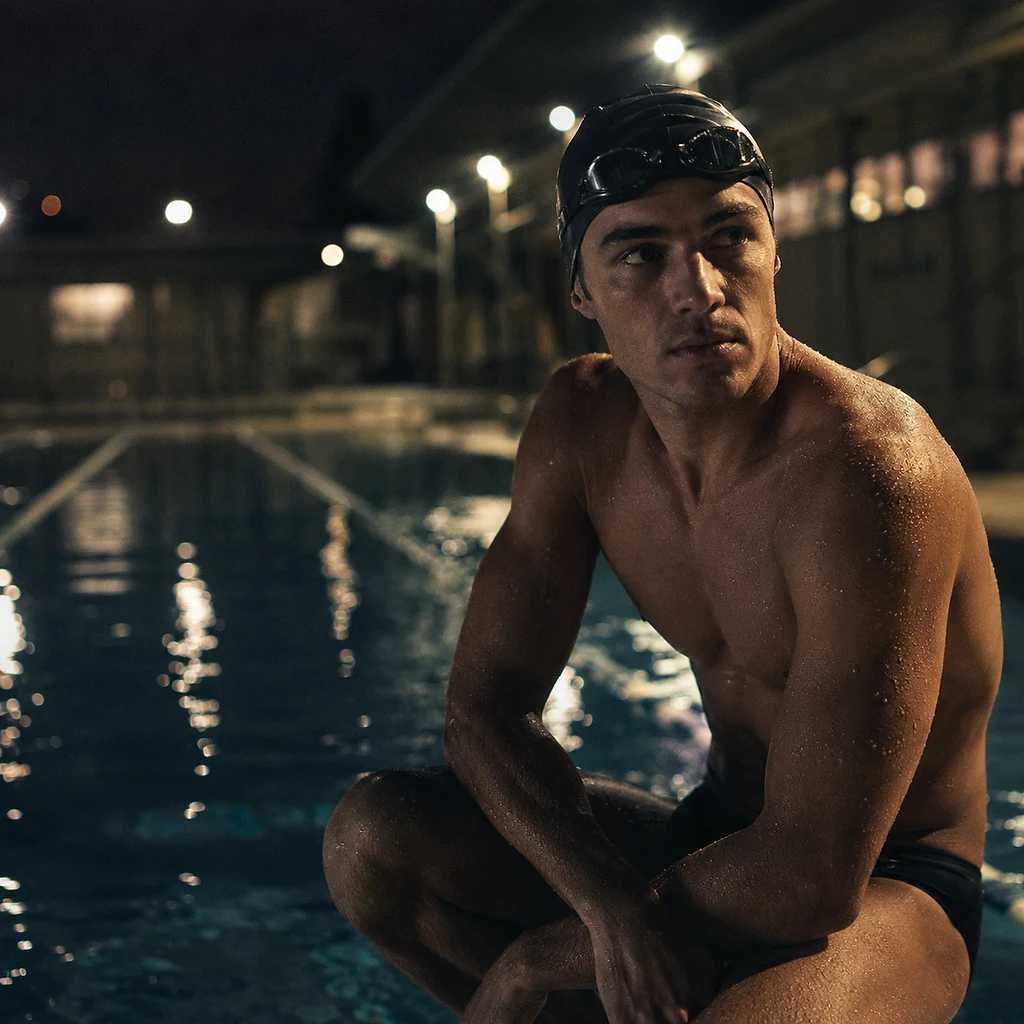
Enhanced Games——硅谷对"公平体育"的一次正面挑战
Enhanced Games Challenge Anti-Doping Rules
About this story
Enhanced Games Challenge Anti-Doping Rules. HSK 5-6 Chinese listening practice.
This is an HSK 5-6 Chinese listening episode that runs about 8 minutes. The full Mandarin script is shown with tap-for-pinyin and a line-by-line English translation, so you can listen and read at once — comprehensible input in the sense of Stephen Krashen's i+1 theory. It teaches 12 key vocabulary words such as 公平、影响、健康 and walks through 4 grammar patterns, each explained in English with examples. The same news story is retold at 4 difficulty levels — use the level selector above to find the version that is challenging but still understandable for you.
Read at your level
原文Read the complete story in Chinese. Reveal pinyin and English only when you need them.
English transcript reference
On May 24, 2026,
in Las Vegas, USA, in
a resort hotel,
a competition
destined to be debated worldwide
was held for the first time.
This competition
has an English name,
"Enhanced Games."
In Chinese,
we can call it
"增强奥运会."
It lasted just one day in all.
But its real meaning
isn't in that single day —
it lies in
its head-on challenge to
one that has continued for over a hundred years —
a piece of sporting common sense:
sports competition
must be "clean";
it cannot rely on PEDs.
Today,
starting from this competition,
we'll talk about several bigger questions:
what
is sport actually competing in?
Is "fairness"
absolute,
or can it be redefined?
When capital
begins treating the human body itself
as an "upgradable" product,
should we be glad,
or wary?
Let's first lay out the facts.
The competition's founder
is named Aron D'Souza,
a person —
an Australian lawyer
and businessman.
His long-held view is:
the current international sports rules
are hypocritical —
top athletes, more or less,
all use PEDs,
they just don't get caught.
Rather than have everyone use them in secret,
better to,
in plain view,
use them under doctors' supervision,
and see where humans' true limits
really lie.
This idea
attracted
a group of very rich investors.
The biggest of them
is the German biotech billionaire,
Christian Angermayer —
he alone
invested twenty million US dollars.
On top of that
there are some Silicon Valley big names.
The "Enhanced Games" also announced
that, by merging with an investment firm,
it would list on the New York Stock Exchange,
at a company valuation
as high as 1.2 billion US dollars.
That is to say,
this is not only
a sports experiment,
but also a business
clearly aimed
at the capital markets.
The competition itself
was divided into three major categories of events:
athletics,
swimming,
weightlifting —
23 events in total.
42 athletes
from 24 countries.
The prize money was also generous:
each event's winner
got a base prize of 250,000 US dollars;
anyone who broke
a current world record
got an extra one-million-dollar bonus.
In the competition,
the most talked-about moment
came from the swimming pool.
The Greek athlete
Kristian Gkolomeev,
in the men's 50-meter freestyle,
swam 20.81 seconds.
The official world record
is 20.88 seconds.
He was, compared with that record,
0.07 seconds faster.
He took home
that one-million-dollar bonus.
But
this "record,"
the real international swimming federation,
will not recognize.
Why?
Two reasons:
First,
he used PEDs.
Second,
the high-tech swimsuit he wore
had itself already been banned by World Aquatics.
In the other events,
American sprint star
Fred Kerley
ran 9.97
to win the 100 meters —
without breaking Bolt's world record.
Iceland's "Mountain," Björnsson,
won the deadlift,
but he and his Canadian opponent
both failed to lift 515 kg.
On the surface,
this was a competition
that didn't break many records
and didn't make too big a wave.
But its real impact
must be seen from a wider angle.
Those opposing this competition
have three layers of reasons.
The first layer
is health.
Long-term,
high-dose use of
testosterone,
growth hormone,
anabolic steroids —
the effects on the body
have, in medical terms, hardly
been studied thoroughly.
The organizers emphasize
that all athletes
took drugs under doctors' supervision —
but medical experts point out
that the "clinical trial" they published
has too small a control group
and too few samples
to prove "safety" at all.
The second layer
is the spirit of sport.
Famous sports ethicists say
sport
has never been only
"who is the fastest."
A more important layer
is "watching humans, within limits,
strive to push past themselves."
Setting rules,
setting boundaries —
these limits
are themselves part of sport.
Remove the PED line
and it's like dismantling
that layer of meaning.
The third layer
is the impact on young people.
Around the world there are countless
youth athletes.
They grow up watching athletes.
If the highest goal they see
is "breaking records by drugs,"
then this message
will quickly seep down into
lower-level competition —
schools,
provincial teams,
even amateur circles.
And adolescents'
tolerance for testosterone
and growth hormone
is much lower than adults'.
But
the supporting side
also has their reasons.
First,
they say,
today's "clean sport"
was always a myth.
Top athletes,
almost all of them have used some gray-zone drug,
they just don't get caught.
Rather than hypocritically ban,
it's better to manage openly.
Second,
adults
should have autonomy over their own bodies.
What I take,
whether I bear the risk —
is my business.
Third,
humans need new experiences.
Watching a
fully-rules-broken limit
isn't necessarily less meaningful
than watching a
not-entirely-trusted "clean record."
The two voices
are both real.
At this point,
I want to pull the view
even further out.
The "Enhanced Games,"
in essence,
isn't just a sports project;
it's Silicon Valley thinking's
frontal challenge
to traditional sport.
Silicon Valley has always believed
any rule taken as "self-evident"
can be "disrupted."
Taxis need licenses?
Disrupt that,
make Uber.
Hotels need regulation?
Disrupt that,
make Airbnb.
Well, PEDs are banned —
why can't that be disrupted?
Make
a sports league that allows drugs,
list it,
scale it,
turn it into an industry.
This "disrupt everything" mindset
sometimes brings efficiency,
sometimes brings disaster.
Which one the Enhanced Games is,
it's still hard to say.
But the question it raises
is, in fact, real:
how long can our attachment to the "natural human body"
hold?
In the next fifty years,
gene editing,
neurotechnology,
brain-computer interfaces —
our ability to modify the body
will only grow stronger.
At that point,
what counts as a "human" achievement?
What counts as "cheating"?
The "Enhanced Games,"
of this future,
is an early signal.
It may be the wrong direction,
but the questions it asks,
we'll have to answer sooner or later.
Finally,
let me leave you with two questions.
The first:
if one day
"clean athletes"
cannot beat
"enhanced athletes,"
which kind of competition would you want to watch?
The second,
and perhaps harder —
when a person says,
"This is my body,
"I have the right to decide
"how I use it" —
do you think
society
should respect that autonomy,
or should it
set a boundary for them?
These two questions
have no standard answer.
But they
are worth thinking about slowly.
Okay.
That's all for today.
See you in the next story.
Listen again
Try it without the transcript and notice what sounds clearer.
What vocabulary does this episode teach?
词汇Fair. The episode's framing question: is 公平 absolute, or can it be redefined?
Influence. The episode's third critique — the Enhanced Games' downstream 影响 on young, more vulnerable athletes.
Health. The first 'layer' of critique — long-term, high-dose use of testosterone, HGH and anabolic steroids has not been thoroughly studied.
Safe. Critics argue the organizers' "clinical trial" cannot prove 安全 — the sample is too small.
Limits. The bioethicists' point: sport is partly about humans striving 在限制中 — within limits — and PEDs remove that very layer.
Market. The episode places the Enhanced Games squarely in the 资本市场 — the capital markets — via its NYSE listing plan.
PEDs. Beyond HSK4. The exact thing the Enhanced Games openly permits — and the line the Olympics has held for over a century.
To disrupt. Beyond HSK4. The Silicon Valley keyword the episode applies: 任何被认为'理所当然'的规则,都可以被'颠覆'.
Hypocritical. Beyond HSK4. D'Souza's framing of the current system — top athletes already dope; the official 'clean sport' rule is 虚伪.
Autonomy. Beyond HSK4. The supporters' second argument: 成年人对自己身体应该有自主权 — adults should have autonomy over their own bodies.
The spirit of sport. Beyond HSK4. The deeper layer of sport — striving within rules and limits — that critics say PEDs erase.
Limit. Beyond HSK4. The pro-Enhanced framing: see 人类真正的极限 — humanity's real limits — by lifting the rules.
* beyond level超纲词
What grammar patterns appear in this episode?
语法不在 A,而在于 B
Locates the real point in the second item, dismissing the first. The episode uses it to say the Enhanced Games' significance isn't in one day but in its challenge to a century of sport.
不在那一天本身——
而在于,它直接挑战了,一个延续了一百多年的,体育常识。
与其 A,不如 B
Compares two options and prefers the second. D'Souza's signature argument: rather than secret doping, better open, supervised use.
与其大家偷偷用,不如,开诚布公地,在医生看护下使用。
与其虚伪地禁,不如公开地管。
把 A 当成 B
把 + A + 当成 + B frames a controversial reframing. The episode's opening warning: 把人体本身,当成可以"升级"的产品 — treating the human body as an upgradable product.
把人体本身,当成可以"升级"的产品。
把消费者,当成承担风险的人。
不只是 A,更是 B
Reaches past a surface description to a larger claim. The episode's analytical hinge: the Enhanced Games is not just a sports project but a Silicon Valley challenge to traditional sport.
不只是一个体育项目,更是硅谷思维,对传统体育的,一次正面挑战。
这不只是,一个体育实验,还是一个,明确瞄准了,资本市场的生意。
Proper nouns
专有名词Free account
Keep learning from this story
Create a free account to keep saved words and your preferred level together.
- Keep words with their story context
- Remember your preferred level
- Build your vocabulary over time