
A Chinese podcast · Same story, 4 levels
巴别塔重建之日——AI 翻译之后,世界变得更近还是更远
AI Translation Rebuilds a Modern Tower of Babel
About this story
AI Translation Rebuilds a Modern Tower of Babel. HSK 5-6 Chinese listening practice.
This is an HSK 5-6 Chinese listening episode that runs about 8 minutes. The full Mandarin script is shown with tap-for-pinyin and a line-by-line English translation, so you can listen and read at once — comprehensible input in the sense of Stephen Krashen's i+1 theory. It teaches 12 key vocabulary words such as 翻译、文化、国家 and walks through 4 grammar patterns, each explained in English with examples. The same news story is retold at 4 difficulty levels — use the level selector above to find the version that is challenging but still understandable for you.
Read at your level
原文Read the complete story in Chinese. Reveal pinyin and English only when you need them.
English transcript reference
In early April 2026,
"X" —
that is, the platform in Musk's hands,
the one originally called "Twitter" —
opened, to its global users,
the official rollout of
its Grok-AI-powered
automatic translation feature.
Open "X,"
see a Japanese person's Japanese post,
and the app will immediately
translate it into your language.
You don't have to tap any button.
What you write in Chinese,
on a foreigner's side,
will also be auto-translated.
This rollout
actually began at the end of March,
in batches.
The earliest were English-speaking users,
then it gradually expanded across the world.
On the surface,
it's just a
not-very-big product feature.
The feature has, in fact, been in use
for over two months.
But after May arrived,
this matter,
on the Chinese internet,
suddenly turned into a
nationwide discussion topic.
Why now?
Because more and more Chinese-speaking people
started noticing:
the Japanese-language world,
Korean-language world,
Arabic-language world they couldn't see before —
suddenly,
are all laid out before their eyes.
A phrase exploded online:
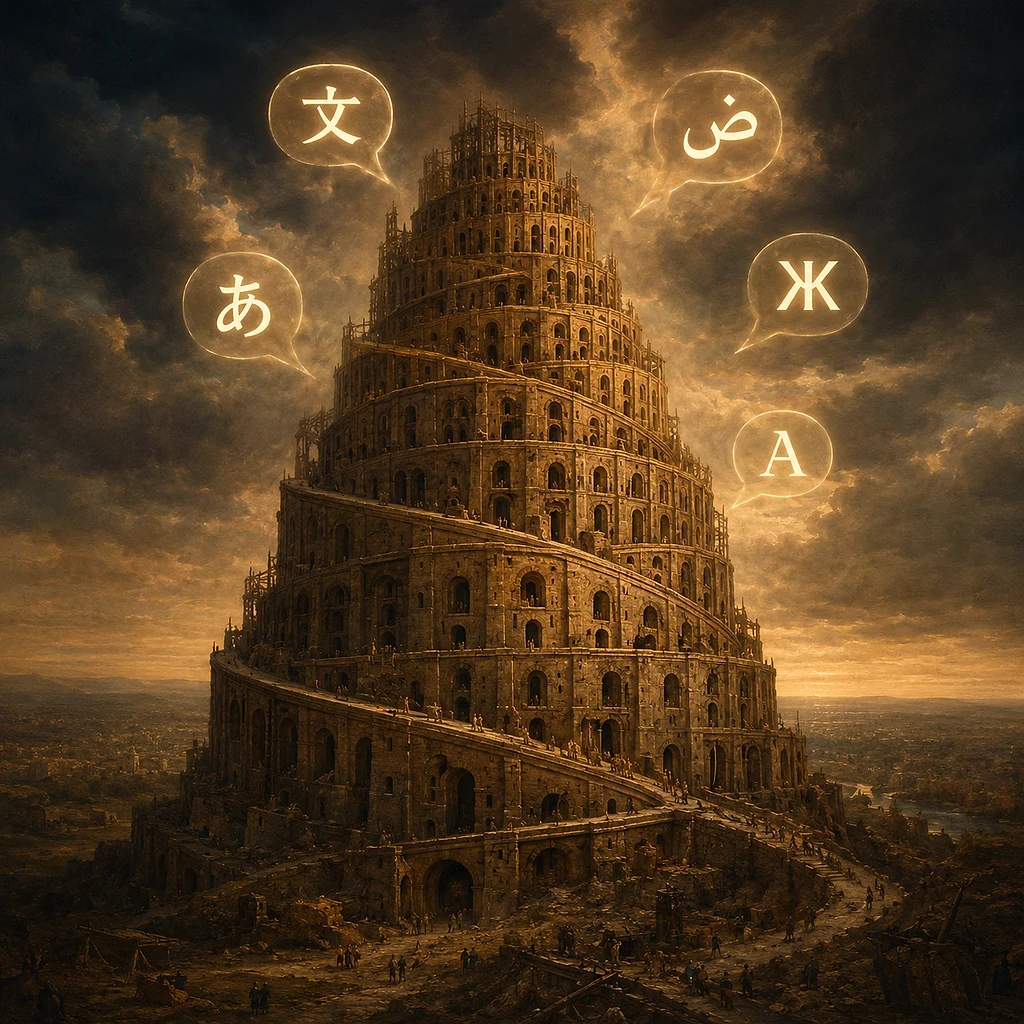
"Musk has built the Tower of Babel."
Today,
starting from this metaphor,
we'll talk about some bigger topics:
"Language" —
is it ultimately connection,
or division?
When AI translation
takes the wall of language
and tears it completely down,
what
do we actually see?
Let's first tell the story of "the Tower of Babel."
"The Tower of Babel"
comes from Genesis in the Bible.
The story goes:
long ago,
all the people of the world
spoke one and the same language.
They gathered in one place
and tried to build
a tower reaching the sky,
to make their name
be remembered.
God saw,
and said something very interesting:
"Behold,
"they are one people
"and all have one language.
"If they have begun to do this,
"then nothing they propose
"will be impossible for them.
The meaning is:
if humans stay united,
their power
will grow large enough that even God worries.
So God did one thing:
he made all people
start speaking different languages.
People couldn't understand each other,
the project stopped,
the people scattered,
and went to the four corners of the world.
And this is,
in today's world,
the source of the thousands of different languages,
their mythic root.
"The Tower of Babel," in Western culture,
is a deeply important
symbol.
It represents:
once humans throw off the division of language,
they may be able
to do things they couldn't before —
whether magnificent
or dangerous.
That is why netizens are saying
Musk's AI translation
is "building the Tower of Babel" —
humanity is, in reverse,
walking through that story:
God tore it down;
we, brick by brick,
are building it back.
So,
after "the Tower of Babel" was built,
what did humanity see?
We'll talk about two layers.
The first layer
is the good side:
connection.
A lot of things
have really gotten better.
People from different countries
for the first time can,
without going through a translator app,
without a middleman,
directly under the same comment
talk to each other.
A Korean netizen joked:
"Right now, opening X
"is like getting up in the middle of the night
"to find an Italian uncle
"and an Indonesian auntie
"in my kitchen,
"going through my fridge.
Italian netizens, seeing
the Japanese "Japanese-style Italian pasta,"
cried out: "What did we Italians
"do wrong?
People in the Portuguese-speaking world
and in the Chinese-speaking world
found that each other's sense of humor
is actually very similar.
These moments
are the kind that, for decades,
any "international exchange" program
could barely deliver.
Humans found
that, with the language layer of translation peeled off,
the distance between us
is much smaller than imagined.
But
there's also a second layer.
And the second layer
is much more complicated.
The most representative example
is Japan.
Japan spent decades
building an international image —
polite,
clean,
refined,
cultured.
Miyazaki's animation,
Kyoto's cherry blossoms,
Mount Fuji photographs,
sushi and tea ceremony —
these are Japan's
carefully crafted,
and genuinely effective, "cultural soft power."
But the translation feature
opened a window
that had been blocked by language.
Through this window,
the whole world directly saw, for the first time:
what Japanese netizens,
inside their own Japanese-language communities,
actually say.
A lot of the content
makes people very uncomfortable.
Some Japanese netizens
publicly deny the Nanjing Massacre,
saying it was "made up by Chinese people."
Some
call Thai tourists
"uncivilized monkeys."
Others
said extremely ugly things
about Chinese people
and Korean people.
Some
on one hand curse "pirated anime is cultural theft" —
but data shows
that on the world's largest piracy site,
of all visitors,
Japanese users make up nearly half.
This kind of content
got translated,
was seen by the whole world,
screenshotted,
and spread.
And the Chinese internet —
the reason it only blew up recently
is not that the feature suddenly opened —
it's that everyone finally,
bit by bit, realized:
the internet next door
is not what we thought it was.
A quote from one Arabic netizen
was widely shared:
"The good image Japan spent decades
"and an enormous diplomatic budget
"to build —
"Musk and his translation robot
"destroyed most of it
"in less than a week.
That is, of course, an exaggeration.
But it points to a
very real phenomenon:
every language community
in fact has two sets of speech —
one is "what we say outward,"
one is "what we say among our own."
These two sets
sometimes differ enormously.
In the past,
language was a natural wall
holding "what we say inward" inside.
Now,
that wall has fallen.
Every sentence you say in your own language
might
be read by the whole world.
More importantly:
this isn't only happening to Japan.
What Chinese netizens say,
Arabs can now see.
What Arabic netizens say,
the Japanese can see.
The fights between Korean netizens,
Americans can watch.
Every language community
is now being, by every other language community,
observed,
recorded,
judged.
This brings about
two contradictory effects.
On one hand,
"hypocrisy" gets harder —
you can't say "I'm great" outward
while, inside your own country,
saying the exact opposite.
The whole world is listening.
On the other hand,
"stereotypes" also get reinforced —
what we read
tends to be the most extreme content
from another language.
Because extreme content
is the easiest to screenshot
and spread.
We use extreme samples
to judge a whole country.
So AI translation
isn't just "breaking the wall of language."
It is at once "connection" and "exposure."
It brings us closer to each other,
but it also makes
every one of every person's sentences
into potential
global content.
To close,
I want to leave you with two questions.
The first:
do you believe
that when language is no longer a wall,
humans will become
more united,
more mutually understanding —
or will discover
that the divisions between us
are bigger than imagined?
The second,
and perhaps harder —
right now, every sentence you say,
in theory,
could be read by
someone you will, your whole life,
never meet.
Should this matter
change the way you speak?
Or
should you hold the line,
be yourself —
let the world
see a real,
unedited person?
These two questions
have no standard answer.
But they
are worth thinking about slowly.
Okay.
That's all for today.
See you in the next story.
Listen again
Try it without the transcript and notice what sounds clearer.
What vocabulary does this episode teach?
词汇Translate. The technical lever of the whole story: Grok auto-翻译 on X.
Culture. The episode argues each linguistic community has its own "内部" culture; translation now exposes it to all.
Country. The story moves between what's said 在自己国家里 (inside one's own country) and what becomes globally visible.
Different. The episode pivots on different language communities suddenly able to read each other.
Important. 更重要的是 — "more importantly" — marks the analytical hinges of the episode.
At the same time. The episode's core thesis: AI translation is 同时是"连接"和"暴露" — at once connection and exposure.
Tower of Babel. Beyond HSK4. The biblical metaphor used to name the AI-translation moment — humans rebuilding what God once scattered.
Image. Beyond HSK4. Japan's carefully built international 形象 collides with what its netizens actually say in Japanese.
Connection. Beyond HSK4. One half of the episode's pair: AI translation as 连接 (connection) AND 暴露 (exposure).
To expose. Beyond HSK4. The other half: the same translation that connects also 暴露 — exposes — what each community used to keep internal.
Hypocrisy. Beyond HSK4. One effect of the translation moment: 虚伪 becomes harder to sustain when everyone can read everyone.
Stereotype. Beyond HSK4. The other effect: 刻板印象 also gets reinforced, because the most extreme content travels farthest.
* beyond level超纲词
What grammar patterns appear in this episode?
语法一旦 X,就 Y
一旦 marks a threshold condition; 就 carries the inevitable consequence. The episode uses it for the Babel metaphor: once language is no longer a wall, things change.
人类一旦摆脱语言的分隔,就有可能,做出原本做不到的事——
信任一旦没了,所有人都会受伤。
一方面 A,另一方面 B
Lays out two sides of a phenomenon evenly. The episode's structural move on the connection-versus-exposure paradox.
一方面,"虚伪"变得更难了。
另一方面,"刻板印象"也被加强了。
不只是 A,B 同时是 C
Rejects a single-frame reading and asserts that the thing is two things at once. The episode's central thesis sentence.
所以 AI 翻译,不只是"打破语言的墙"。
它同时是"连接"和"暴露"。
不是因为 A——而是因为 B
Reframes a misread cause with a sharper one. The episode uses it to correct the popular narrative that the feature "just launched" for Chinese users.
不是因为功能突然开通——
是因为大家终于,一点一点意识到了。
Proper nouns
专有名词Free account
Keep learning from this story
Create a free account to keep saved words and your preferred level together.
- Keep words with their story context
- Remember your preferred level
- Build your vocabulary over time