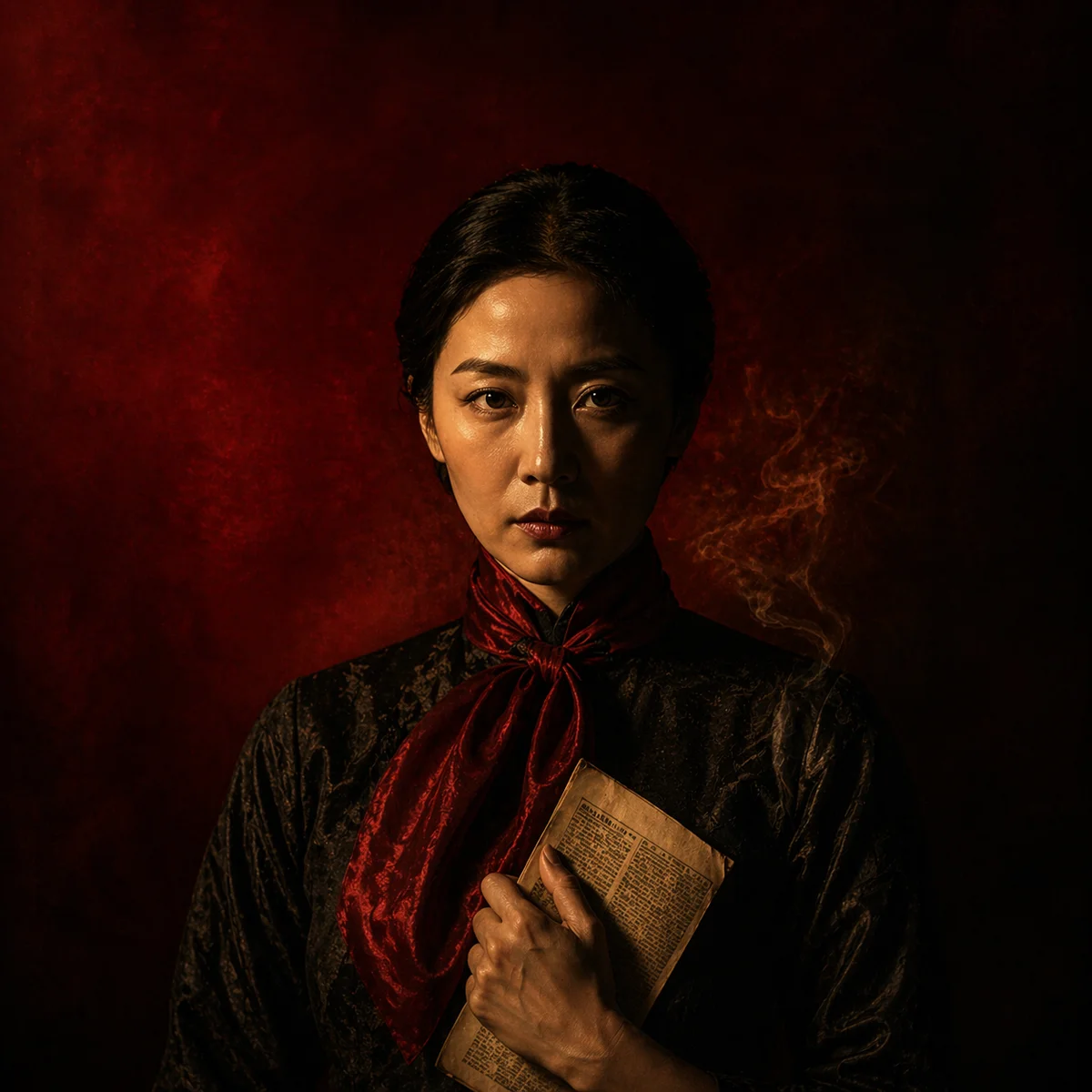
Welcome to Fluentide True Crime. A real case from Chinese history, in English. Learn Chinese without trying.
I handle the Chinese. You follow the story.
It was still dark on the 上午 of November 13, 1935, when the woman who called herself Shi Jianqiao left her house in Tianjin and walked toward a prayer hall on the other side of the city.
上午. Morning.
In her bag she carried a stack of printed pages. Under her coat, a Browning pistol.
She had been preparing for this 上午 for ten 年.
年. Year. Ten 年 is ten years. You'll hear this word a lot today.
One of the pages was a poem she had written herself, in the classical seven-character form her father had taught her before she could hold a brush. It began like this.
"I dare not forget the revenge of my father for a single moment. It breaks my heart to watch my mother's temples turn gray."
She was thirty. Her birth name had been Shi Gulan. Ten 年 earlier, on the day the news from Bengbu reached her family, she had started calling herself Shi Jianqiao instead.The characters she chose meant sword raised.
The streets of Tianjin were cold that 上午. She walked through them without stopping, without looking at anything that might have reminded her she had a choice.She was walking toward a man who did not know she was coming.
This is Fluentide True Crime. Season One. Over the next twenty-five episodes, I am going to tell you how this woman came to be at that prayer hall door, with pages in her bag and a gun under her coat.
The answer has two parts. Her father. And a warlord named Sun Chuanfang. The ten 年 between those two parts is what this season is about.
Her father's name was Shi Congbin. He was a career military officer from a small village in Anhui who had risen through the warlord armies of northern China in the 1910s and early 1920s.
In the autumn of 1925, he led a brigade of four thousand soldiers into a town in Anhui province called Guzhen. The battle went badly. By the end of the first day, his forces were broken.
By the end of the second, he was a prisoner.
The man who had captured him was Sun Chuanfang.
On direct order, Shi Congbin was beheaded that same day.
And Sun Chuanfang did not stop at the beheading. He ordered the head sent to the railway station at Bengbu, where it was placed on a pole above the platform and left on public display. Travelers saw it.Returning soldiers saw it.
Village children on their way to sell vegetables saw it. Widowed wives crossing the platform to collect other bodies saw it. The head stayed on that pole for days.
What stood on that pole was no longer a 人.
人. Person.
A 人 has a name. What was left at Bengbu had been stripped of the word 人 and made into something else.
This was the humiliation Shi Jianqiao had been preparing to answer for ten 年.
The pages in her bag were her answer.
Sun Chuanfang had helped found a lay-Buddhist society in Tianjin seven 年 earlier, after he retired from the warlord life. He came to the hall every 上午.
He knelt on the same cushion and worked through the same string of prayer beads.
He had taken a Buddhist name that meant Smooth Circle.
By 1935, Sun Chuanfang was fifty years old, and he believed, in the way a man who has changed his name and his company can sometimes come to believe, that the violent part of his life was behind him.
He was wrong.
Shi Jianqiao had been coming to the same hall for a month. Every 上午, in the same cold gray hour, she sat near the back and watched him pray.
Over the course of that month, she memorized the pace at which the wooden beads moved between his fingers, the shape his shoulders took when he was starting to tire,the sudden lift she could see in his back when the chant changed tempo,
the small pause he always took before the final phrase of the morning sutra.
By the end of the month she knew when he arrived, when he finished, which of the other worshippers he spoke to afterwards, and which ones he ignored. He never once recognized her.
She had made sure of that.
This 上午 was different.
The chanting was already going when she slid through the door. Incense burned. Small candles flickered along the low wooden altar at the front of the hall.
Sun Chuanfang was kneeling on his cushion, head bowed, the beads moving slowly in his right hand.
She took her usual seat and waited, until the chant reached a line she had been using, all month, to count.
On that line, she reached into her coat.
Three shots. A room gone completely still. A stack of pages pressed into the hand of the nearest worshipper. A woman not running. A man on a cushion who would not be getting up.
I am going to tell you all of it. But not yet. To understand what happened in those seconds, you need to understand the ten 年 before them.
You need to go back to a military household in Anhui, to a young daughter who had not yet learned to shoot, to a letter that came home in the autumn of 1925,
and to a train platform in Bengbu where a family went north to find a body.
That is where we start Episode Two.