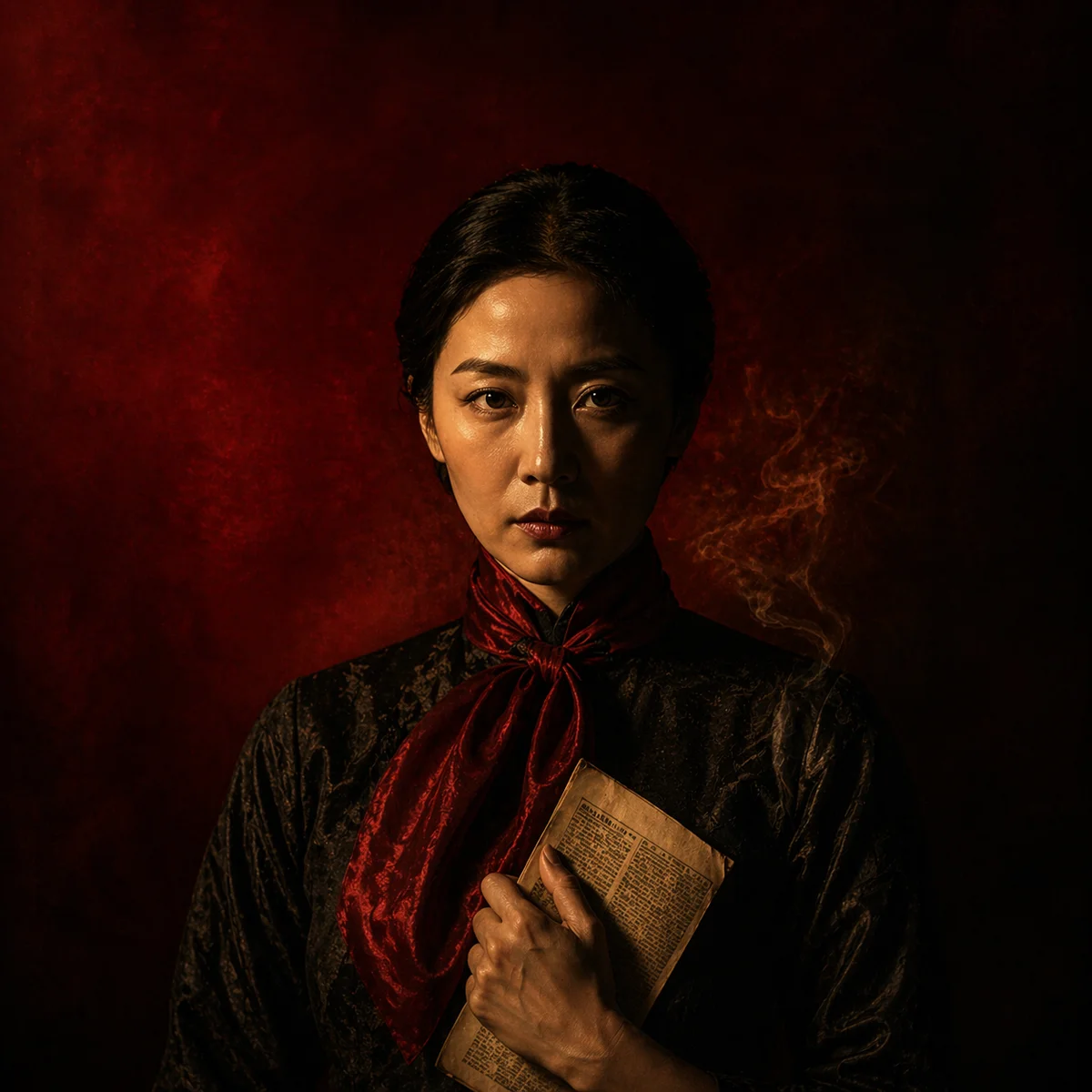
Welcome to Fluentide True Crime. A real case from Chinese history, in English. Learn Chinese without trying.
I handle the Chinese. You follow the story.
Inside the 家 her 爸爸 built in Shazigang, the room that mattered most to Shi Gulan 是 the study.
是. The Chinese for "to be." Is, am, are, was, were. 是 carries them all when there's a noun on the other side of it. The room 是 the study means the room is the study.
It 是 a small room. Cold in winter, hot in summer.
A wooden desk under the one window, three low shelves of books along the back wall, a porcelain ink stone her 爸爸 had brought back from his first posting in Manchuria, and on the shelves,
the books Shi Gulan would spend her childhood inside.
This 是 where her 爸爸 did his own work when he was home. It 是 also where, from the time she could hold a brush, he taught Shi Gulan to read.
Her 爸爸 是 a soldier by trade. But before he 是 a soldier, he had been a student. Her 爸爸 不 是 an ordinary warlord-era officer.
不. "Not." Put 不 in front of 是 and you get 不 是. Her 爸爸 不 是 an ordinary officer means her father is not an ordinary officer.
He 是 a man who had passed the provincial civil-service exams before the Qing dynasty collapsed, who had memorized the Confucian classics, who wrote poetry in his spare hours,and who expected his children to do the same.
By the standards of Shazigang, this was unusual. By the standards of a military family in 1910s Anhui, it was more unusual still.
Most officers of his generation treated learning as a finished project, something they had done in order to pass an exam and then moved on from. Her 爸爸 had not moved on.He read throughout the day, until late into the evening by oil lamp.
And he taught his eldest daughter.
The lessons began when Shi Gulan was maybe three years old. Not three on a formal schedule, but three in the sense that she had learned to walk and could sit still on a stool for ten minutes without sliding off.
He 不 是 a patient teacher in the modern sense. He did not explain. He wrote out a character. He pointed. He said the word. He wrote it again.
What he asked of her was that she copy it and remember it, and that when he came home from his next posting she show him what she had retained.
The thing he did not tolerate 是 laziness. If she forgot a character she had been taught, she did not eat dinner with the rest of the 家 until she could write it again.
The thing he tolerated even less 是 the idea that a daughter should not be pushed the way a son was pushed. He pushed her harder.
By the time she was seven, Shi Gulan could recite Tang dynasty poetry from memory. By the time she was ten, she was reading classical commentaries on the Analects out loud to her 爸爸 while he drank his 上午 tea.
She 是 a 好 student.
好. "Good." 好 student means good student.
He knew it. She knew it. The pride between them, on those cold 上午 in the study, 是 the most unambiguous thing in either of their lives.
This 是 why the news from Bengbu ten 年 later would land the way it did.
Shi Congbin 不 是 only her 爸爸. He 是 her teacher.
And when his head was put on a pole in a railway platform, what Shi Gulan lost was the 人 who had taught her how to read, how to think clearly, how to write, and how to hold her own in a room of men.
To a classical Chinese father, a 好 student 是 a debt.
Shi Gulan spent the next ten 年 figuring out how to repay it.
In Episode Four, the first pages of that debt arrive in the form of telegrams from the front.
That is where we start Episode Four.