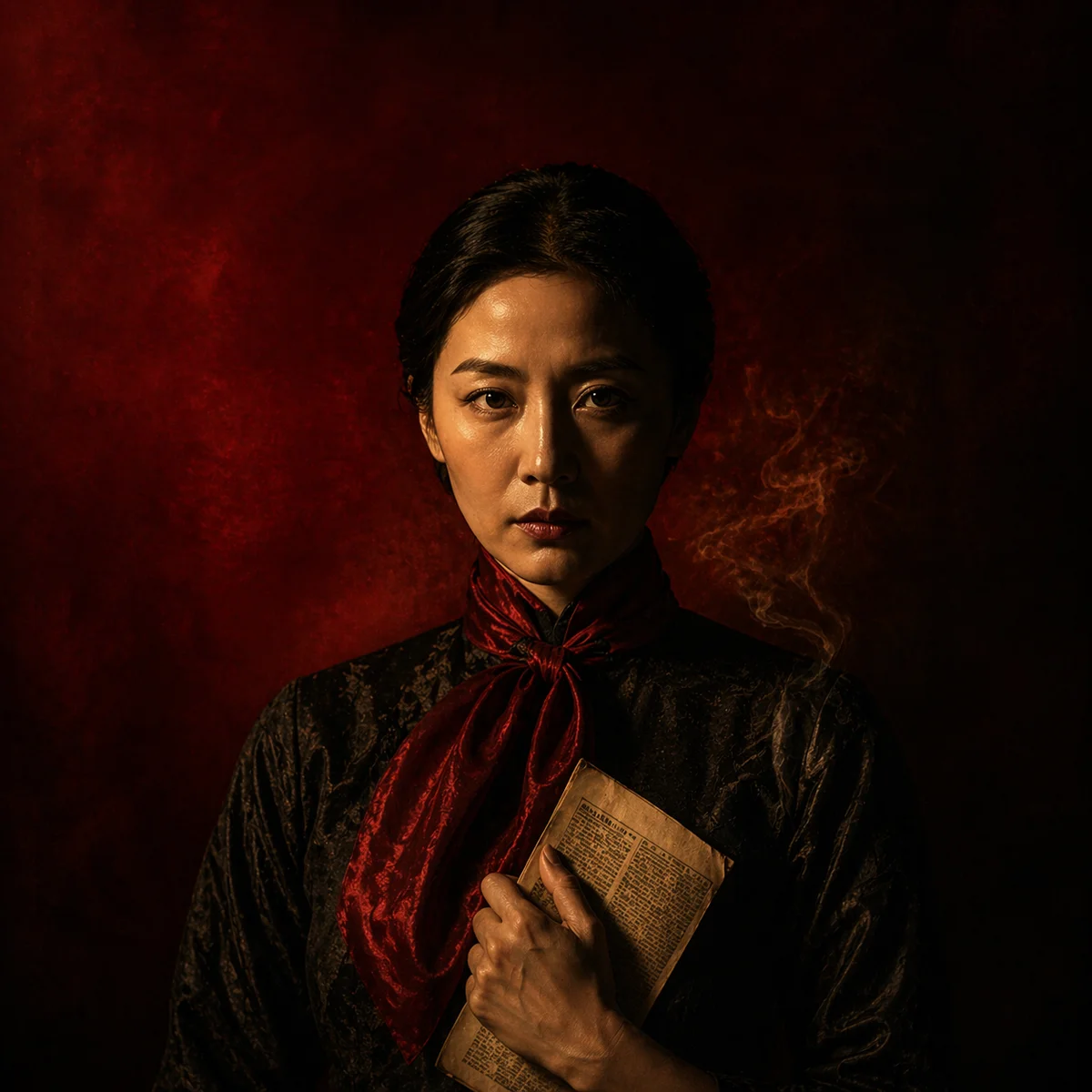
Welcome to Fluentide True Crime. A real case from Chinese history, in English. Learn Chinese without trying.
I handle the Chinese. You follow the story.
In the spring of 1926, six months after the news from Bengbu, Shi Gulan sat down at the desk in her 爸爸的 study and chose a new 名字 for herself.
名字. Name. 名字 in two characters. You'll hear it again at the end of this episode.
She did not announce it. She did not consult her 妈妈. She did not ask her elder brother.She sat alone at the desk where she had been taught to read classical commentaries on the Analects, and she opened a small dictionary her 爸爸 had used as a young man.
What she 想 about, choosing the new 名字, was sound. She wanted the 名字 to carry on the surname her 爸爸 had carried into the army.
She wanted the two 字 of the given 名字 to make a sound a 人 hearing it for the first time would not forget.
字. Character. The written sign. A 名字 is built out of 字. In her case, two 字: the family 字 and her own.
She kept the family 字. 施.
For the personal half of the 名字, she went through the dictionary one section at a time. She marked candidates with a thin pencil mark in the margin.She read each candidate aloud once, by herself, in the empty study.
Most of them she crossed out the same afternoon.
By the third evening, she had narrowed the candidates to two 字 that worked together.
The first was 剑. Sword.
The second was 翘. Raised. Held aloft.
Together, the two 字 read as one phrase. Sword raised.The kind of phrase a Sun Chuanfang subordinate would notice if it appeared in a courtroom transcript or on a printed pamphlet, and the kind of phrase a 人 hearing it once would carry.
Shi Gulan wrote the new 名字 on the inside cover of a small notebook her 爸爸 had given her when she was twelve.
Shi Jianqiao.
She did not yet sign letters with the new 名字. She kept the new 名字 to herself for the time being. The 妈妈 in the 家 was still in mourning.
The brothers were dealing with the recovery of the body and a partial funeral that took most of 1926 to arrange.
The household had no room, that 年, for a daughter announcing she had become someone else.
In the summer of 1926, the question of marriage 来 up.
Shi Gulan的 elder brother had been quietly arranging it since the previous winter. The candidate was a Anhui人 named Shi Jingong. No relation by blood. He was twenty-eight years old.
He held a clerical position in the new provincial administration that had taken over after Sun Chuanfang的 armies pushed through the region. He was steady. He was educated. He was not a soldier.
Shi Gulan agreed to the match.
She agreed quickly enough that her elder brother was relieved and her 妈妈 was confused. She did not tell either of them what she had decided in the spring.She did not tell either of them about the new 名字 in the inside cover of the notebook.
She told them she was ready to marry.
What she 想 about the match, in private, was practical.
A married woman in 1926 Anhui could move around the province without arousing comment.
A married woman with a steady husband in a clerical job could ask questions about the postings and movements of provincial military commanders without being noticed.
A married woman could keep a small allowance of household money for her own correspondence. A married woman could disappear for stretches of an afternoon to the market town and not be required to explain.
An unmarried daughter in mourning could not be those things.
She married Shi Jingong in the autumn of 1926.
In 1927, she bore him a son.
She bore the boy in the small town in southern Anhui where Shi Jingong's family had a courtyard 家.
The Shi Jingong family register entered him as Da Li, "big benefit," after a great-grandfather in Shi Jingong's line. He had a steady cry.
He took the breast on the second day. Shi Gulan held him and 看 him and did the work a 妈妈 does in the first weeks, and she did not sleep more than three hours at a stretch for the next two months.
She had a 儿子.
儿子. Son. The boy she just bore is her 儿子. Family word, like 妈妈 and 爸爸.
In 1928, she bore a second 儿子. The Shi Jingong family register entered him as Er Li, "second benefit," to pair with his older brother.
Two 儿子, Da Li and Er Li, two birth records, two formal entries on the Shi Jingong family register. By the end of 1928 she had been a wife for two 年 and a 妈妈 for one and a half.
She had not signed her own correspondence with Shi Jianqiao yet.
She had signed it Shi Gulan, and on the household ledgers she was still Shi Gulan, and to her 妈妈 in Shazigang she was still Shi Gulan.
The two boys were still Da Li and Er Li too, on the same ledger.Shi Gulan, alone in the back room of the courtyard 家 in Anhui, had already begun to think about a different pair of given 名字 she would give them when the moment was right.
The four 字 of the new given 名字 were ones she had picked in the dictionary the same week she had picked her own. She kept them in the same notebook.The four 字 were the kind a boy would only see once he was old enough to read on his own.
What was changing was the inside.
She kept reading. The same dictionaries her 爸爸 had used. The same classical commentaries.She also began reading newspapers, every newspaper she could get from the market town, looking for Sun Chuanfang的名字.
Sun Chuanfang的名字 appeared in the newspapers less and less through 1927 and into 1928. The Northern Expedition had broken his five-province command.
By the end of 1927 he had lost most of his armies.
By the middle of 1928 he had retired from public political life and was, on paper, an ordinary private citizen.
Most of the country forgot Sun Chuanfang during those 年.
Shi Gulan did not.
On the inside cover of the small notebook, the new 名字 was still there in pencil. Shi Jianqiao. Sword raised.
The 名字 was not a decoration. The 名字 was a promise. The promise had a name attached to it on the other side.
By the end of 1928, the 妈妈 of two small 儿子 in a small Anhui town had decided that the next thing she needed to learn was not reading. She already 看 well enough.
What she needed to learn was how to use a handgun.
In Episode Nine, she finds someone to teach her.
That is where we start Episode Nine.