Welcome to Fluentide True Crime. A real case from Chinese history, in English. Learn Chinese without trying.
I handle the Chinese. You follow the story.
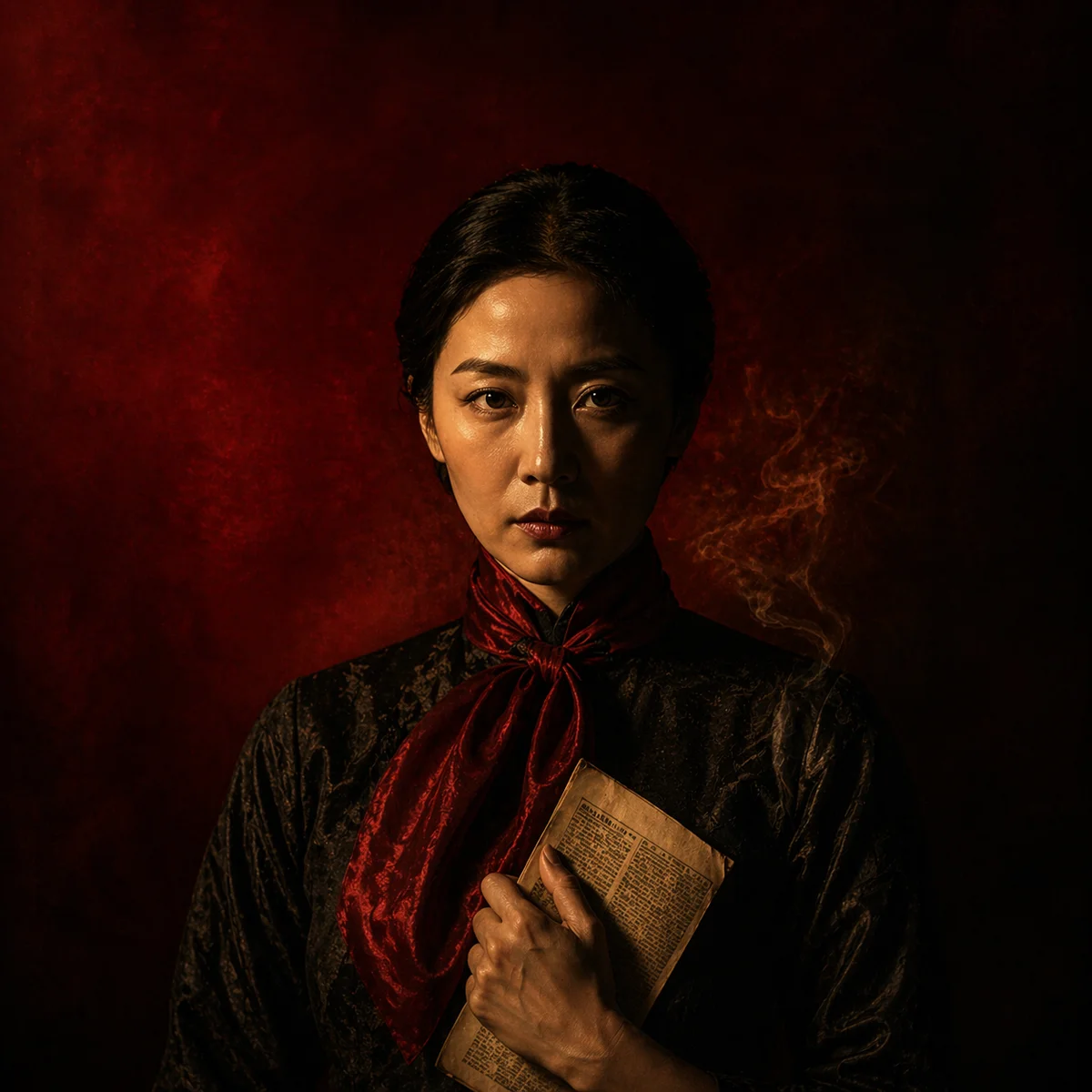
By late 1934, the small leather 书 in Shi Jianqiao的 sewing basket held just over a thousand entries. She had filled a thousand pages over six 年.
书. Book. The small leather 书 means the small leather book.
The first entry 来了 in the spring of 1928.
了. A small particle. Put 了 after a Chinese verb to mark that the action is finished or that something has changed. 来 means come, so 来了 means has come, has arrived.
The first entry 来了 means the first entry arrived.
了 only attaches to Chinese verbs, never to English ones.
She had started the 书 in the spring of 1928, the autumn after her second 儿子 was born, the spring after Sun Chuanfang disappeared from the front page of every newspaper in China.
Sun Chuanfang的 political collapse had been quick. The Northern Expedition had broken his five-province command in late 1927. By the end of 1927 he had lost most of his armies.
By the spring of 1928 he had lost the rest.
He retired to a private villa in the British concession of Tianjin and announced, through a press release his secretary wrote, that he was done with public life.
Most of China believed him.
Shi Jianqiao did not.
The first entry in the 书, dated April 1928, was a single line in her own hand. Sun Chuanfang, Tianjin, English concession, address unknown.
The second entry, dated June 1928, was a rumor from the Anhui朋友. Sun Chuanfang in Beijing for a week, staying with a former subordinate.
The third entry, dated August 1928, was wrong. The man who had been seen in Beijing turned out to be a Sun who was not the Sun. A merchant from Shandong with the same surname.
Shi Jianqiao drew a line through the entry and wrote, in a small careful hand to the right, the word "wrong."
By the end of 1928 the 书 had forty entries. Eleven were marked "wrong." Six were marked "unconfirmed." The rest were rumors she had not yet been able to test.
By the end of 1929 the 书 had a hundred and twenty entries. Twenty-eight "wrong." Forty "unconfirmed." The rest a slow accumulation of small consistent details.
Sun Chuanfang had been seen attending a Buddhist function in Tianjin.
Sun Chuanfang had been heard reciting sutras at a small temple. Sun Chuanfang had taken to wearing simple clothes.
By the end of 1930, the 书 was nearly full.
She bought a second leather 书 of the same size from the same market stall and began copying the unmarked entries from the first 书 into the second.
Halfway through the copying, she realized the unmarked entries all pointed to Tianjin.
She stopped copying and went back to the first 书.
In 1931 the rumors thickened. The Beijing朋友 wrote that Sun Chuanfang had taken a dharma name, a Buddhist 名字, and that the dharma name was Zhi Yuan.
In 1932 the rumors thickened further. Sun Chuanfang, under the 名字Zhi Yuan, had become co-founder of a lay-Buddhist association in Tianjin and chaired its board.
In 1933 a 朋友 in Tianjin who owed her 爸爸 a debt that long predated the assassination wrote a single line. Sun Chuanfang attends the chanting at the TianjinJushilin every morning at six.
Shi Jianqiao did not act on the 1933 letter immediately. She had learned, from a thousand entries, that a single line from a single 朋友 was not enough.
Through 1934 she asked the same 朋友 to confirm. She asked another Tianjin contact she had built up since 1932 to confirm independently.
She waited until 今天的 letter said the same thing the previous day's letter had said.
今天. Today. 今天的 letter means today's letter. The 的 you just learned in Ep 06 connects 今天 and letter — today's.
By the autumn of 1934, three independent 朋友 had reported the same address, the same hall, the same morning attendance, and the same dharma name.
On the evening of November 8, 1934, almost exactly one 年 before the morning that would matter, Shi Jianqiao sat at the kitchen table in the small Anhui town and opened both 书 side by side.
The first 书 had a thousand and twelve entries, of which two hundred and seventy-three were marked "wrong," four hundred and four were marked "unconfirmed," and the rest were unmarked.
The second 书 had blank pages, except for the partial copy she had abandoned in 1930.
She tore out the partial copy.
On the first clean page of the second 书 she wrote, in the same careful hand she had used to file her 爸爸的 telegrams when she was seven 年 old, a single entry.
Sun Chuanfang. TianjinJushilin. Zhi Yuan. Six in the morning. Confirmed.
She closed the 书. She closed the first 书. She put the first 书 in a paper envelope and walked to the kitchen stove and burned it.
When the cook arrived in the morning to start the fire, the ashes were not yet cold.
Shi Jianqiao sat at the table with the second 书 in front of her. Her elder 儿子, who was seven 年 old, came down for breakfast and asked his 妈妈 what the new 书 was for.
She told him it was for a 学习 project.
In the spring of 1935, the 学习 project would become the cover story she would use to live in Tianjin for as long as it took.
In Episode Twelve, we leave Shi Jianqiao的 kitchen and walk into Sun Chuanfang的 prayer hall.
That is where we start Episode Twelve.