
A Chinese podcast · Same story, 4 levels
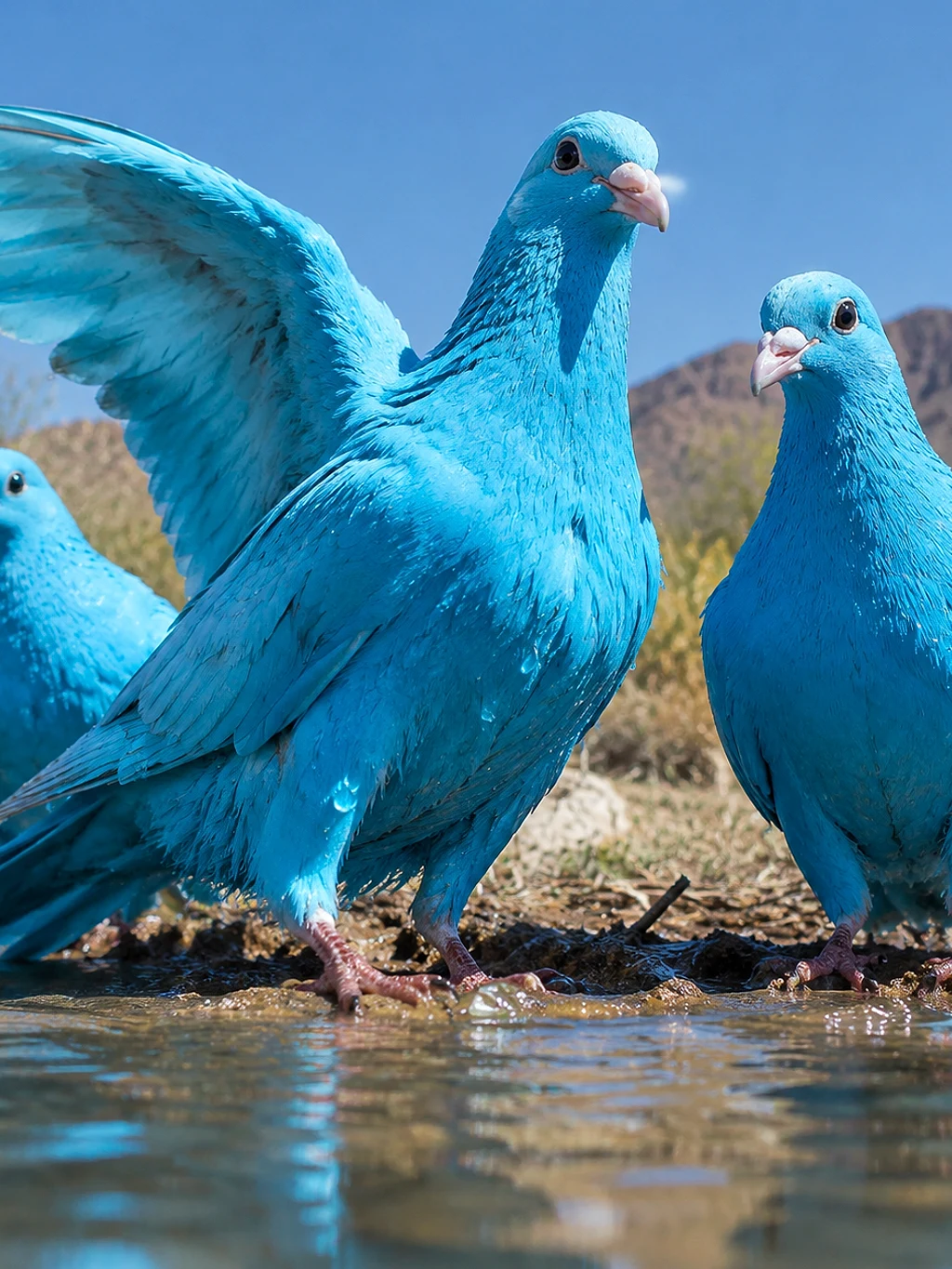
他们把白鸽染成蓝色放上了天:几天后有人在河边找到它们,蓝色怎么洗都洗不掉
Blue-Dyed Gender-Reveal Doves Found Days Later
About this story
An Arizona couple had a dove-release company dye white doves blue for a gender reveal in July 2026. Days later the birds showed up along the Salt River, a wildlife rehabilitator washed them again and again, and the dye would not come out. Chinese listening practice at four levels. HSK 4 Chinese listening practice.
This is an HSK 4 Chinese listening episode that runs about 5 minutes. The full Mandarin script is shown with tap-for-pinyin and a line-by-line English translation, so you can listen and read at once — comprehensible input in the sense of Stephen Krashen's i+1 theory. It teaches 12 key vocabulary words such as 简单、完成、发现 and walks through 3 grammar patterns, each explained in English with examples. The same news story is retold at 4 difficulty levels — use the level selector above to find the version that is challenging but still understandable for you.
Read at your level
原文Read the complete story in Chinese. Reveal pinyin and English only when you need them.
English transcript reference
First the thing itself, then why it is worth telling.
July this year, Arizona, in the United States.
That part of the country is desert: brutally hot in summer, with a sky that holds almost no cloud most of the year.
A couple there were about to have a baby.
They were going to throw a party and tell their friends the news.
This kind of party has become very popular in America in recent years; it is called a gender reveal.
The format is this: the parents do not say it themselves. They do something first and let the people in the room work out whether it is a boy or a girl.
Colour usually does the work — blue stands for a boy, pink for a girl.
This couple had a decent following online, so they wanted something better looking.
They found a small company, one that keeps white doves.
The company's usual work is simple: weddings, birthdays, shop openings — release a flock of white doves into the air.
White doves taking off really is a beautiful shot, and a lot of people photograph it.
But this couple made one extra request.
They said: it is a boy, so could the doves be blue?
The company agreed.
That day, the doves were released.
A flock of blue birds went up, the guests looked up, and everyone was delighted.
The photos went online and did very well.
Up to this point, it reads like a successful party.
The problem showed up a few days later.
Somebody walking along the Salt River saw a few blue birds on the water.
It struck her as wrong — there are no blue wild birds in this area.
She photographed them and posted it, and it spread fast.
There is a woman locally who has spent years rescuing injured wildlife.
Someone called her, she went out, and one look told her what it was.
This was no new species. These were the doves released at that party.
She took back the ones she could catch and tried to wash the colour out.
She washed them once, and they were still blue.
A second time, a third time, and the blue was still there.
She tried many times, and in the end she had to admit it: it would not come off.
At this point a lot of people will ask: but isn't a blue bird rather pretty?
It is. And for a bird, pretty is the problem.
There are two separate things to say here.
The first is being seen.
When a white dove is flying, finding it overhead is actually not easy.
The sky is bright, the clouds are white, and white up there is camouflage.
Blue is not.
A blue bird in the sky can be picked out from hundreds of metres away.
In the wild, what it means to be picked out does not need spelling out.
The second thing is the body.
Birds should not have anything on them.
They preen their feathers with their beaks every day, and whatever is stuck to the feathers goes into the mouth.
A bird's respiratory system is also unusually sensitive, and its body is small, so a little is a large dose.
The company owner later explained that the dye was food grade and non-toxic.
That statement may well be true, but it answers a different question.
The question is not whether swallowing it causes poisoning. The question is whether a bird should have anything on it that does not belong there.
And there is a third thing, which has to do with how these particular doves are used.
These are not ordinary birds.
They are homing pigeons. Once released, they have to fly home themselves.
Some have tens of kilometres to cover, entirely on their own.
For a blue homing pigeon, that journey is far harder than it is for a white one.
You sent it out. You did not guarantee it would get back.
Once the story spread, the criticism online was fierce.
The company owner said a few things: the dye was food grade and non-toxic; it was the first time she had coloured birds; she will not do it again.
That last sentence is the only settled outcome this story has.
What I want to say is that there is no villain here.
Nobody set out to hurt those birds.
They just wanted one afternoon to look a little better.
And that is exactly why it is worth telling — the cost was paid by someone else, and the party is the one place you cannot see who is paying it.
Think about it: you are holding a bird.
Today someone has turned it blue.
You open the cage and let it go.
Would you still say it is certain to come back?
Listen again
Try it without the transcript and notice what sounds clearer.
What vocabulary does this episode teach?
词汇HSK 3. The company's usual work is simple — weddings, birthdays, shop openings.
HSK 3. 要完成这段路 — the flight home the bird has to finish alone.
HSK 3. What the walker did by the river, and what a predator does from the air.
HSK 4. Never stated outright; the episode builds it from visibility instead.
HSK 4. 会不会被猛禽提前发现 — being spotted early is the entire cost.
HSK 4. Gender reveals became popular, and then the format kept escalating.
Named after the format is described, so the term lands on something already understood.
The fact that changes everything: these birds are supposed to fly back on their own.
沾在毛上的东西会进嘴里 — the route from the dye to the inside of the bird.
食用色素 — food-grade, which answers a question nobody was asking.
白色在里面是保护色 — white was doing a job, and the dye removed it.
HSK 6. 鸟的呼吸系统也特别敏感 — small body, sensitive system, large effective dose.
* beyond level超纲词
What grammar patterns appear in this episode?
语法不得不……
Has no choice but to. Stronger and more resigned than 只能 — used for a conclusion someone was pushed into.
她试了很多次,最后不得不承认:洗不掉。
不用我多说
I do not need to spell it out. A spoken move that hands the conclusion to the listener instead of stating it — more effective than saying the grim part aloud.
在野外,被看清楚意味着什么,不用我多说。
问题不是……,问题是……
Redirects from the question being answered to the question that matters. Used here to take apart a technically true defence.
问题不是这个东西吃下去会不会中毒,问题是鸟不该沾上任何不属于它的东西。
Proper nouns
专有名词Sources
来源Free account
Keep learning from this story
Create a free account to keep saved words and your preferred level together.
- Keep words with their story context
- Remember your preferred level
- Build your vocabulary over time