
A Chinese podcast · Same story, 4 levels
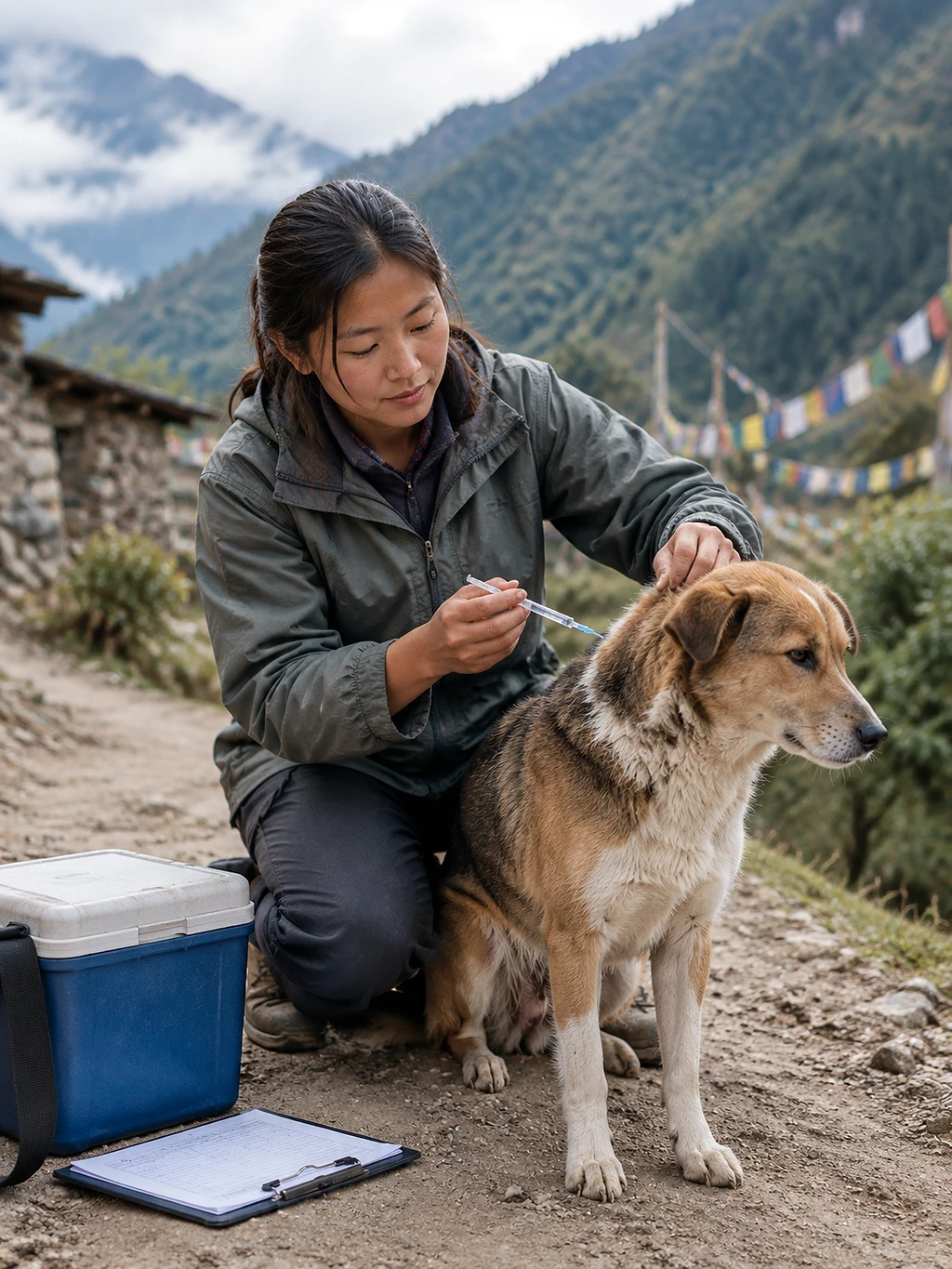
不丹三年没有一个人死于狂犬病:他们没有只救人,他们去给狗打针
Bhutan Prevents Rabies Deaths by Vaccinating Dogs
About this story
The WHO has validated Bhutan for eliminating dog-transmitted rabies — zero human deaths since June 2023, the first country in its region. It worked because Bhutan moved its effort from treating bitten people to vaccinating the dogs. Chinese listening practice at four levels. HSK 3 Chinese listening practice.
This is an HSK 3-4 Chinese listening episode that runs about 4 minutes. The full Mandarin script is shown with tap-for-pinyin and a line-by-line English translation, so you can listen and read at once — comprehensible input in the sense of Stephen Krashen's i+1 theory. It teaches 12 key vocabulary words such as 动物、组织、健康 and walks through 3 grammar patterns, each explained in English with examples. The same news story is retold at 4 difficulty levels — use the level selector above to find the version that is challenging but still understandable for you.
Read at your level
原文Read the complete story in Chinese. Reveal pinyin and English only when you need them.
English transcript reference
Let's start with a number: zero.
From June 2023 until today, not one person in Bhutan has died of dog-transmitted rabies.
Three years and more, zero.
On September the fourth, the World Health Organization formally certified it.
Across the whole of South-East Asia, Bhutan is the first country to manage it.
To understand how hard that is, you first need to know what rabies is.
It is a virus, spread mainly through the saliva of an infected animal — most commonly a dog bite.
At the moment of the bite there is not much sensation, and the wound may be small.
The virus travels slowly up the nerves, towards the brain.
That process can take weeks, or months.
And here is the crucial part: once symptoms appear, it is close to one hundred percent fatal.
The window in which modern medicine can save you exists only before symptoms.
Worldwide, roughly fifty to sixty thousand people die of rabies each year, the great majority in Asia and Africa, and a large share of them children.
Bhutan's circumstances were not favourable.
It is wedged into the Himalayas, with a population of about eight hundred thousand — fewer than many cities.
It is not a rich country; there are many mountain roads, and some villages cannot be reached by car at all.
And it is this country that has achieved what far better-resourced nations still have not.
Their method is worth spelling out.
Faced with rabies, the most intuitive response is to save the person: vaccinate immediately after a bite, which is called post-exposure prophylaxis.
That step is essential, and Bhutan does it, and does it well.
But it has a fundamental limitation — it is reactive.
You save one person, and the dog is still at the edge of the village, the virus is still circulating, and tomorrow someone else is bitten.
You are permanently running behind, and you have to keep running.
Bhutan moved the weight of its effort to the other end: the animals.
They vaccinated dogs at scale, both owned dogs and strays.
They sterilised as well, to control the stray population.
And they added something outsiders easily overlook: they connected the human medical system to the animal health system.
When a person is bitten, that information has to reach the department that handles animals; when a dog falls ill, that has to reach the department that handles people.
This framework has a name — "One Health".
Put plainly, it admits one thing: human disease and animal disease were always the same subject.
Bhutan kept this up for more than a decade.
The result can be calculated.
Once the proportion of immunised dogs is high enough, the virus can no longer pass between dogs.
Break the chain on the dogs' side and it breaks on the human side by itself.
So that zero is not luck; it is the outcome of a set of decisions taken more than ten years ago.
This August, from the seventeenth to the twenty-second, the WHO and the World Organisation for Animal Health sent a joint team to Bhutan to verify it on the ground.
Before that, there had been a round of documentary review.
Both rounds passed, and only then came the conclusion of September the fourth.
One last thing.
The WHO's goal is that by 2030, nobody in the world dies of dog-transmitted rabies.
What Bhutan means is that this is achievable for a small country and a poor one too.
What it relied on was putting the effort in the right place.
Think about it: is there something near you where everyone is dealing with the consequences, and almost nobody is touching the cause?
Listen again
Try it without the transcript and notice what sounds clearer.
What vocabulary does this episode teach?
词汇HSK 3. 不丹把重心挪到了另一头:动物 — the decision the whole story turns on.
HSK 3. The WHO, and the body that came to verify it.
HSK 3. 同一健康 — the name of the framework Bhutan used.
HSK 3. 结果是可以算出来的 — the point that this was predictable, not lucky.
HSK 3. Implicitly contrasted with organisation as the real difficulty.
HSK 3. 一旦症状出现,几乎百分之百会死 — the fact that makes prevention everything.
What rabies actually is, and what has to stop circulating.
Cheap, mature, and the entire answer — once you point it at dogs.
狗那边的传播链一断,人这边自然就断了。
The line past which medicine cannot help: 现代医学能救的窗口,只在症状出现之前。
暴露后预防 — necessary, but reactive by nature.
The population that makes this hard, and that Bhutan did not skip.
* beyond level超纲词
What grammar patterns appear in this episode?
语法一旦……,就……
Once X happens, Y follows inevitably. Stronger and more formal than 如果 — used for thresholds you cannot come back from.
一旦症状出现,几乎百分之百会死。
把 A 挪到 B
Move A to B. Here it states the strategic decision in one clause: the weight of effort moved from people to animals.
不丹把重心挪到了另一头:动物。
说穿了就是……
Put bluntly, it amounts to… A spoken move that strips a formal term down to what it actually means.
说穿了就是承认一件事:人的病和动物的病,本来就是一件事。
Proper nouns
专有名词Sources
来源Free account
Keep learning from this story
Create a free account to keep saved words and your preferred level together.
- Keep words with their story context
- Remember your preferred level
- Build your vocabulary over time