
A Chinese podcast · Same story, 4 levels
鱼子酱便宜到可以喂两岁的小孩了:一个很大的原因是中国的养鱼场
Caviar Got Cheap Enough to Feed a Toddler — and a Big Reason Is Chinese Fish Farms
About this story
A 125g tin of classic Osetra costs $495 at a Manhattan caviar house; new direct-to-consumer brands sell comparable roe for $125 to $138, in pink tins, with promo codes. The reason is supply: sturgeon predate the dinosaurs and take years to produce roe, wild catches were banned after the Soviet collapse, and over the past decade Chinese sturgeon farms have matured — giant Chinese producers now supply both the discount brands and Michelin-starred kitchens. One luxury-strategy professor says the old prices were simply convention, and the newcomers called the bluff. Chinese listening practice at four levels. HSK 5-6 Chinese listening practice.
This is an HSK 5-6 Chinese listening episode that runs about 6 minutes. The full Mandarin script is shown with tap-for-pinyin and a line-by-line English translation, so you can listen and read at once — comprehensible input in the sense of Stephen Krashen's i+1 theory. It teaches 12 key vocabulary words such as 市场、习惯、怀疑 and walks through 3 grammar patterns, each explained in English with examples. The same news story is retold at 4 difficulty levels — use the level selector above to find the version that is challenging but still understandable for you.
Read at your level
原文Read the complete story in Chinese. Reveal pinyin and English only when you need them.
English transcript reference
Let's put two prices side by side.
At a high-end caviar shop in New York, a 125-gram tin of classic Osetra costs four hundred and ninety-five dollars.
The same shop's top-grade Osetra, in the same quantity, comes to nearly three thousand dollars.
Now look at another set of figures.
A new brand selling direct online lists 100 grams of Osetra at a hundred and twenty-five dollars.
Another new brand, running a promotion, took 125 grams from three hundred and forty-six dollars down to a hundred and thirty-eight.
Within a single category, the price gap reaches more than tenfold.
That gap is now unsettling a market long dictated by a handful of established names.
To understand how this happened, you first have to understand why caviar was expensive.
Caviar is sturgeon roe after it has been cured with salt.
The sturgeon is an extraordinarily ancient fish; it predates the dinosaurs.
Its growth cycle is long, and a single sturgeon needs many years before it can spawn.
Which means the supply of caviar cannot be scaled up quickly, as a matter of physics.
With supply constrained, the price naturally stayed high.
But it is worth noting that caviar has not always been a luxury.
In nineteenth-century America, bars would sometimes offer it free as a bar snack.
What pushed it into the high-price bracket was a chain of later events.
In the 1990s the Soviet Union dissolved, and Caspian caviar prices crashed for a period.
Falling prices triggered unrestrained fishing, and wild sturgeon populations shrank rapidly.
A number of countries then banned the catching of wild sturgeon.
Today, the overwhelming majority of caviar circulating in the American market is farmed.
The real turning point has come in the last decade, and the turning point is in China.
Over the past ten-odd years, China began farming sturgeon at scale.
Sturgeon farming is a business that demands patience, because you have to wait for the fish to mature.
Now, that generation of fish has matured.
Chinese producers of enormous scale have emerged.
They supply the new online brands on one side and Michelin-starred restaurants on the other.
An author who has written specifically about caviar describes it fairly bluntly.
She says: there is a great deal of Chinese caviar on the market now, much of it extremely cheap, and much of it of very good quality.
When a supply-constrained category suddenly stops being constrained, the price structure begins to loosen.
What the new entrants have changed is the entire mode of presentation; price is merely the most visible part of it.
The old brands' packaging is black and gold, conveying formality and rarity.
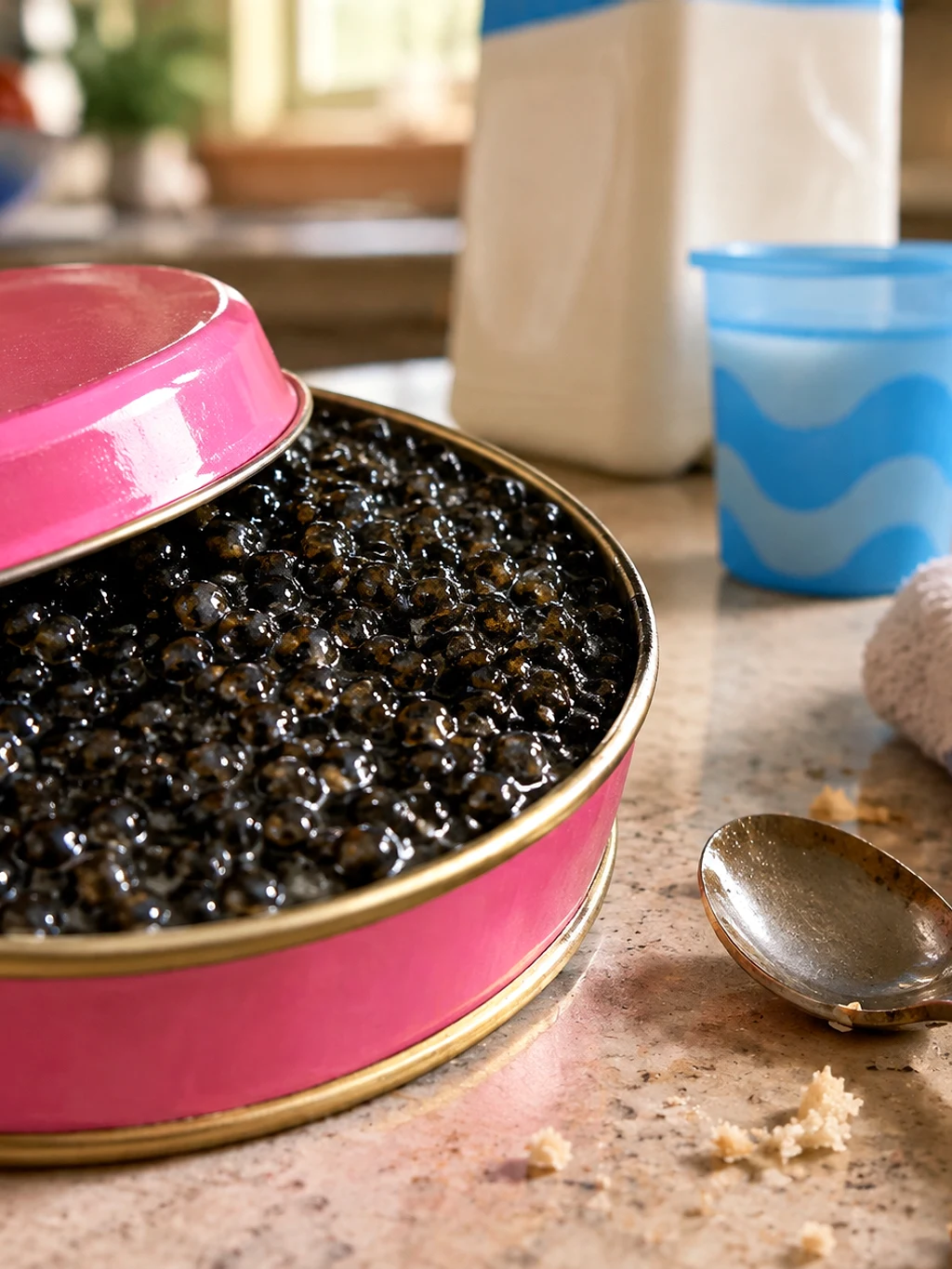
The new brands' tins are pink and bright yellow, conveying ease and the everyday.
They advertise on social platforms, offer discount codes, free delivery, even holiday gift sets.
Those words would almost never have appeared in the same sentence as caviar in the past.
The target customer is completely different too.
A Miami brand's core customer is women aged twenty-five to forty-five.
A co-founder of a Boston brand has observed something: some young women who are drinking less have started treating caviar as a substitute small indulgence.
The co-founder of the Miami brand mentions customers who have repurchased six to eight times within a year.
That brand's positioning for itself is a slogan: the People's Caviar.
Within the industry, the welcome is not unanimous.
The head of partnerships at that high-priced New York shop offers a warning.
He says: if caviar is abnormally cheap, the consumer should be on guard — it may be too good to be true.
But the opposite explanation is equally persuasive.
A professor who studies high-end brands points out that many brands price high simply because this category has long been priced that way.
He believes what these new brands have done is call the whole trade's bluff.
Both readings have merit, and they are not mutually exclusive.
Some cheap caviar really is of questionable quality, and some expensive caviar really is expensive only by convention.
Finally, back to specific people, because that is where the meaning of a price change actually lives.
A thirty-three-year-old woman lives in a small town in the American south, bakes bread, and writes caviar reviews on social media.
She says: for a long stretch of time, caviar belonged only to people inside that circle.
I live in the countryside, and there are no European delis near me.
Now she can eat it at home, and her favourite way is on an ordinary weeknight, in a robe, before a bath.
A thirty-four-year-old woman used to eat caviar only on special occasions in restaurants.
Now she and her husband can enjoy it more freely, and she has even given her two-year-old daughter a spoonful.
That child's reaction was three words: more, more, more.
Pull back from the whole thing and it is not only about a food.
Sometimes a thing is expensive because it is genuinely scarce in physical terms.
Sometimes it is expensive only because everyone assumes by default that it ought to be.
Those two kinds of expensive look identical on the shelf, and the answer only emerges when someone brings the price down.
What China's fish farms have done is precisely the bringing of that answer into the open.
Now put yourself in it.
Something you have always felt you could not afford suddenly becomes affordable.
Do you go and buy it immediately, or do you doubt it first?
Listen again
Try it without the transcript and notice what sounds clearer.
What vocabulary does this episode teach?
词汇HSK 4. 一个长期由少数老牌子说了算的市场 — who used to set the price.
HSK 3. The professor's whole argument: price by habit.
HSK 4. 其中很多非常便宜 — and the closing question asks whether you would doubt it.
HSK 4. 传递的是正式与稀有 — what black and gold packaging was saying.
HSK 3. 最后回到具体的人 — where a price change actually means something.
HSK 3. Implicit throughout: the answer only emerges when someone cuts the price.
在物理上就稀缺 — the first, legitimate kind of expensive.
当一个受供给限制的品类突然不再受限 — the mechanism of the whole story.
中国的养殖场做的,正是把答案揭晓的那件事 — the episode's last claim.
同一个品类,价差达到十几倍 — industry vocabulary for a kind of product.
只是贵在惯例上 — the second, less honest kind of expensive.
答案才会揭晓 — used for results being announced.
* beyond level超纲词
What grammar patterns appear in this episode?
语法之所以……,只是因为……
The reason X is simply Y. A formal frame that deflates a cause people assumed was deeper.
很多牌子之所以定高价,只是因为这个品类长期以来就是这么定价的。
并不互相排斥
Are not mutually exclusive. Used to hold two explanations at once instead of picking a side.
这两种说法各自都有道理,而且它们并不互相排斥。
直到……,……才……
Not until X does Y happen. Marks the moment hidden information becomes visible.
这两种贵在货架上看起来完全一样,直到有人把价格降下来,答案才会揭晓。
Proper Nouns
专有名词Free account
Keep learning from this story
Create a free account to keep saved words and your preferred level together.
- Keep words with their story context
- Remember your preferred level
- Build your vocabulary over time