
A Chinese podcast · Same story, 4 levels
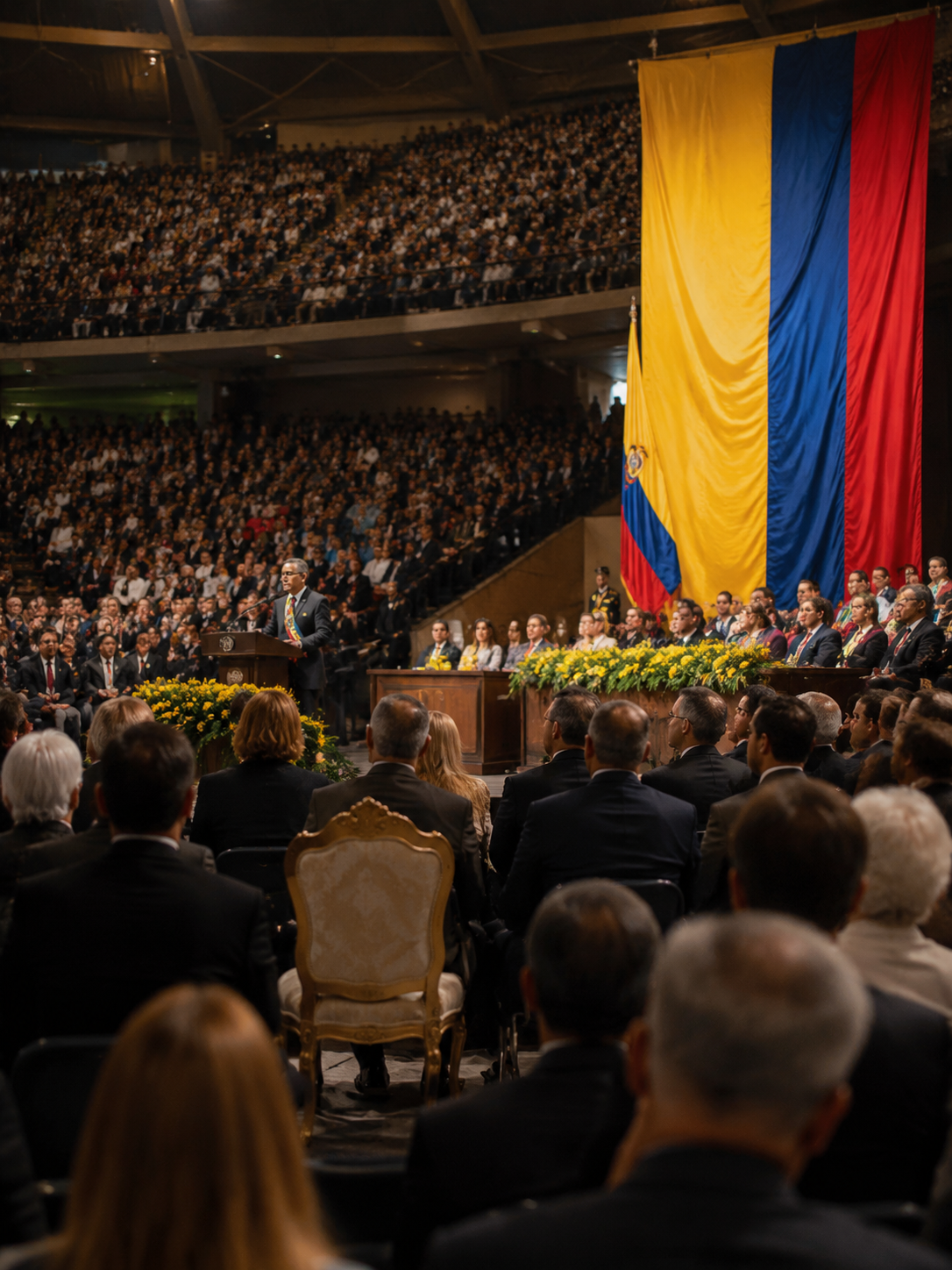
因新总统坚持在军营宣誓引发违宪争议,哥伦比亚就职仪式改在卡利举行,前总统锁营缺席。
Colombia Moves Presidential Inauguration to Cali
About this story
Colombia Moves Presidential Inauguration to Cali. HSK 3 Chinese listening practice.
This is an HSK 3-4 Chinese listening episode that runs about 2 minutes. The full Mandarin script is shown with tap-for-pinyin and a line-by-line English translation, so you can listen and read at once — comprehensible input in the sense of Stephen Krashen's i+1 theory. It teaches 10 key vocabulary words such as 规矩、首都、起因 and walks through 3 grammar patterns, each explained in English with examples. The same news story is retold at 4 difficulty levels — use the level selector above to find the version that is challenging but still understandable for you.
Read at your level
原文Read the complete story in Chinese. Reveal pinyin and English only when you need them.
English transcript reference
Colombia changed presidents today, but what made the news is where it happened.
By the rules, a new president has to swear an oath in public before he takes office.
For more than a hundred years, that ceremony has been held in the capital, Bogotá.
Today's was held in Cali.
It started because the new president wanted to swear his oath at a military barracks.
The moment word got out, constitutional scholars said flatly: that is unconstitutional.
The reasoning is simple: in Colombia the military obeys the president, not the other way round.
Going to a barracks to be sworn in ties you to the army.
Petro, who had not yet left office, ordered every military site closed.
And he said a line that then went round the whole country: the president obeys the people, not the military.
And there it stuck.
In the end Congress brokered a compromise: an arena at a university in Cali.
More than six thousand people came today, among them the King of Spain.
And Petro himself — did he show up?
No.
By custom, the outgoing president attends and hands power to his successor.
He said in advance he would not go, and in the end he did not.
Twenty-five lawmakers from his own party boycotted it as well.
A new president's first day is usually the most united day a country has.
Colombia did not get that day.
Think about it: when a country changes leaders, why does it matter so much where the ceremony is held and who turns up?
Listen again
Try it without the transcript and notice what sounds clearer.
What vocabulary does this episode teach?
词汇按规矩 = by the rules, as convention requires.
首都波哥大 = the capital, Bogotá.
起因是…… = it started because…
国会出面折中 = Congress stepped in and brokered a compromise.
最团结的日子 = the most united day.
按惯例 = by custom.
当众宣誓 = to swear the oath in public. Without it he is not president.
The venue he wanted, and the whole reason for the fight.
违 (to violate) + 宪 (constitution).
集体抵制 = boycotted as a group.
* beyond level超纲词
What grammar patterns appear in this episode?
语法等于……
"amounts to / is tantamount to" — states what an action really means.
跑去军营宣誓,等于把自己和军队绑在一起。
不能反过来
"and not the other way round" — fixes the direction of a relationship.
军队服从总统,不能反过来。
按……
"according to / by …". 按规矩、按惯例 are both used here.
按规矩,新总统要当众宣誓。
按惯例,卸任总统应该出席。
Proper nouns
专有名词Sources
来源Free account
Keep learning from this story
Create a free account to keep saved words and your preferred level together.
- Keep words with their story context
- Remember your preferred level
- Build your vocabulary over time