
A Chinese podcast · Same story, 4 levels
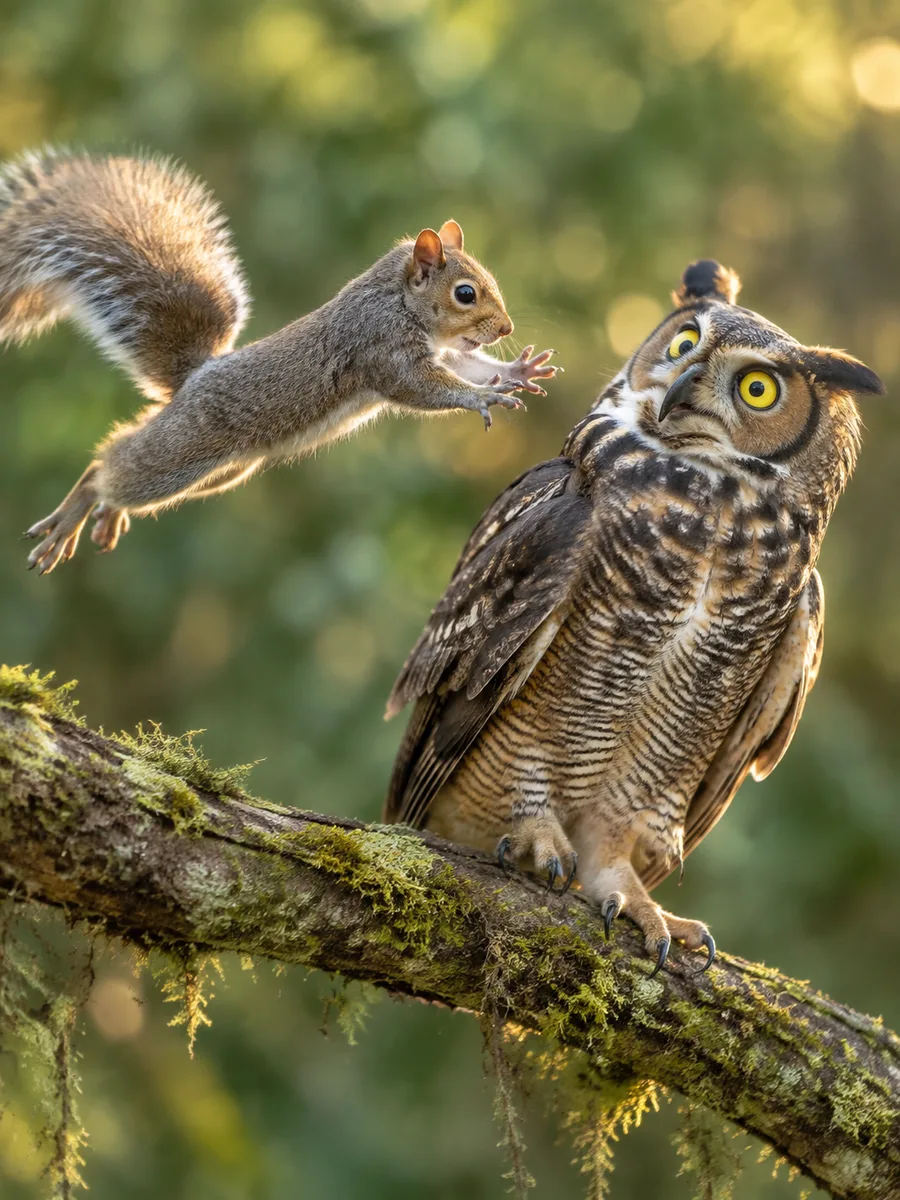
松鼠打猫头鹰、驼鹿打喷嚏:2026年最好笑的野生动物照片入围名单出炉
A Squirrel Attacks an Owl and a Moose Sneezes: The Funniest Wildlife Photos of 2026 Are In
About this story
Inside the 2026 Comedy Wildlife finalists, the Born Free partnership, and whether funny animal photos help conservation. HSK 5-6 Chinese listening practice.
This is an HSK 5-6 Chinese listening episode that runs about 3 minutes. The full Mandarin script is shown with tap-for-pinyin and a line-by-line English translation, so you can listen and read at once — comprehensible input in the sense of Stephen Krashen's i+1 theory. It teaches 16 key vocabulary words such as 突然、明确、目的 and walks through 6 grammar patterns, each explained in English with examples. The same news story is retold at 4 difficulty levels — use the level selector above to find the version that is challenging but still understandable for you.
Read at your level
原文Read the complete story in Chinese. Reveal pinyin and English only when you need them.
English transcript reference
In Santa Cruz, California, a squirrel is hurling itself at a great horned owl in an almost suicidal pose.
Bear in mind, the great horned owl is one of North America's fiercest owls, and squirrels are already on its menu.
But in this photo, predator and prey seem to have suddenly swapped places, and the owl's face, written all over with 'are you serious?', becomes the whole joke.
This shot, 'Are You Kidding Me?', is one of the finalists in the 2026 Nikon Comedy Wildlife Awards.
The bar for entry is clear: it has to be real wildlife, and it has to make people laugh.
This year it received more than 10,000 entries from 112 countries, the most in the contest's history.
The 56 shortlisted entries include 40 single images, 3 works by under-16s, 4 portfolios and 9 videos.
Since this is a podcast, we can only 'see' with words, but luckily each of these photos is a little story in itself.
Hanover, Germany: a red squirrel stuffs a whole mouthful of grass into its cheeks, its head bulging to nearly twice the size; the photographer named it 'Little Godzilla.'
Maligne Lake, Alberta, Canada: a series of three—a moose first has a runny nose, then lets out a giant sneeze, and finally breaks into a satisfied grin, exactly how everyone looks after a sneeze.
Amboseli National Park, Kenya: an adult elephant gives a youngster an over-vigorous 'dust bath,' titled 'Lessons.'
Quick science note: elephants throwing dust on themselves is serious business—dust protects against sun and insects and helps them cool down—it's just that this time the force left the young elephant looking rather aggrieved.
There's also a South African photographer under 16 who captured a sunbird with a petal stuck to its beak, as if playing dress-up.
Why has this contest kept growing?
On one hand, it hits the rhythm of social media: a funny animal photo spreads far faster than a serious conservation report.
On the other hand, there's a very clear purpose behind it.
One of the co-founders is photographer Tom Sullam; the contest has always partnered with wildlife conservation groups, and this year's partner is Britain's Born Free Foundation.
Their logic: first make you laugh, then make you care.
Sullam says the contest has grown far bigger than they ever imagined.
Of course, some people have reservations about this kind of anthropomorphism.
Making animals look like people does bring us closer, but it may also make us remember only their cute side and ignore the real situation they face, like shrinking habitats, poaching and climate change.
So the best way to enjoy these photos may be to ask one more question after laughing: this squirrel, this moose, these two elephants—are their homes okay?
The final winners will be revealed on December 8th, and two exhibitions in London are showing the finalists now.
One last question: do you think 'cute' and 'funny' really make people more willing to protect wildlife?
Listen again
Try it without the transcript and notice what sounds clearer.
What vocabulary does this episode teach?
词汇HSK 3. 位置好像突然对调了.
HSK 5. 门槛很明确.
HSK 4. 一个很清楚的目的.
HSK 5. 传播速度.
HSK 5. 一篇严肃的保护报告.
HSK 4. 拉近距离.
HSK 5/6. 忽略它们面对的真实处境.
HSK 4. 保护野生动物.
北美最凶猛的猫头鹰之一.
猎物和捕食者.
猎物和捕食者的位置.
入围作品之一.
对这种拟人化有保留意见.
栖息地缩小.
非法捕猎和气候变化.
比赛的联合创始人之一.
* beyond level超纲词
What grammar patterns appear in this episode?
语法要知道,……
Bear in mind….
要知道,大雕鸮是北美最凶猛的猫头鹰之一
一方面……,另一方面……
On one hand…, on the other….
一方面,它踩中了社交媒体的节奏
另一方面,它背后有一个很清楚的目的。
先……,再……
First…, then….
他们的逻辑是:先让你笑,再让你在意。
对……有保留意见
Have reservations about….
当然,也有人对这种"拟人化"有保留意见。
确实……,但也可能……
Indeed…, but it may also….
把动物拍得像人,确实能拉近距离,但也可能让我们只记住它们可爱的一面
远远超过……
Far exceeds….
一张好笑的动物照片,传播速度远远超过一篇严肃的保护报告。
Proper nouns
专有名词Free account
Keep learning from this story
Create a free account to keep saved words and your preferred level together.
- Keep words with their story context
- Remember your preferred level
- Build your vocabulary over time