
A Chinese podcast · Same story, 4 levels
建数据中心,每户发一万美元:宾州小镇居民为什么不买账
$10,000 for Every Household If the Data Center Gets Built: Why a Pennsylvania Township Isn't Buying It
About this story
A developer promised $10,000 to each of Hazle Township's 4,500 households — $45 million in all — if the Pennsylvania town lets it build a data center. Most residents still say no: the noise, their property values, and a deep distrust of who is paying. 'Are they trying to bribe us here?' Chinese listening practice at four levels. HSK 5-6 Chinese listening practice.
This is an HSK 5-6 Chinese listening episode that runs about 5 minutes. The full Mandarin script is shown with tap-for-pinyin and a line-by-line English translation, so you can listen and read at once — comprehensible input in the sense of Stephen Krashen's i+1 theory. It teaches 12 key vocabulary words such as 收入、信任、采访 and walks through 3 grammar patterns, each explained in English with examples. The same news story is retold at 4 difficulty levels — use the level selector above to find the version that is challenging but still understandable for you.
Read at your level
原文Read the complete story in Chinese. Reveal pinyin and English only when you need them.
English transcript reference
Starting in June, residents of Hazle Township, Pennsylvania, began receiving letters from a developer.
The promise in the letters was simple: if the township agreed to a data center, every household would get ten thousand dollars.
The developer wrote that the money could be used on "really whatever you want."
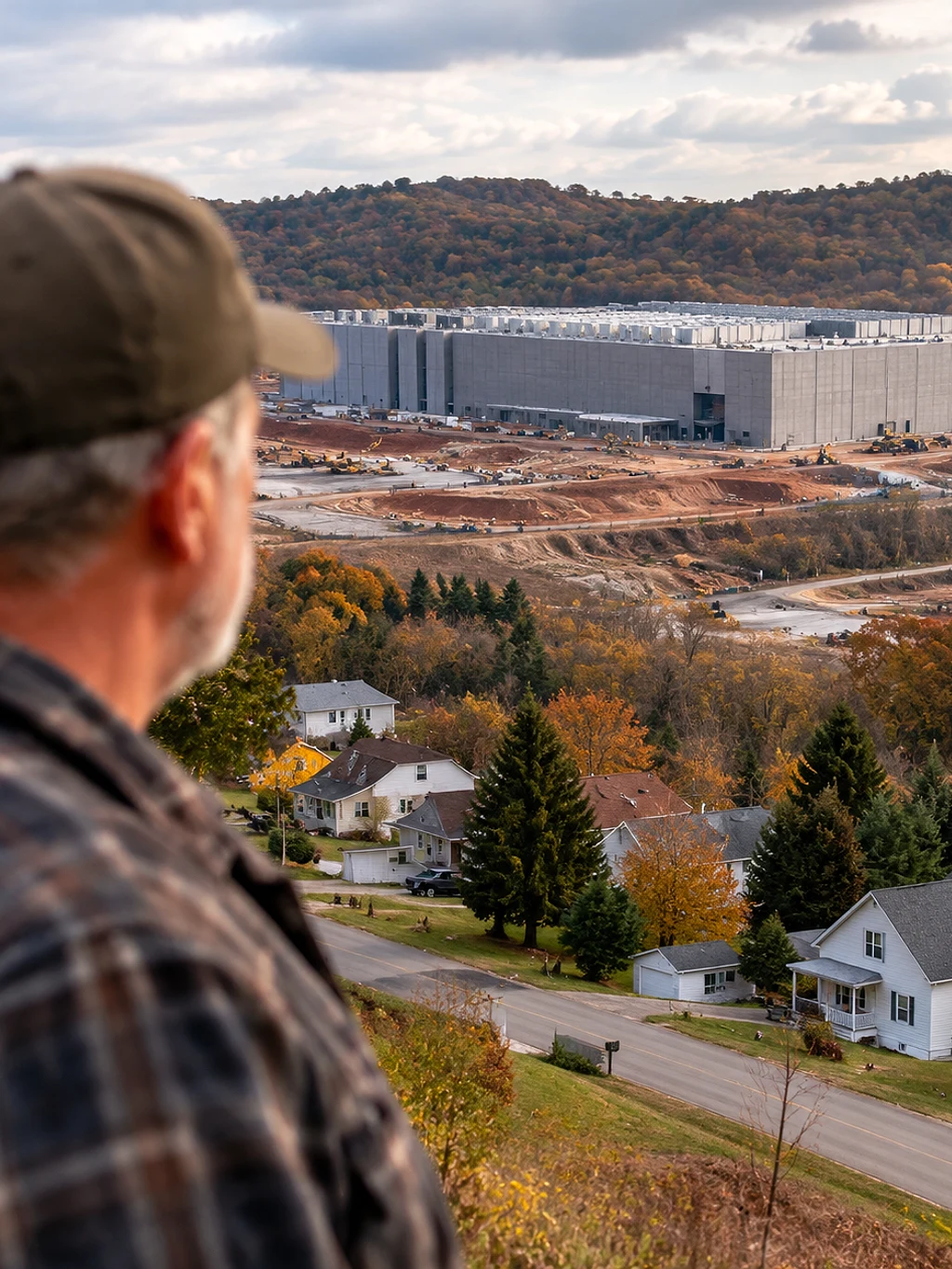
The company is NorthPoint Development, and it plans fifteen data-center buildings on more than five hundred hectares in the Pocono foothills; this would be only the first.
The township has 4,500 households in all, which adds up to 45 million dollars.
In Hazle Township, the median household income is about sixty thousand dollars a year.
So for many families, ten thousand dollars is a significant sum.
Even after taxes, it would cover about six months' rent on a two-bedroom apartment, or many months of groceries and fuel.
But whatever their income, whether they had jobs or not, wherever they lived, almost none of the residents interviewed were willing to welcome the data center for the money.
Their reasons for opposing it vary.
Some fear the noise of construction and machines; some dislike how fast artificial intelligence is spreading.
But many have one thing in common: they don't trust these projects, or the people behind them.
Zola, a resident of a nearby town, says small-town politicians in Pennsylvania are too easily won over by big developers.
He says once the gates open, local governments give developers ten-year tax breaks.
More and more data-center developers now offer towns packages worth tens of millions of dollars, such as money for fire departments, emergency services and schools.
In Hazle Township, residents even spotted free amusement rides sponsored by NorthPoint at the local Italian festival.
But handing cash directly to every resident is something new in the AI building boom.
Fasnacht, a retired teacher, lives right near the planned data center.
He worries that the construction over the next several years will be noisy the whole time.
Fresh from a round of golf and smoking a cigar, he said: ten thousand dollars doesn't come close to what my house is going to lose in value.
Some residents also feel that the government and developers have been hiding information from the public.
On that point, Governor Shapiro signed an executive order last month banning local governments from signing non-disclosure agreements with data-center companies.
Leshko used to do maintenance and cleaning work and now lives in a seniors' apartment building nearby.
He lives outside the area that would get the money, but he understands why it's appealing.
He said: ten thousand dollars doesn't come along every day.
The money could buy a new car, or go toward a down payment on a house.
He says he has always wanted a house of his own.
Spallone, a special-education teacher, also received the letter.
Her biggest worry is that more and more data centers will eventually make her house lose its value.
But she and her husband just renovated their house and put on a new roof, using up a good part of their savings.
So she said: ten thousand dollars would still be pretty nice.
NorthPoint's chief marketing officer, Miles, says the idea of paying people came from a rowdy public meeting last year.
At the time, angry residents asked: what do I get for supporting the data center?
Miles says the idea is cutting-edge, a direct answer to "what's in it for me?"
Besides this money, the company plans to pay another 120 million dollars over the next fifteen years, including money for a police department and other community investments.
He estimates that by answering questions and clearing up claims about water, electricity costs and noise, the company has changed the minds of nearly a hundred residents who were skeptical.
Some of the people who got the letter live in big houses with mountain views.
Others live in the old coal-patch towns around the small city of Hazleton, where the houses are old and worn and the taverns fill up by five o'clock.
In nearby Salem Township, dozens of families made millions of dollars selling their land for data centers.
But now opposition to data centers is growing across Pennsylvania.
To many residents, ten thousand dollars looks like a too-cheap attempt to buy their silence.
Majusiak, a retired foundry worker, sat in a bar with a beer, thinking it over.
He said at first he thought, well, OK, maybe I'll think about it.
But in the end he decided: we don't need that around here.
He remembers that fifteen years ago, developers started cutting down trees to build warehouses.
His favourite deer-hunting spot turned into cinder blocks.
Now the data center's fate is hard to predict.
Last November, the Hazle Township government rejected the project on zoning grounds.
NorthPoint then sued the township to overturn the decision, and the case is still going on.
While it updates its zoning rules, the township has temporarily halted all data-center construction.
Negra, a retiree who is helping organize the opposition, says the ten thousand dollars may end up backfiring.
He says most people's first reaction is: are they trying to bribe us?
If a company offered you ten thousand dollars in exchange for a data center near your home, would you accept?
Listen again
Try it without the transcript and notice what sounds clearer.
What vocabulary does this episode teach?
词汇HSK 4. 家庭年收入的中位数.
HSK 4. 不信任这些项目.
HSK 4. 接受采访的居民.
HSK 3. 这笔钱为什么有吸引力.
HSK 4. 本来怀疑的居民.
HSK 4. 地方政府.
陆续收到了信.
中 (middle) + 位 (position) + 数 (number).
减 (reduce) + 税 (tax).
对公众隐瞒信息.
花了不少积蓄.
An idiom: the result is the opposite of what was intended.
* beyond level超纲词
What grammar patterns appear in this episode?
语法不管……,都/也……
No matter…
可是,不管收入高低,有没有工作,住在哪里,接受采访的居民里,几乎没有人愿意为了这笔钱欢迎数据中心。
就算……,也……
Even if…, still…
就算交了税,也差不多够付半年两居室的房租,或者买好几个月的菜和汽油。
以……为理由
On the grounds of…
去年十一月,黑泽尔镇政府以土地用途的规定为理由,否决了这个项目。
Proper Nouns
专有名词Free account
Keep learning from this story
Create a free account to keep saved words and your preferred level together.
- Keep words with their story context
- Remember your preferred level
- Build your vocabulary over time