
A Chinese podcast · Same story, 4 levels
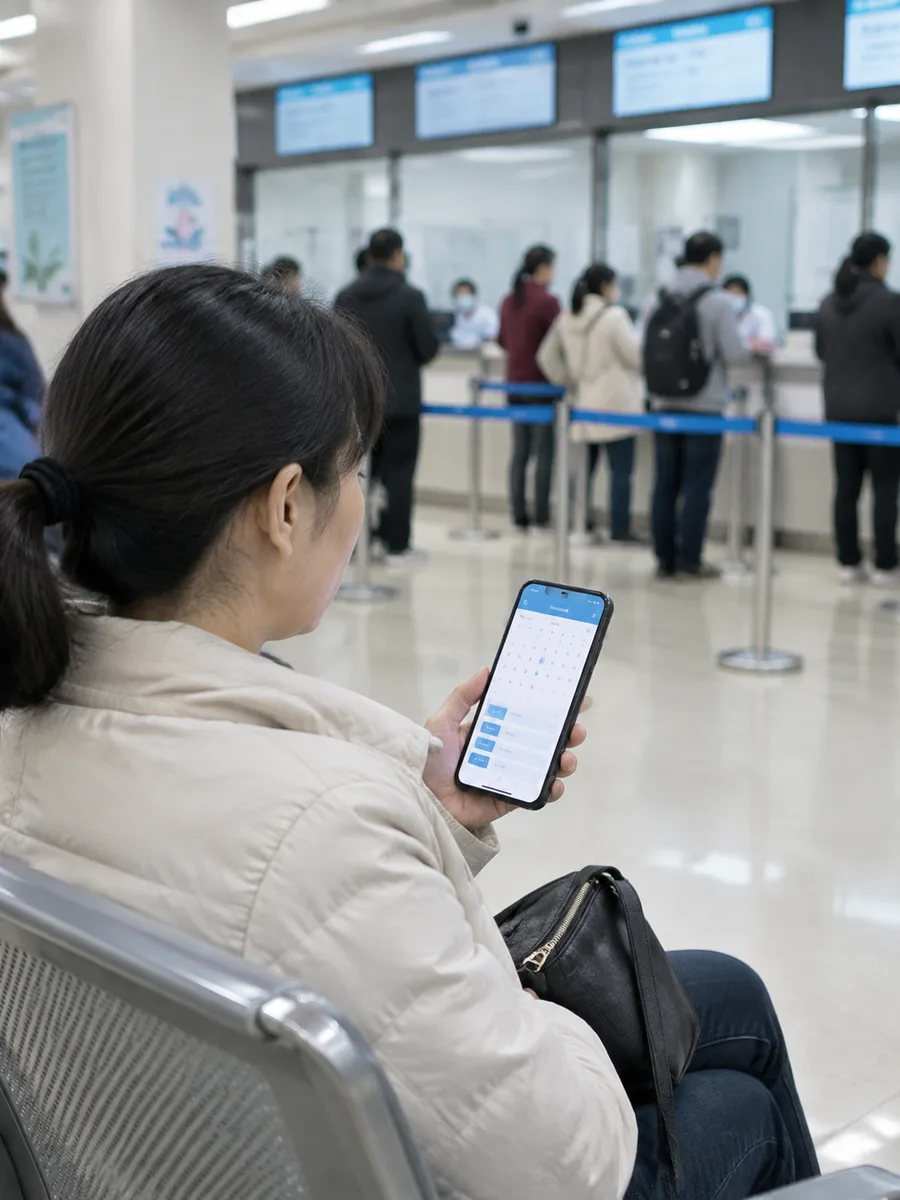
帮女友挂号,怎么最后被判刑?
Hospital Booking Bots Lead to Convictions
About this story
HSK 1-3 Chinese listening. Booking software helped a girlfriend see a doctor, then paid bookings and an overloaded hospital system led to convictions.
This is an HSK 3-4 Chinese listening episode that runs about 3 minutes. The full Mandarin script is shown with tap-for-pinyin and a line-by-line English translation, so you can listen and read at once — comprehensible input in the sense of Stephen Krashen's i+1 theory. It teaches 12 key vocabulary words such as 医院、医生、电脑 and walks through 4 grammar patterns, each explained in English with examples. The same news story is retold at 4 difficulty levels — use the level selector above to find the version that is challenging but still understandable for you.
Read at your level
原文Read the complete story in Chinese. Reveal pinyin and English only when you need them.
English transcript reference
There was a programmer who helped his girlfriend grab a hospital appointment, and in the end both of them were sentenced.
This programmer, we'll call him Zhou Ming, and his girlfriend, we'll call her Wang Lin.
The report uses pseudonyms; these two names are not real names.
Wang Lin's health was not very good, and she had to go to the hospital often.
To go to the hospital, you first have to register for an appointment.
Registering for an appointment means first telling the hospital, I want to come see a doctor, please give me a number.
Only once you have a number can you see the doctor.
But some specialist doctors have very few numbers, and they are hard to get.
Specialist doctors are doctors who understand a lot about certain illnesses.
Zhou Ming is a programmer; a programmer is a person who writes computer programs.
He wanted to help his girlfriend, so he wrote a piece of software.
Software is a small program inside a computer; whatever you tell it to do, it does.
What does this software do?
It helps people grab appointment numbers.
Grabbing a number means quickly getting a number online.
A person clicking by hand can click at most six or seven times per second.
This software can click more than a thousand times per second.
So it can always grab a number.
Zhou Ming used this software to help Wang Lin get a number.
Wang Lin's problem of seeing a doctor was solved.
Later, people who knew Wang Lin learned about this and also wanted numbers.
At first, they did not ask for money and helped a few people grab numbers for free.
Free means not asking for money.
But more and more people came looking for them.
The two of them could not handle it anymore.
So they started charging money.
Charging money means others give them money, and only then do they help.
Wang Lin posted ads on a social app to find customers.
Zhou Ming used software to grab numbers, then marked up the price and sold them.
Marking up means asking for more money than the original price.
Police found that Zhou Ming actually made a profit of 12,900 yuan.
But they were not the only people using this kind of software to grab numbers.
There were also three other people who used the same software to grab numbers.
Several people each grabbing numbers meant the registration system of a hospital in Wuhan could not work normally.
When the system cannot work normally, other people cannot register.
The hospital discovered it and called the police.
Later, police captured Zhou Ming and Wang Lin.
The police found phones, computers, and a notebook at their place.
Money was recorded in the notebook.
Later, the court said they had committed a crime.
The name of this crime is the crime of damaging a computer information system.
The court determined that their actions constituted this crime.
The court sentenced Zhou Ming to twelve months.
Wang Lin was an accomplice, sentenced to ten months with a one-year suspended sentence.
In this case, the court believed Wang Lin played a relatively small role.
The court gave Wang Lin a suspended sentence, so for now she does not have to go to prison.
The hospital is a place where everyone goes to see a doctor.
Many patients need these numbers; when a computer program grabs numbers for a small number of people, it is harder for others to get them.
The software clicks more than a thousand times per second, while a person clicks six or seven times per second; people cannot beat software.
Other people also want to see a doctor, but the system can no longer register appointments.
Think about it: if you were sick, but could not get an appointment, what would you do?
Listen again
Try it without the transcript and notice what sounds clearer.
What vocabulary does this episode teach?
词汇HSK 3. A place for medical treatment. Common collocations: 去医院 (go to the hospital), 一家医院 (a hospital).
HSK 3. A medical professional. In the script: 看医生 (see a doctor), 专家医生 (specialist doctor).
HSK 3. An electronic device for computing. In the script: 写电脑程序 (write computer programs), 电脑里的小程序 (small program in a computer).
HSK 3. A person you know well and like. In the script: 女朋友 (girlfriend), 帮女朋友 (help his girlfriend).
HSK 3. Can mean a job or the functioning of a system. In the script: 不能正常工作 (cannot work normally).
HSK 3. Used before a verb to show the start of an action. In the script: 一开始 (at first), 开始收钱 (start charging money).
A common medical term. 挂号 means getting a numbered ticket before seeing a doctor. In the script: 先要挂号 (first need to register), 挂号系统 (registration system).
抢 means to grab or snatch; 号 means a number/ticket. Refers to quickly securing a limited hospital appointment online. In the script: 帮人抢号 (help people grab numbers).
A computer program or application. In the script: 写了一个软件 (wrote a piece of software), 用软件抢号 (use software to grab numbers).
A person who writes computer programs. 程序 means program; 员 means a person who does a job. In the script: 有一个程序员 (there was a programmer).
A legal term: the sentence is not served in prison immediately if conditions are met. In the script: 判十个月,缓刑一年 (sentenced to ten months, suspended for one year).
A legal term for a person who plays a lesser role in a crime. In the script: Wang Lin是从犯 (Wang Lin was an accomplice).
* beyond level超纲词
What grammar patterns appear in this episode?
语法先……才……
Expresses that one action must happen first before another can happen. 先 introduces the prerequisite, and 才 introduces the result that becomes possible only after it.
有了号,你才能看医生。
去医院,先要挂号。
Used to explain or define something, often meaning 'that is' or 'means'. It introduces a simple explanation of the preceding term.
挂号,就是先跟医院说,我要来看病,请给我一个号。
软件,就是电脑里的小程序,你叫它做什么,它就做什么。
免费,就是不要钱。
Means 'more and more' as a change over time. It is followed by an adjective or a verb phrase describing an increasing degree.
但是找他们的人越来越多。
The passive construction. The subject receives the action rather than doing it. In the script it appears in 被判了刑 (were sentenced).
有一个程序员,他帮女朋友抢医院的号,最后两个人都被判了刑。
Proper nouns
专有名词Sources
来源Free account
Keep learning from this story
Create a free account to keep saved words and your preferred level together.
- Keep words with their story context
- Remember your preferred level
- Build your vocabulary over time