
A Chinese podcast · Same story, 4 levels
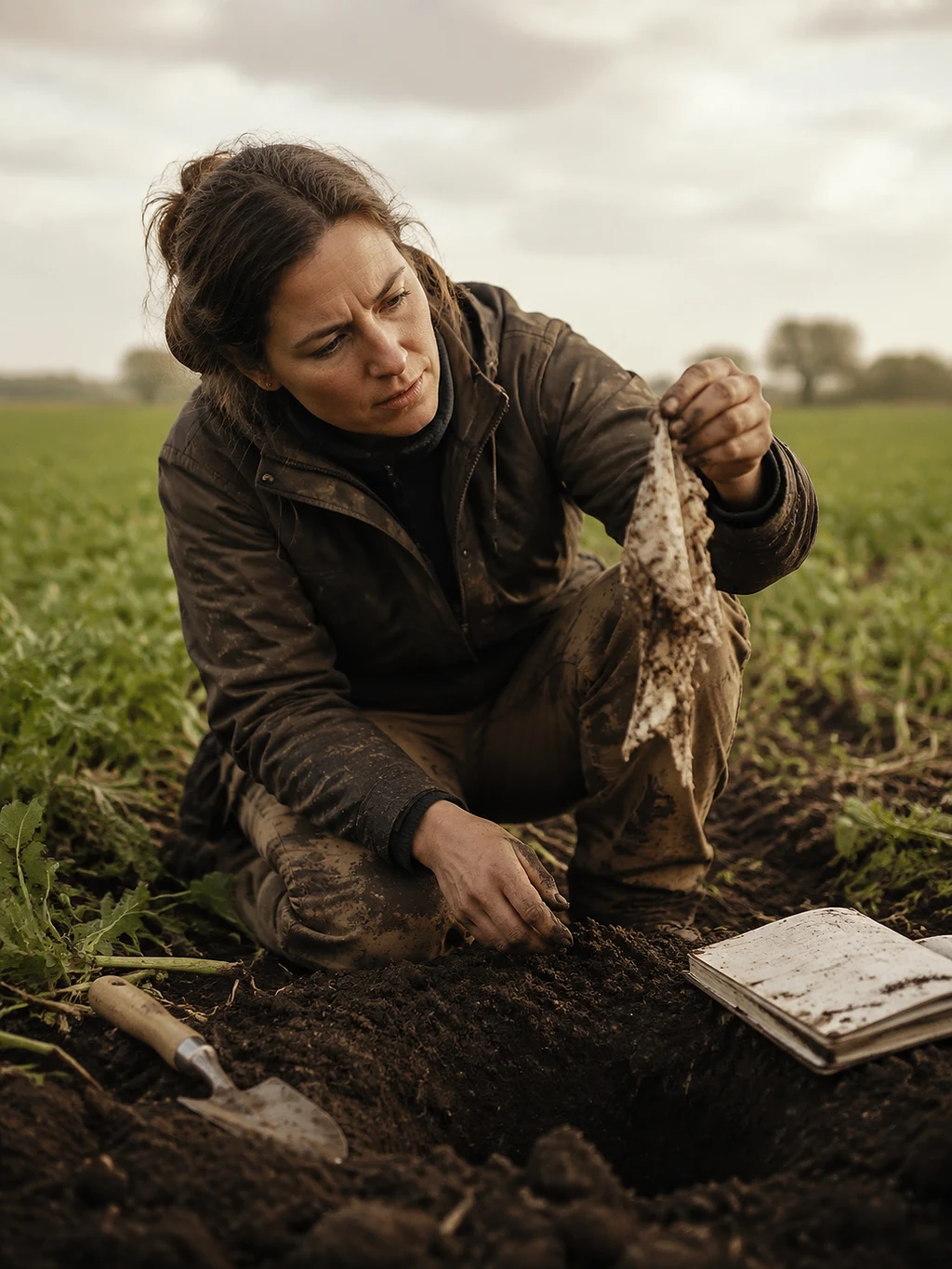
他们把几千条内裤埋进二十五个国家的土里:这项研究拿了今年的搞笑诺贝尔奖
Buried Underpants Reveal Soil Health in 25 Countries
About this story
A team buried thousands of pairs of cotton underpants across 25 countries for two months, then dug them up to measure soil health — and won a 2026 Ig Nobel Prize, awarded in Zurich for the first time in 35 years. Chinese listening practice at four levels. HSK 2 Chinese listening practice.
This is an HSK 2 Chinese listening episode that runs about 3 minutes. The full Mandarin script is shown with tap-for-pinyin and a line-by-line English translation, so you can listen and read at once — comprehensible input in the sense of Stephen Krashen's i+1 theory. It teaches 12 key vocabulary words such as 笑、真、有意思 and walks through 3 grammar patterns, each explained in English with examples. The same news story is retold at 4 difficulty levels — use the level selector above to find the version that is challenging but still understandable for you.
Read at your level
原文Read the complete story in Chinese. Reveal pinyin and English only when you need them.
English transcript reference
On the evening of September the third, fifteen hundred people were sitting in a big hall.
Every one of them was holding a paper aeroplane.
Each time somebody on stage received a prize, the audience threw their paper aeroplanes.
Is this not just a place for jokes?
Yes — and no.
The prize is called the Ig Nobel Prize.
It has one line that says it very clearly:
first it makes you laugh, then it makes you think.
This year there were ten prizes.
Every one of them sounds funny.
But every one of them is real scientific research.
Today we will talk about two.
The first is about soil.
Some scientists bought several thousand pairs of underpants.
All of them white, all of them cotton.
They buried those underpants in the ground.
In twenty-five countries, they buried underpants in the soil.
They left them two months before going back and digging them up.
Why do that?
Because they wanted to know whether the soil was healthy.
There are enormous numbers of tiny things in soil, and we call them microbes.
You cannot see microbes, but they are eating all the time.
Good soil means more microbes.
More microbes, and something made of cotton gets eaten fast.
Poor soil means fewer microbes.
Fewer microbes, and after two months the underpants are still intact.
So you dig them up, take one look, and you know.
Little left of them: this soil is full of life.
Still in good condition: this soil has a problem.
The best part is that it needs no expensive machine — a farmer can do it alone.
The second prize is about smell.
Some scientists asked a question:
do small children smell nice?
Do teenagers smell nice?
They found a lot of mothers and fathers to do the smelling.
The results were interesting.
The parents said a small child's head smells lovely.
When it came to teenagers, they shook their heads.
A lot of people laughed when they heard about this study.
But these scientists were serious.
They wanted to know whether that bond between parent and child has something to do with smell as well.
And there is one more thing about the prize this year that people are talking about.
For thirty-five years it was always held in America.
This year, for the first time, it came to Europe.
The place was Zurich, in Switzerland.
The people handing over the prizes on stage were real Nobel laureates.
The prize money is funny too: ten trillion.
But it is old money from one country, and today it buys nothing at all.
Think about it: you hear about a piece of research and your first reaction is that it is hilarious.
Then you think about it for a moment, and decide it makes sense after all.
When was the last time that happened to you?
Listen again
Try it without the transcript and notice what sounds clearer.
What vocabulary does this episode teach?
词汇HSK 2. The prize's rule in one word: 先让你笑,再让你想。
HSK 2. The turn of the episode: 每一个,都是真的科学研究。
HSK 2. 结果很有意思 — how the smell study is introduced.
HSK 2. The subject of the second prize, small ones and big ones.
HSK 2. Why the method matters: no expensive machine needed, a farmer can do it.
HSK 2. 有几个科学家问了一个问题 — how each prize starts.
Several thousand pairs of them, cotton and white, buried in 25 countries.
The verb the whole experiment turns on: 他们把这些内裤,埋到土里。
The other half of the method: 两个月,他们才回去,把内裤挖出来。
Glossed on first use: 土里有很多很小的东西,我们叫它们微生物。
The second prize's punchline: parents shake their heads at this one.
Who the cheap method is actually for: 农民自己就能做。
* beyond level超纲词
What grammar patterns appear in this episode?
语法先让你……,再让你……
Causative 让 in a paired structure — makes you do one thing first, then another. Quoted here as the prize's own rule.
先让你笑,再让你想。
才 + verb
Marks that something happened later than you might expect. 两个月,他们才回去 stresses that they waited the full two months.
埋了两个月,他们才回去,把内裤挖出来。
A 就 B,A 就 B
Chained conditionals used to walk through a mechanism in small steps — the episode uses four in a row to explain the science.
土好,微生物就多。
土不好,微生物就少。
Proper nouns
专有名词Sources
来源Free account
Keep learning from this story
Create a free account to keep saved words and your preferred level together.
- Keep words with their story context
- Remember your preferred level
- Build your vocabulary over time