
A Chinese podcast · Same story, 4 levels
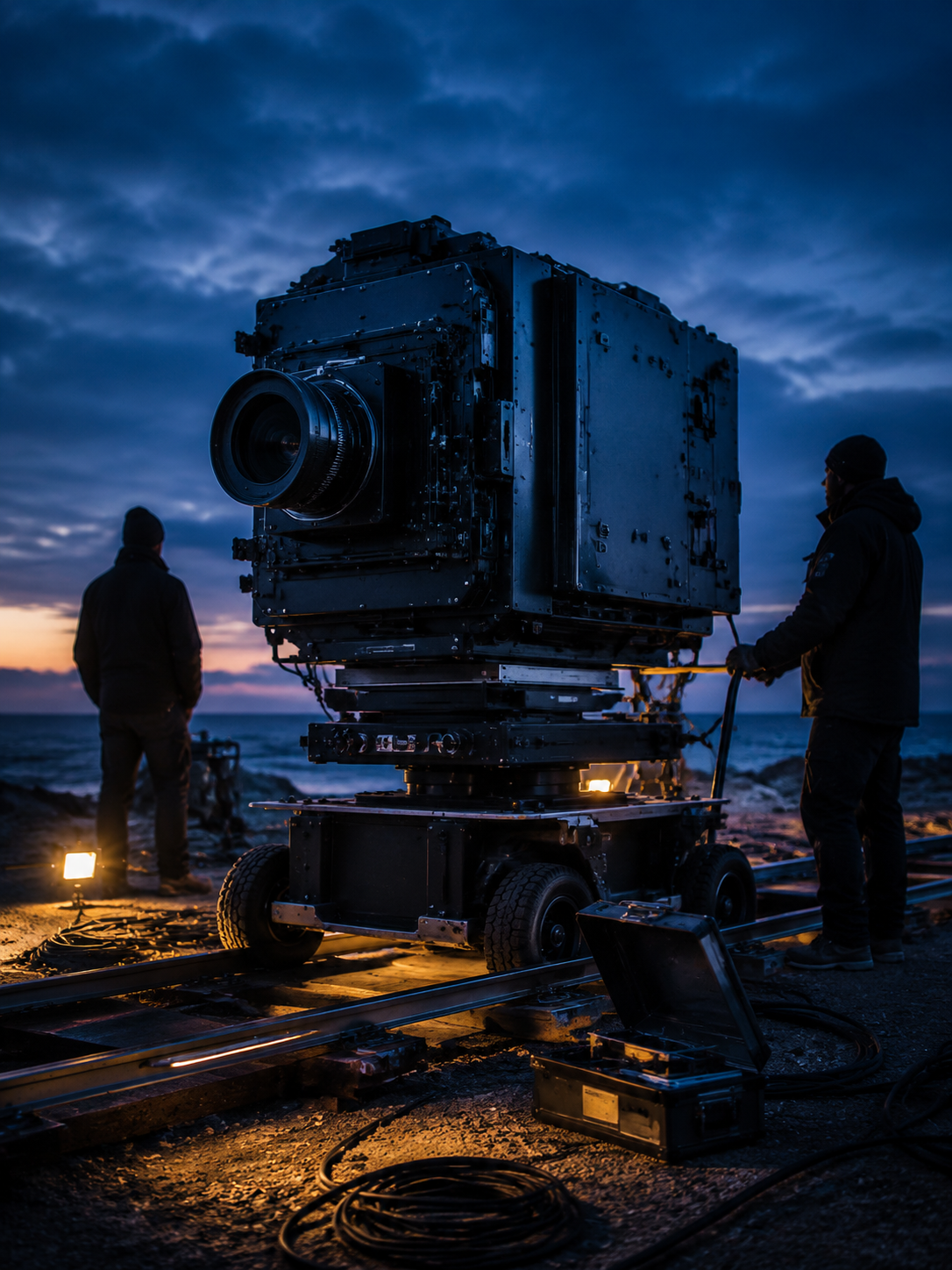
诺兰用 IMAX 胶片拍完了整部《奥德赛》。那台新摄影机,用一对在 IMAX 干了五十三年的夫妻命名。
Nolan's IMAX Camera Honors Longtime Partners
About this story
Nolan's IMAX Camera Honors Longtime Partners. HSK 5-6 Chinese listening practice.
This is an HSK 5-6 Chinese listening episode that runs about 2 minutes. The full Mandarin script is shown with tap-for-pinyin and a line-by-line English translation, so you can listen and read at once — comprehensible input in the sense of Stephen Krashen's i+1 theory. It teaches 10 key vocabulary words such as 电影、丈夫、名字 and walks through 3 grammar patterns, each explained in English with examples. The same news story is retold at 4 difficulty levels — use the level selector above to find the version that is challenging but still understandable for you.
Read at your level
原文Read the complete story in Chinese. Reveal pinyin and English only when you need them.
English transcript reference
Start with a name: Keighley.
It is the name of a camera.
Naming a machine after a person’s surname is uncommon; naming one after a married couple’s is rarer still.
The husband spent fifty-three years at IMAX, and what he did was not shooting but quality control.
When a film was finished, he checked it: are the colours right, is the picture clean, can it go up on that enormous screen.
Fifty-three years; roughly five hundred films passed through his hands.
His wife is still at the company today, doing the same job.
So when the new machine was built, the company engraved that surname on it.
Now, why a new one had to be built at all.
IMAX film stock is exceptionally large, and the bigger the frame, the more information reaches the screen.
But large-format film cameras have a twenty-year-old complaint: noise.
Cinematographer Hoyte van Hoytema described the old camera as a lawnmower coming apart.
Once the machine runs, live sound cannot be recorded; what you hear is the machine, not the lines.
So the standard practice used to be: shoot the big scenes on IMAX, and swap to a quiet camera the moment there was dialogue.
One film, two sets of equipment, traded back and forth.
Until Nolan made a demand nobody had managed before: shoot the entire film on IMAX, every line of dialogue included.
And so there is the Keighley.
How much quieter?
Officially thirty percent; the cinematographer says in practice it is more like ten or twenty.
But the character of the sound changed completely — from a lawnmower coming apart to a well-oiled sewing machine.
The new machine is still unwieldy: wrapped in a soundproof shell, the whole rig runs to over a hundred kilos, too heavy to push, so it rides on a cart built from steel plate.
And one limit that cannot be designed around: a roll of film only lasts three minutes.
Three minutes up: stop, change the magazine, start again.
The film is called The Odyssey, with Matt Damon.
The story is a man who gets himself home on one mouth and one set of wits, improvising the whole way.
A story about speaking, shot on a machine that can finally record speaking.
The result was 1.1 billion dollars — the highest of Nolan’s career, and the biggest release in IMAX history.
And finally, back to that surname.
The husband never shot a single film in his life.
What he did was look at pictures for fifty-three years and judge whether they were right.
Think about it:
One thing — could you do it for fifty-three years?
Listen again
Try it without the transcript and notice what sounds clearer.
What vocabulary does this episode teach?
词汇The first shot entirely on IMAX film.
One half of the couple the camera is named after.
Naming a machine after a person is uncommon; after a couple, rarer still.
What the new camera finally became.
Part of what he checked for fifty-three years.
Naming a machine after a person is 不常见; after a couple, rarer still.
The bigger the 画幅, the more information reaches the screen.
通行做法 = the standard practice, the way it is normally done.
Heavy and awkward. The rig is 笨重 even after the redesign.
没法绕 = cannot be designed around. The three-minute roll is that kind of limit.
* beyond level超纲词
What grammar patterns appear in this episode?
语法没法绕
没法 + verb means there is no way to do it. 绕 is to go around, so 没法绕 = cannot be worked around.
还有一条限制没法绕。 — And one limit that cannot be designed around.
……,更……
Escalates a comparison: X is already so; Y even more so.
机器用人的姓命名不常见;用一对夫妻的姓,更少见。 — Naming a machine after a surname is uncommon; after a couple, rarer still.
归到……上
To come back to / come down to something — used to land a closing point.
最后归到那个姓上。 — And finally it comes back to that surname.
Proper nouns
专有名词Sources
来源Free account
Keep learning from this story
Create a free account to keep saved words and your preferred level together.
- Keep words with their story context
- Remember your preferred level
- Build your vocabulary over time