
A Chinese podcast · Same story, 4 levels
飓风吹倒了夏威夷的牛油果树,一个小岛用掉在地上的果子办了场比赛,救下了自己的电台
A Hurricane Flattened Hawaii's Avocado Trees — So One Island Held a Guacamole Contest and Saved Its Own Radio Station
About this story
Hurricane Lowell knocked thousands of avocado trees down on Kauaʻi in September 2026, at the exact start of avocado season, and the island filled up with free fruit nobody could eat. In the same week its community radio station — the only thing still broadcasting through the outage — warned it was nearly out of diesel. On 17 September, twenty-five batches of guacamole and nearly two hundred people raised over $5,000, double the target, and kept it on the air. Chinese listening practice at four levels. HSK 3 Chinese listening practice.
This is an HSK 3-4 Chinese listening episode that runs about 4 minutes. The full Mandarin script is shown with tap-for-pinyin and a line-by-line English translation, so you can listen and read at once — comprehensible input in the sense of Stephen Krashen's i+1 theory. It teaches 12 key vocabulary words such as 影响、办法、消息 and walks through 3 grammar patterns, each explained in English with examples. The same news story is retold at 4 difficulty levels — use the level selector above to find the version that is challenging but still understandable for you.
Read at your level
原文Read the complete story in Chinese. Reveal pinyin and English only when you need them.
English transcript reference
This September, Hurricane Lowell reached Hawaii.
The island hit hardest was a small one called Kauaʻi.
After the wind stopped, people stepped outside and found fallen trees everywhere.
A great many of them were avocado trees.
The timing landed at exactly the worst possible moment.
Hawaii's avocados happen to start ripening in September.
Which is to say, the trees were blown over at the point when they were carrying the most fruit.
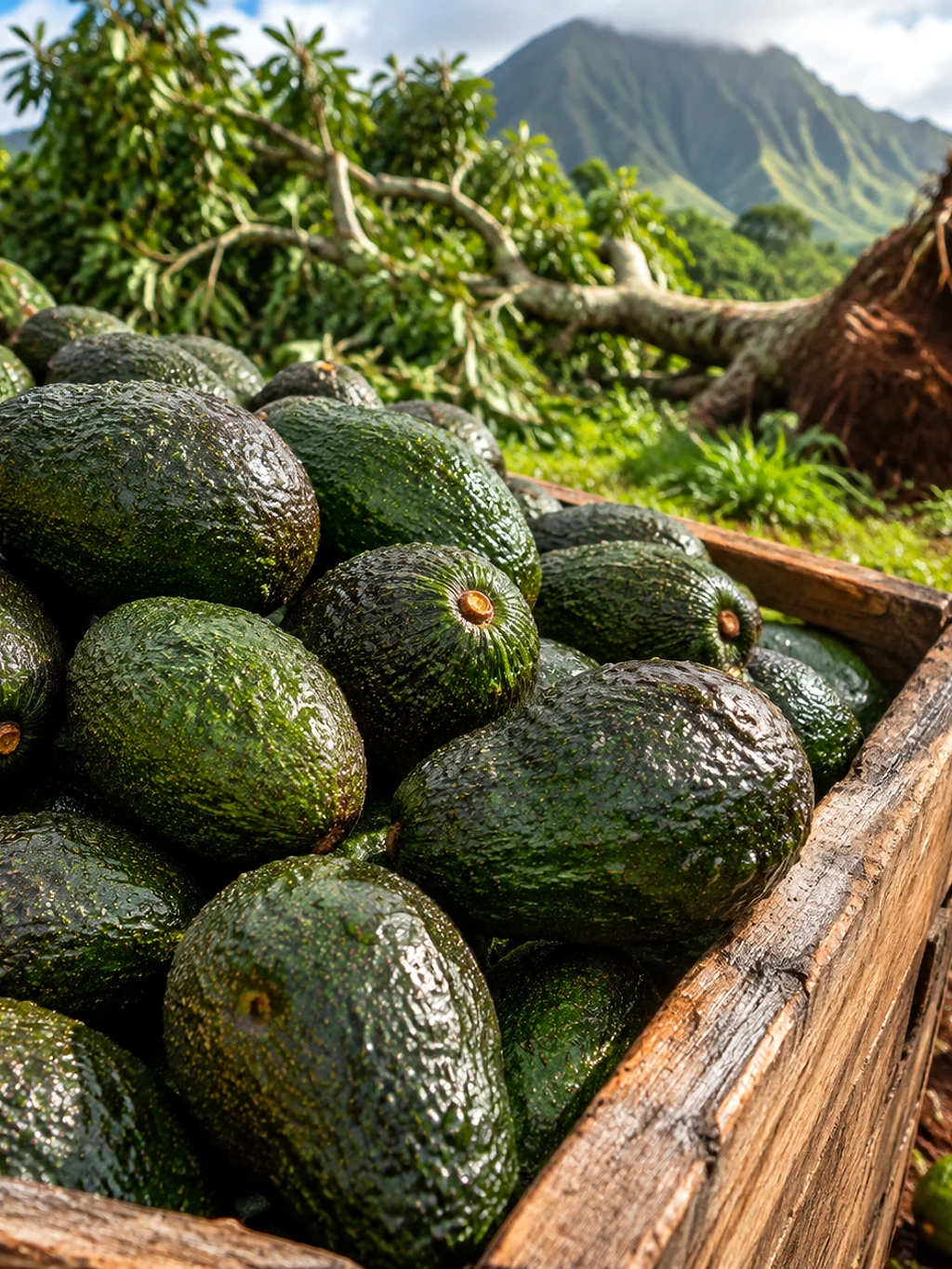
Overnight, thousands of avocados appeared on the ground.
Here it is worth explaining what makes Hawaii's avocados different.
There are roughly two hundred varieties here.
They ripen at different times, and they differ in size and in taste.
So Hawaii's avocados never became a real commercial crop.
This is not something grown to be sold.
It is more like something neighbours give to one another.
And now there was suddenly more of it than anyone could possibly eat.
Left out, it rots; thrown away, it is a waste.
Everyone on the island understood that all this could not simply be allowed to disappear.
What happened next was photographed by a lot of people and posted online.
At the roadside, in shop doorways, beside petrol stations, one box appeared after another.
In buckets, in boxes, in little carts — all of it avocados.
The words written on them varied, but the meaning was always one thing: free, help yourself.
One local said it seemed like every neighbourhood had a bin of free avocados sitting out.
But in that same week, there was something more urgent going on.
Kauaʻi has a community radio station.
During the hurricane, many places lost power, and phones had no signal.
At a time like that, all people have is the radio.
The station tells everyone which roads are passable, whether the water is safe, and where to pick up food.
But on the ninth of September, the station itself asked for help.
It said its fuel was nearly gone and the generator would not run much longer.
With no fuel, the station would have to stop.
And once the station stops, nobody can hear anything at all.
So that hurricane really did two things.
It made everyone desperate for information, and it very nearly silenced the people giving it.
At that point, somebody had an idea.
The thing this island has most of right now is avocados — so use avocados to buy the fuel.
On the afternoon of the seventeenth, they held a guacamole contest behind a small restaurant.
There were twenty-five batches of guacamole, all made by local people.
The organisers had assumed a hundred people showing up would be a good turnout.
Close to two hundred came.
They had hoped to take in two thousand five hundred dollars.
They ended up with more than five thousand — twice what they had hoped for.
The station did not go off the air.
It is still talking.
Look at the whole thing from beginning to end and it becomes very clear.
The hurricane knocked over the trees, the trees dropped their fruit, the fruit raised the money, the money bought the fuel, and the fuel kept the station talking.
And what the station was talking about was what to do after the hurricane.
The thing the hurricane broke turned out to be the thing that fixed it.
If one day a box of unwanted fruit appeared outside your door, would you take it home?
Listen again
Try it without the transcript and notice what sounds clearer.
What vocabulary does this episode teach?
词汇HSK 3. 受影响最大的,是一个叫考艾的小岛 — 受影响 is the standard passive frame for disaster reporting.
HSK 3. 有人想了一个办法 — 想办法 is the collocation; you think up a 办法, you do not make one.
HSK 3. 让所有人都特别需要消息 — the commodity the whole second half is about.
HSK 3. 办了一场牛油果酱比赛 — note the measure word 场, which is what events take.
HSK 3. 邻居之间互相送的东西 — the only distribution system Hawaii's avocados ever had.
HSK 2. 把这件事从头到尾看一次,就很清楚了 — the signal that the summary is coming.
这里大概有两百种牛油果 — two hundred varieties is why it never became a business.
飓风洛厄尔 — the Chinese for a Pacific hurricane, distinct from 台风.
电台一停,大家就什么也听不到了 — stated as a consequence, not a sentiment.
人们只能听收音机 — distinguished from 电台: the 收音机 is the object, the 电台 is who is speaking.
发电机开不了多久 — the physical reason a radio station can run out of voice.
一家社区电台 — community-run, which is exactly why a guacamole contest could save it.
* beyond level超纲词
What grammar patterns appear in this episode?
语法一边……,又差一点……
On one hand it did X, and on the other it very nearly did Y. Used to show a single cause producing two opposed effects at once.
它让所有人都特别需要消息,又差一点让说消息的人停下来。
放着会……,扔了又……
Leave it and X happens; throw it out and Y happens. A two-clause frame for a dilemma where neither option is acceptable.
放着会坏,扔了又太可惜。
A 换来了 B
A was exchanged for B. Chaining 换 clauses turns a sequence of events into a visible causal chain.
飓风吹倒了树,树掉下了果子,果子换来了钱,钱买了油。
Proper Nouns
专有名词Free account
Keep learning from this story
Create a free account to keep saved words and your preferred level together.
- Keep words with their story context
- Remember your preferred level
- Build your vocabulary over time