
A Chinese podcast · Same story, 4 levels
飓风吹倒了夏威夷的牛油果树,一个小岛用掉在地上的果子办了场比赛,救下了自己的电台
A Hurricane Flattened Hawaii's Avocado Trees — So One Island Held a Guacamole Contest and Saved Its Own Radio Station
About this story
Hurricane Lowell knocked thousands of avocado trees down on Kauaʻi in September 2026, at the exact start of avocado season, and the island filled up with free fruit nobody could eat. In the same week its community radio station — the only thing still broadcasting through the outage — warned it was nearly out of diesel. On 17 September, twenty-five batches of guacamole and nearly two hundred people raised over $5,000, double the target, and kept it on the air. Chinese listening practice at four levels. HSK 5-6 Chinese listening practice.
This is an HSK 5-6 Chinese listening episode that runs about 4 minutes. The full Mandarin script is shown with tap-for-pinyin and a line-by-line English translation, so you can listen and read at once — comprehensible input in the sense of Stephen Krashen's i+1 theory. It teaches 12 key vocabulary words such as 严重、恢复、政府 and walks through 3 grammar patterns, each explained in English with examples. The same news story is retold at 4 difficulty levels — use the level selector above to find the version that is challenging but still understandable for you.
Read at your level
原文Read the complete story in Chinese. Reveal pinyin and English only when you need them.
English transcript reference
This September, Hurricane Lowell made landfall in Hawaii, and the island worst hit was Kauaʻi.
The damage it caused was the conventional kind: widespread power cuts, roads severed, houses damaged, state parks closed indefinitely.
But this hurricane also left behind something highly unconventional.
After the wind dropped, people pushed open their doors to find the ground covered in fallen trees.
A large share of them were avocado trees.
The timing was bad in a way that felt almost deliberate.
Hawaii's avocado season happens to begin in September.
Which is to say, these trees were torn up by the roots at the exact moment they were carrying the most fruit.
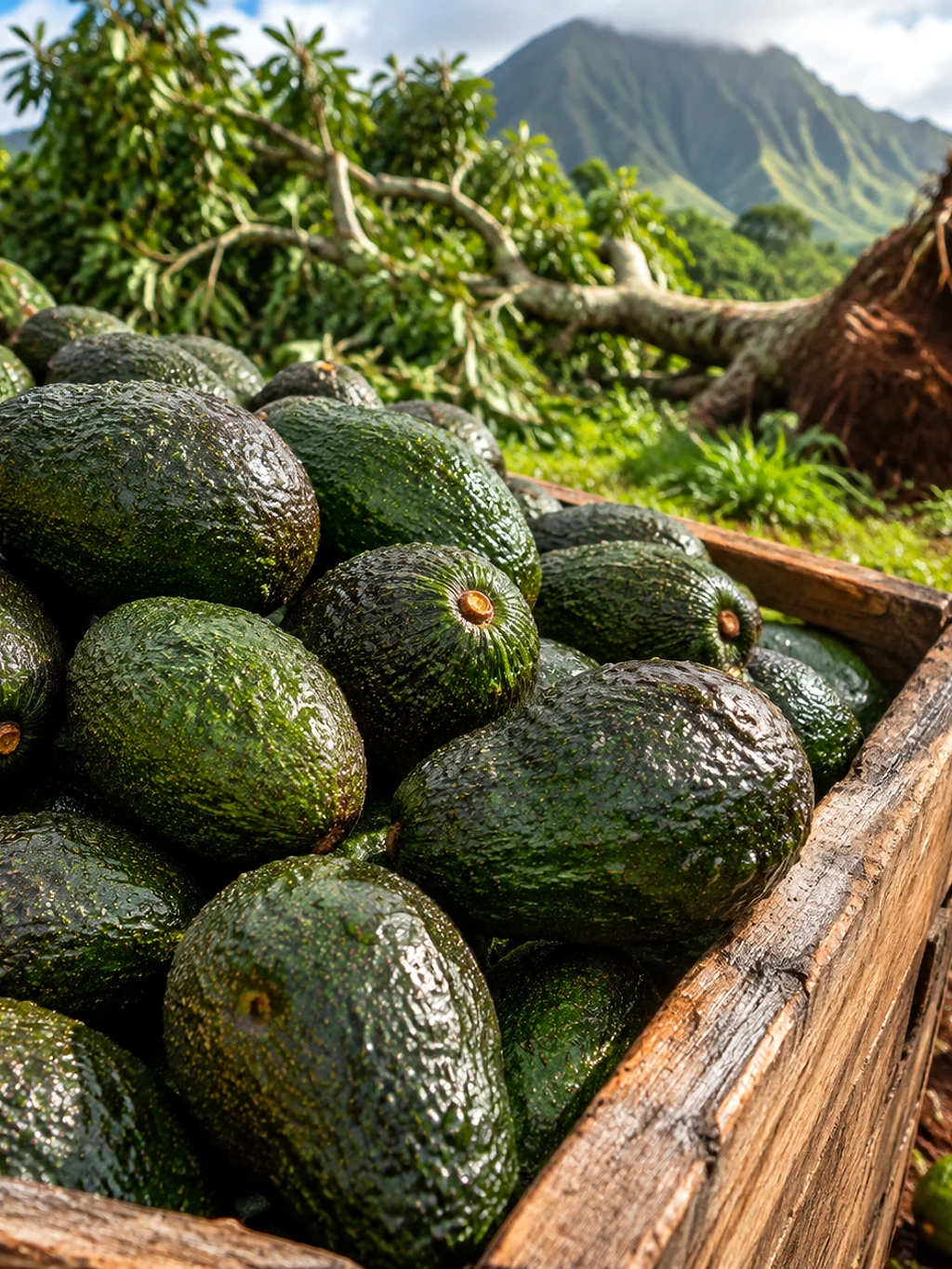
Overnight, thousands of avocados appeared on the ground.
To understand what happened next, you first need to know one thing about Hawaii's avocados.
There are around two hundred different varieties here, ripening at staggered times, and differing in size, oil content and flavour.
Variety on that scale meant it could never become a standard commodity that can be bought in bulk and shipped out.
For a long time, Hawaii's avocados have moved in only one way: neighbours giving them to each other.
Now this thing that already travelled on goodwill suddenly exceeded what anyone could handle.
Left out it rots, and throwing it away comes close to wasting food — and the aftermath of a disaster is exactly when food should least be wasted.
So the island produced a scene that was photographed over and over and posted online.
At the roadside, in shop doorways, beside petrol stations, outside people's own yards, one container after another was set out.
Buckets, cardboard boxes, wheelbarrows, canvas bags — every one of them full of avocados.
The wording varied slightly, but it all meant one thing: free, help yourself.
Something said by a local woman who works in food describes the mood precisely.
She said nearly every community was piled with bins of free avocados, so it looked like a good opportunity.
The opportunity she meant pointed at something more pressing happening on the island that same week.
Kauaʻi has a community radio station.
During the hurricane, with widespread outages and no phone signal, a radio is often the only thing still working.
What the station broadcasts is the most concrete material there is: which roads are open again, whether the tap water is drinkable, where to collect food.
In other words, it is part of the post-disaster infrastructure — it just happens to be the part the government does not run.
Yet on the ninth of September, the station itself put out an appeal.
It said its diesel was nearly gone and the generator would not hold out much longer.
Once the diesel ran out, the station would have to stop broadcasting.
This produced a very sharp situation.
One hurricane simultaneously made everyone desperate for information and came close to silencing the only people still able to supply it.
The solution came from that pile of unwanted fruit.
The thing the island has least shortage of right now is avocados — so use avocados to buy the fuel the station needs.
On the afternoon of the seventeenth, a guacamole contest was held behind a small restaurant in Old Kapaʻa Town.
Twenty-five batches of guacamole were entered, every one of them made by local people.
The organisers had estimated that a hundred people turning up would count as a success.
Close to two hundred came.
Their fundraising target was two thousand five hundred dollars.
What they took in was over five thousand — twice the target.
The station did not go off the air.
Lay the whole chain out end to end and its shape becomes very clear.
The hurricane overturned the trees, the trees shook loose the fruit, the fruit was exchanged for money, the money bought the diesel, and the diesel let the station go on telling people what to do after a hurricane.
What was destroyed became the material that repaired it.
This is worth telling because it states a fact that is usually overlooked.
What actually works in disaster recovery is often just whatever a community happens to have left in its hands, plus whether anyone thinks of a use for it.
Big plans take time. The avocados were already on the ground.
If one day a box of unclaimed fruit turned up outside your door, would you carry it home, or walk past as though you had not seen it?
Listen again
Try it without the transcript and notice what sounds clearer.
What vocabulary does this episode teach?
词汇HSK 3. 受灾最严重的是考艾岛 — 受灾 plus 严重 is the fixed register for reporting disaster impact.
HSK 4. 灾后恢复里真正起作用的 — the subject of the episode's closing argument.
HSK 4. 只是这一部分不归政府管 — the sentence that reframes a small radio station as infrastructure.
HSK 3. 被摧毁的东西,最终变成了修复它的材料 — the whole episode compressed into one line.
HSK 4. 数量一下子超过了所有人能处理的范围 — abundance described as a capacity problem.
HSK 4. Paired with 超过 above; together they turn "too many avocados" into a precise statement.
大约有两百个不同的品种 — the fact that explains why this crop never industrialised.
它是灾后基础设施的一部分 — the claim the episode spends four sentences earning.
柴油一旦断供,电台就必须停播 — the specific fuel, because the specific detail is the story.
The single outcome the entire fundraiser existed to prevent.
邻居之间互相赠送 — more formal than 送, and used here to name a distribution system.
他们设定的筹款目标是两千五百美元 — and they took in twice it.
* beyond level超纲词
What grammar patterns appear in this episode?
语法一旦……,就必须……
The moment X happens, Y necessarily follows. 一旦 marks a threshold, and 必须 marks that no discretion remains once it is crossed.
柴油一旦断供,电台就必须停播。
换句话说,……
In other words. A discourse marker that restates a fact at a higher level of abstraction — the move from "small radio station" to "infrastructure".
换句话说,它是灾后基础设施的一部分,只是这一部分不归政府管。
恰恰是……
Precisely, exactly this one. 恰恰 sharpens a claim by ruling out coincidence, which is why it suits an unexpected reversal.
而灾后恰恰是食物最不该被浪费的时候。
Proper Nouns
专有名词Free account
Keep learning from this story
Create a free account to keep saved words and your preferred level together.
- Keep words with their story context
- Remember your preferred level
- Build your vocabulary over time