
A Chinese podcast · Same story, 4 levels
一家博物馆没把他想看的画挂出来,于是乔治·卢卡斯用十五年和十亿美元,自己盖了一座
A Museum Wouldn't Show George Lucas the Painting He Asked For, So He Spent Fifteen Years and a Billion Dollars Building His Own
About this story
George Lucas once asked a museum to see its Norman Rockwell and was told it was not on view — illustration being widely dismissed as commercial rather than fine art. The Lucas Museum of Narrative Art opened in Los Angeles on 22 September 2026: fifteen years in the making, 28,000 square metres, a reported $1bn, with 7% of gallery space given to Star Wars props. Rejected first by San Francisco and then Chicago, it now displays those failed designs in a gallery of their own. Both director and chief curator left in 2025 and Lucas has been curating it himself; there is almost no wall text, which is his insistence. Chinese listening practice at four levels. HSK 3 Chinese listening practice.
This is an HSK 3-4 Chinese listening episode that runs about 5 minutes. The full Mandarin script is shown with tap-for-pinyin and a line-by-line English translation, so you can listen and read at once — comprehensible input in the sense of Stephen Krashen's i+1 theory. It teaches 12 key vocabulary words such as 艺术、普通、反对 and walks through 3 grammar patterns, each explained in English with examples. The same news story is retold at 4 difficulty levels — use the level selector above to find the version that is challenging but still understandable for you.
Read at your level
原文Read the complete story in Chinese. Reveal pinyin and English only when you need them.
English transcript reference
The starting point of all this was a man being slighted in a museum.
He asked a member of staff: do you have any Rockwell paintings here?
Rockwell was a very well known twentieth-century American painter.
Almost everything he painted was the daily life of ordinary Americans.
The staff member said: we do, but it is not on display today.
That answer is actually very common in museums.
A lot of paintings sit in storage and are not hung every day.
Because in plenty of people's eyes, Rockwell drew illustrations and does not count as real art.
Illustration has always sat awkwardly, kept in storage year after year and not hung.
The man decided on the spot: in that case I will build my own museum.
For anyone else, that is just something you say when you are annoyed.
But he is Lucas, the man who made Star Wars.
He was short of neither money nor time.
So that angry remark, he actually carried out.
From then until today, this took fifteen years.
On the twenty-second of September this year, the museum opened in Los Angeles.
Start with a few numbers.
The building is about twenty-eight thousand square metres.
The cost reported externally is one billion dollars.
Set against today's museums, that number is near the top.
Which is to say, this is a very expensive museum.
For comparison: another Los Angeles art museum's new galleries cost seven hundred and twenty-four million dollars.
The look of the building is hard not to notice.
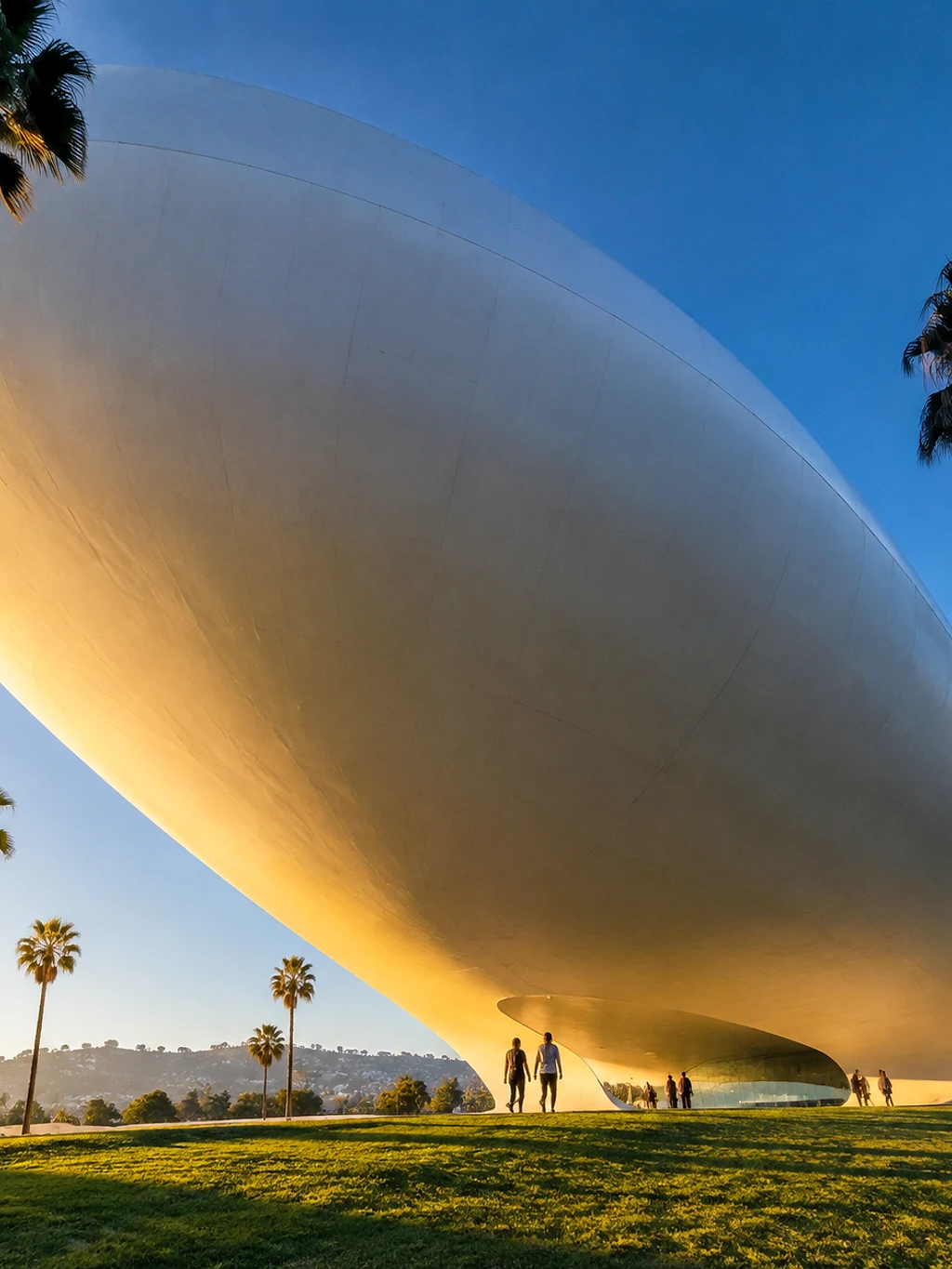
From outside, it resembles a white spaceship parked on the ground.
Once you walk in, the feeling changes again.
Inside it is more like a film set dressed up to look like a museum.
The galleries have screens playing digital versions of famous works held elsewhere.
There is an ancient Roman column, there is a painting from a church ceiling, and there are pieces from the Louvre.
There are also two halls for watching films, where you can sit down for a documentary or an old picture.
The entrance hall is called the portal, and there is not a single right angle in it.
But the most popular part of the whole museum is probably somewhere else.
A lot of people come specifically to see this one section.
Seven per cent of the gallery space is given to Star Wars.
What is in there are the props actually used at the time: the landspeeder, the podracer, costumes, a robot.
The other galleries hold things that do not usually get into an art museum.
Illustrations from children's books, and comics, are all in there.
Lucas and his wife call these pictures that tell a story.
Though you might wonder: which picture is not telling a story?
The museum's road here was not a smooth one.
Lucas first wanted to build it in San Francisco, and local people objected.
He then switched to Chicago, and was blocked again over the design and over taking up park land.
So it ended up in Los Angeles.
What is interesting is that the museum has kept one gallery specially for the two designs that never got built.
This is at least partly addressed to the people who objected back then: you missed out on the jobs, and on the visitors.
The criticism concentrates on one very specific thing.
There is almost no explanatory text on the walls.
You can see the picture; you cannot see any words.
You look at a painting but do not know who painted it, or why it deserves to hang here.
The museum's answer is direct.
The head of the museum says this is what Lucas insisted on.
He wants you looking at that picture, not at the history lesson beside it.
The trouble is that the people who most need the explanation are exactly the ones he says he wants to bring in — those who do not know art history.
There is one more detail worth recording.
The museum's director and the person who chose the works both left last year.
The person actually choosing the works now is Lucas himself.
An art history teacher has a judgement about museums like this.
She says: this kind of museum is both extremely selfish and extremely public.
Which side weighs more will take many years to know.
And the answer depends to a large degree on what it becomes once the founder is gone.
In the end, Lucas's reason for doing this is perfectly clear.
He believes illustration is simply pictures made for ordinary people, requiring no special knowledge and no one to explain it.
That sentence is both his reason for building the museum and precisely the thing he is criticised for.
So whether this museum is good depends on what you want to get out of it.
Now put yourself in it.
There is a painter you love.
You make a special trip to a museum to see his work.
They tell you: we have it, but it is not hung today.
What would you do?
Listen again
Try it without the transcript and notice what sounds clearer.
What vocabulary does this episode teach?
词汇HSK 3. 算不上真正的艺术 — the sentence that put Rockwell in storage.
HSK 3. 普通美国人的日子 — and at the end, 给普通人看的画. The word closes the loop.
HSK 3. 当地人反对 — what San Francisco and Chicago did, and what the museum now answers back to.
HSK 3. 批评的话主要集中在一件很具体的事上 — the episode names the complaint precisely rather than gesturing at it.
HSK 3. 不需要谁来解释 — Lucas's position, and the exact thing critics say the museum fails at.
HSK 3. 不需要专门的知识 — the democratic claim the whole building rests on.
插画的位置一直很尴尬 — a whole category's standing, stated in one clause.
常年被放在库房里 — where art goes when a museum decides it is not fine art.
展厅面积的百分之七 — the percentage is how the museum's real centre of gravity is measured.
当年真正用过的道具 — 真正用过 is what separates a museum from a gift shop.
那两个没能做成的方案 — displayed on purpose, which makes the gallery an argument.
又非常自私,又非常公共 — the art historian refuses to resolve the contradiction, and so does the episode.
* beyond level超纲词
What grammar patterns appear in this episode?
语法换成别人,……
Had it been anyone else… Introduces a counterfactual comparison to show that what follows depends entirely on who the person is.
换成别人,这只是一句气话。
但他是卢卡斯,拍《星球大战》的那个人。
问题在于,最……的,恰恰是……
The trouble is that the most X are precisely Y. Names an irony by putting the superlative and the identification in the same sentence.
问题在于,最需要说明的,恰恰是他想请进来的那批不懂艺术史的人。
既是……,也正好是……
It is both X and, as it happens, exactly Y. Used to show that a strength and a weakness are the same fact seen twice.
这句话既是他建馆的理由,也正好是他被批评的地方。
Proper nouns
专有名词Free account
Keep learning from this story
Create a free account to keep saved words and your preferred level together.
- Keep words with their story context
- Remember your preferred level
- Build your vocabulary over time