
A Chinese podcast · Same story, 4 levels
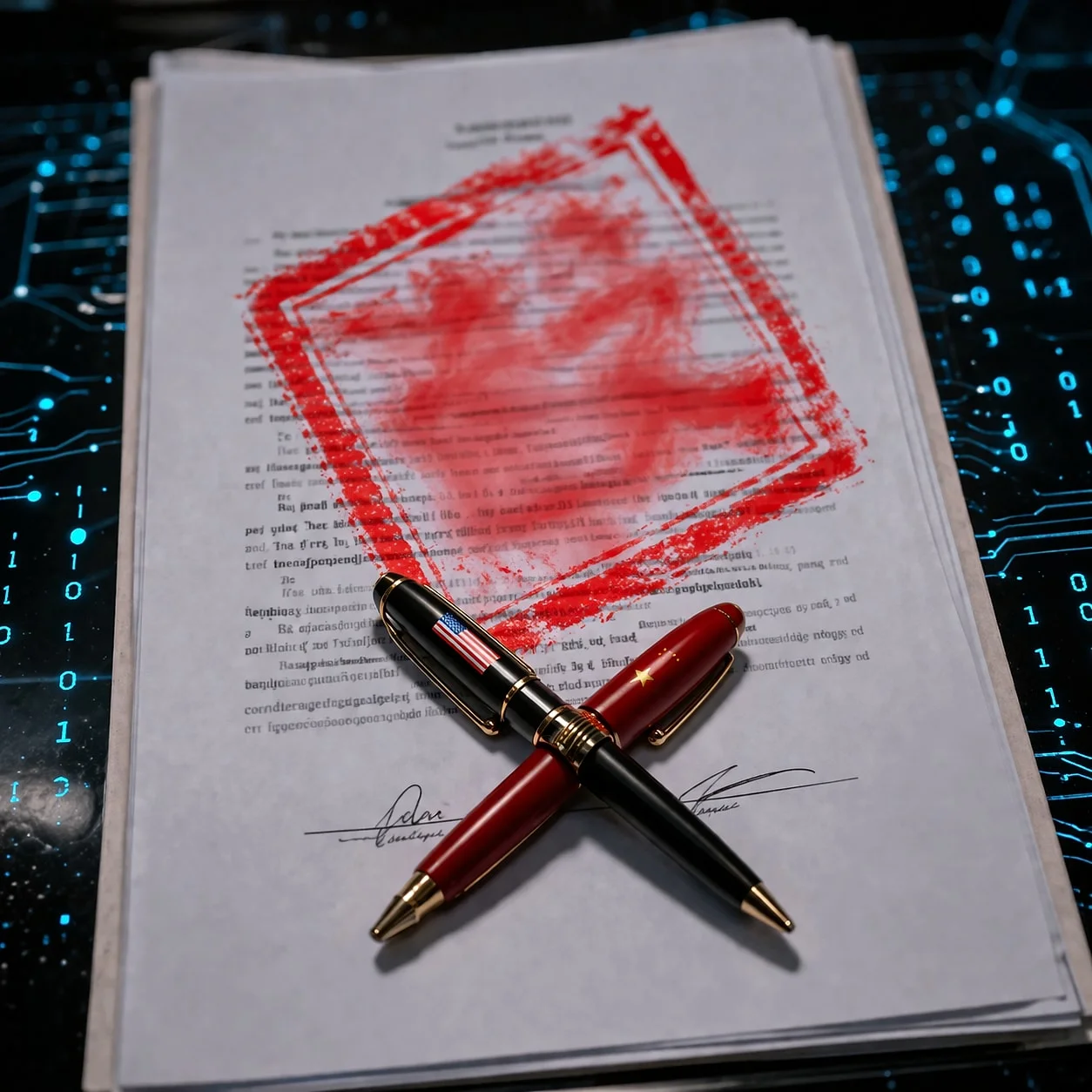
Manus事件:中国突然出手停了一笔大生意
China Blocks Meta's $2B Manus Deal
About this story
China steps in and stops Meta's 2-billion-dollar deal to buy AI-agent startup Manus, citing national security. HSK 3 Chinese listening practice.
This is an HSK 3-4 Chinese listening episode that runs about 9 minutes. The full Mandarin script is shown with tap-for-pinyin and a line-by-line English translation, so you can listen and read at once — comprehensible input in the sense of Stephen Krashen's i+1 theory. It teaches 17 key vocabulary words such as 突然、决定、通知 and walks through 7 grammar patterns, each explained in English with examples. The same news story is retold at 4 difficulty levels — use the level selector above to find the version that is challenging but still understandable for you.
Read at your level
原文Read the complete story in Chinese. Reveal pinyin and English only when you need them.
English transcript reference
Speaking of today's most surprising tech-world news — China suddenly stepped in and stopped Meta's big deal to acquire Manus.
Let's go through it step by step.
Today is April 27th.
Just today, a department of the Chinese government issued a notice.
This department is the "National Development and Reform Commission," or NDRC for short.
What did the NDRC say?
It said: Meta's plan to buy Manus — not allowed.
Cannot buy, cannot sell.
Both sides have to withdraw the deal.
"Withdraw" means: treat it as if it never happened.
So what kind of deal was this?
Why is it such a big deal?
Let me first talk about Manus the company.
Manus is an AI company.
But not an ordinary AI company.
What they make is called an "AI 代理," or AI agent in English.
What is an AI agent?
Let me give you an analogy.
A regular AI is like an encyclopedia.
You ask it a question, it answers.
Whatever you say, it answers that.
But an AI agent is different.
An AI agent is more like an actual assistant.
You give it one big task.
It figures out how to do it on its own.
Then step by step, it completes the task.
Finally it tells you the result.
For example, suppose you want to do a market analysis.
You say: "Help me look at how the Chinese EV market has done over the past year."
A regular AI would give you some information, but you'd still have to organize it yourself.
An AI agent?
It goes online by itself, finds all kinds of data.
It reads various reports by itself.
It writes a report for you by itself.
It might even make some charts.
You say one sentence, and it finishes a big task.
That's why AI agents are seen as the next big direction in AI.
That's exactly what Manus does.
And they did it early, and did it well.
They released their first product in March last year.
At the time, most people had never heard of the company.
But everyone who used it said: this is incredible.
Word of mouth got better and better.
"Word of mouth" means what users say to each other.
Slowly, more and more users came.
By the end of last year, Manus's annual revenue had reached one hundred million US dollars.
For a company that had only existed a short time, that's a remarkable result.
So everyone says Manus is "China AI's next DeepSeek."
DeepSeek is another Chinese AI company that became especially famous last year.
That's the background on Manus.
So which country is this company from?
This is where things get complicated.
Manus started in Beijing, China.
The founders are Chinese, and the technology was built in China.
But later, Manus made a decision.
They moved the company to Singapore.
Not just one or two people moved — the whole company moved.
Why move?
Because over the past year or two, the business environment has changed.
What does that mean?
Relations between China and the US are increasingly tense.
The US doesn't want American money invested in Chinese tech companies.
Especially AI companies.
So American investors can't directly give money to Chinese companies.
What to do?
Some Chinese companies came up with a workaround.
They open a new company in Singapore.
Then they say: we're a Singapore company, not a Chinese company.
That way American investors are willing to invest.
This practice is called "新加坡洗" — in English, "Singapore washing."
Wash what?
Wash off the "China" label.
Manus used this approach.
After moving to Singapore, they got money from a US investment firm.
That investment firm is Benchmark, and they gave Manus seventy-five million dollars.
With this money, Manus grew bigger.
Then, an even bigger thing happened.
Last December, Meta announced:
"We're going to acquire Manus."
The price was two billion dollars.
Some reports said 2.5 billion.
Whichever the number, it's an astronomical figure.
What's an "astronomical figure"?
It's something as big as the stars in the sky.
Extremely, extremely large.
What is Meta?
It's one of the largest companies in the world.
Facebook, Instagram, WhatsApp — all theirs.
Why did Meta want to buy Manus?
Because Meta also wants to do AI agents.
Meta thought: rather than build it slowly ourselves, why not just buy a great one outright.
Buy Manus, and you instantly have the technology.
Then put it on Facebook and Instagram.
Let billions of users worldwide use it.
Sounded like a great plan.
But the Chinese government doesn't see it that way.
The Chinese government's view is this:
Manus may now be called a "Singapore company,"
but the technology was built by Chinese people.
The people are Chinese, the knowledge is Chinese.
How can such core technology be allowed to be bought by America?
So in January, China started investigating.
The investigation lasted more than three months.
Today, the result came out.
China said: no.
This decision is very significant.
Why do I say so?
Let me break it down into three points.
First, for Meta, this is a major blow.
Meta spent a lot of time and effort negotiating this deal.
Now they suddenly can't, and the entire two-billion-dollar plan has to be rethought.
More importantly, Meta's broader plan to do AI also needs to be redrawn.
Meta said: everything we did complied with the law.
We hope to discuss it again.
But China is unlikely to change its mind.
Second, for other Chinese companies considering moving to Singapore, this is a warning.
A "warning" means telling you: be careful, don't do this.
In the past, "Singapore washing" was a popular tactic.
Many Chinese companies were doing it.
But starting today, that tactic may no longer work.
The Chinese government's message is clear:
You want to take foreign money — fine.
But ask me first.
If I agree, you can take it.
If I don't agree, you can't.
This is essentially closing a door.
Third, for the US-China tech rivalry, this is a new round.
A "round" means a stage.
Both sides are making moves.
Previously, the US moved first.
The US said: American money can't invest in Chinese AI.
Some Chinese companies moved to Singapore as a response to that move.
Now, China is countering.
China is saying: technology can't be sold to America.
Moving to Singapore won't help either.
So the tech rivalry between the two sides is getting more tense.
What does this mean for ordinary people like us?
Honestly, in the short term, the impact isn't big.
The AI we use is still the same AI.
The products that work still work.
But in the long term, this will affect the direction of AI's development.
China may further close its doors and build AI on its own.
The US will also further close its doors and build AI on its own.
The two sides' technologies will diverge and stop interacting.
For AI's overall development, this may not be good.
Because the best state for science and technology is everyone working together and learning from each other.
But competition between countries is making this kind of cooperation harder and harder.
Finally, a word about timing.
China is set to meet with the US president in mid-May.
The two leaders will hold talks in Beijing.
Right before that meeting, China made this move.
This timing surely isn't a coincidence.
"Coincidence" means no reason — things just happen at the same time.
In other words, China deliberately chose this moment.
It's a message for the US.
Telling the US: in this meeting, we have our own positions.
It's not just whatever you say.
So this isn't just a business deal.
It's a major showdown between two great powers — China and the US.
That's it for today.
April 27th — China stepped in and stopped Meta from buying Manus.
Let's keep watching to see how this develops.
Listen again
Try it without the transcript and notice what sounds clearer.
What vocabulary does this episode teach?
词汇HSK 3. 突然出手 = suddenly stepped in. Adverb. Conveys unexpected, abrupt action.
HSK 3. Both verb and noun. 这个决定意义很大 = the significance of this decision is huge.
HSK 4 but glossed inline. The NDRC issued a 通知. Also used in everyday life: 一个通知 = a notice.
HSK 4. 调查这件事 = investigate this matter. Both noun and verb. The episode highlights China's three-month 调查.
HSK 4. 核心技术 = core technology — the key concept of why China cares about this deal.
HSK 5 but very common. 投资人 = investor. 投资公司 = investment firm. The episode discusses US investments in Chinese AI.
HSK 5. Used here in the political/strategic sense — a 'signal' the government is sending.
HSK 2. 这个决定很重要. The episode keeps emphasizing the importance of the move.
HSK 4. 改变想法 = change one's mind. 不会改变 = won't change. Both verb and noun.
HSK 3. 影响AI的发展方向 = affect the direction of AI's development.
HSK 6 but central to the episode. 收 (collect) + 购 (purchase). Specifically used for buying out a whole company.
Idiomatic. Lit. 'put out the hand.' Used metaphorically: 中国出手 = China made a move/stepped in. Also used for selling: 出手 a stock.
Compound. 市场 (market) + 分析 (analyze). The episode uses this as an example of what an AI agent can do.
Lit. 'mouth-monument.' Refers to user-to-user word of mouth. Glossed inline in the episode. Common in marketing.
Idiom. 天文 (astronomy) + 数字 (number). Used for sums of money so large they're 'like the stars.' Glossed inline.
HSK 5. Both verb and noun. 一个警告 = a warning. Glossed inline as 'telling you to be careful.'
Originally from chess/wrestling: one 回合 = one round. Used for negotiations, geopolitical exchanges. Glossed inline.
* beyond level超纲词
What grammar patterns appear in this episode?
语法把 + Object + Verb + Result
Disposal construction. Frontloads the object so the verb can carry a clear result/disposal. Required when the verb has a quantitative or directional outcome.
把Meta收购Manus的这笔大生意给停了。
两边都要把这笔生意撤回来。
买了Manus,就有这个技术了。
X 是 ... 的地方 (relative clause with 的)
Common spoken construction for 'X is the place where ...' or 'X is the where-of...' Used to define or identify.
这就是事情复杂的地方。
公司就是很多人一起做事的地方。
对 X 来说 (from X's perspective)
Topicalizer. 'For X, ...' or 'From X's point of view, ...' Pivots the discussion to whose situation we're examining.
对Meta来说,是一个大打击。
对其他想搬到新加坡的中国公司来说,这是一个警告。
对一家成立时间不长的公司来说,这是非常厉害的成绩。
因为 ... 所以 ... (because ... therefore ...)
Cause-effect connector. Either half can be omitted in spoken Chinese, but the full pair is the textbook form.
因为Meta也想做AI代理。
所以这件事不只是Manus一家公司的事。
所以两边的科技竞争,越来越紧张。
不只是 ... 还是 / 也是 ... (not just X, also Y)
Builds toward emphasis. 'X isn't only Y, it's also Z.' Stronger and broader than just listing.
AI不只是技术。AI也是国家和国家之间的事。
不只是Manus一家公司的事。是所有中国AI公司都要面对的事。
不只是一笔生意的事。是中美两个大国之间,一次重要的较量。
越来越 + Adj/Verb
'More and more X.' Marks progressive change.
中国和美国的关系越来越紧张。
用户越来越多。
越来越紧张。
X 简称 Y (X, abbreviated as Y)
Used to introduce an abbreviation right after the full name. Common in news/expository register.
国家发展改革委员会,简称发改委。
Proper Nouns
专有名词Free account
Keep learning from this story
Create a free account to keep saved words and your preferred level together.
- Keep words with their story context
- Remember your preferred level
- Build your vocabulary over time