
A Chinese podcast · Same story, 4 levels
麻省理工做出了一块可以吞下去的电池:它在猪的身体里工作了三天,然后自己化掉了
MIT Built a Battery You Can Swallow. It Powered a Device Inside a Pig for Three Days, Then Dissolved.
About this story
Swallowing a battery is one of the things every child is warned about. On 21 September 2026 a team led by Giovanni Traverso at MIT published a paper battery designed to be swallowed: magnesium and molybdenum trioxide on paper, wrapped in a cellulose film inspired by the edible rice paper around a sweet. It delivers about 1.84 V — more than a household AA — occupies a quarter of a capsule, and powered both a signal tag and a gastric stimulator inside pigs for three days before dissolving. One caution from outside the study: degrading is not the same as disappearing. Chinese listening practice at four levels. HSK 2 Chinese listening practice.
This is an HSK 2 Chinese listening episode that runs about 4 minutes. The full Mandarin script is shown with tap-for-pinyin and a line-by-line English translation, so you can listen and read at once — comprehensible input in the sense of Stephen Krashen's i+1 theory. It teaches 12 key vocabulary words such as 医生、医院、身体 and walks through 3 grammar patterns, each explained in English with examples. The same news story is retold at 4 difficulty levels — use the level selector above to find the version that is challenging but still understandable for you.
Read at your level
原文Read the complete story in Chinese. Reveal pinyin and English only when you need them.
English transcript reference
Let's start with something everyone was told as a child.
You cannot eat a battery.
If a small child swallows a battery, the adults have to rush them to hospital straight away.
Because there are very harmful things inside a battery.
But now a group of doctors has made a battery you can eat.
And they really did feed it to pigs.
Why would anyone want to eat a battery?
To answer that, we have to start from a different problem.
Doctors want to see what your body looks like inside.
The old way was to go to hospital and look with a very big machine.
Later, people came up with a new way.
Make a very small machine and put it inside something shaped like a pill.
You swallow it, it looks as it travels, and in the end it comes out by itself.
This kind of small machine already exists.
The problem is that it needs electricity.
Needing electricity means needing a battery.
But a battery must not touch the body.
So the old approach was to wrap the battery very tightly so it never touches you.
Most of the time this is fine.
But sometimes that outer layer fails.
And sometimes the whole thing gets stuck inside the body and cannot come out.
So the best answer is a battery that was never going to hurt anyone in the first place.
On the twenty-first of September this year, a group of doctors at MIT in America published how they did it.
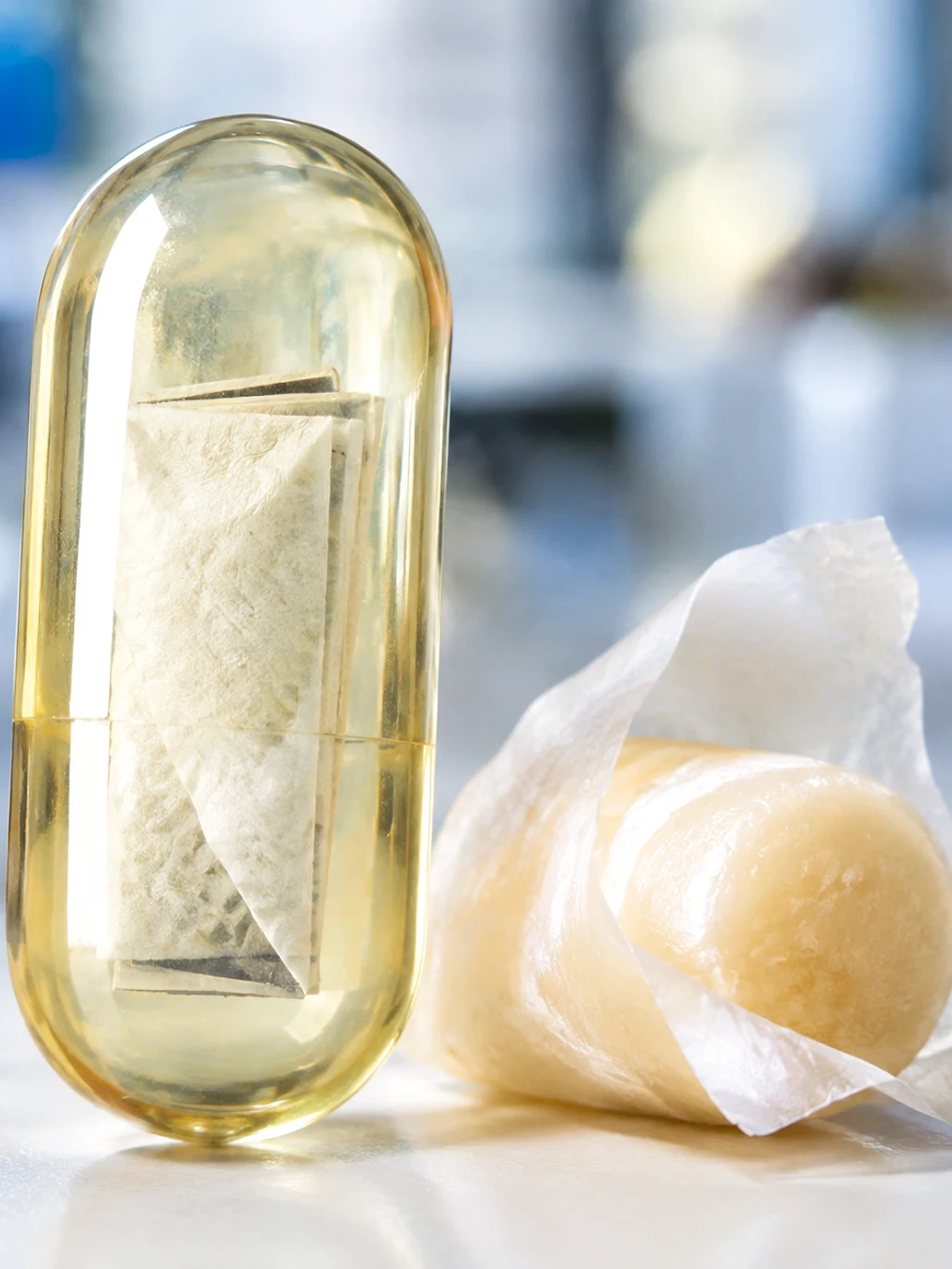
The battery they made is made of paper.
Inside is magnesium, a metal the human body already contains a little of.
The outside is wrapped in a layer that holds off the water in your stomach.
The idea came from sweets.
Some sweets have a thin sheet of paper on the outside that you can eat along with them.
That outer layer on the battery means the same thing.
How big is this battery?
It takes up only a quarter of an ordinary pill capsule.
The rest of the space can hold a machine, or medicine.
And how much electricity?
One point eight four volts — a little more than an ordinary household battery.
They put the battery together with a small machine and had a pig swallow it.
People outside the pig's body really did receive the signal the machine sent out.
They ran a second experiment too.
They had the battery drive a machine that delivers electricity inside the pig's stomach.
The pig's body responded, exactly as the doctors expected.
Last comes the timing.
The battery worked inside the pig for about three days.
After three days the water in the stomach got in, and the battery began to break down and dissolve.
That is precisely what they wanted.
But one doctor who was not part of this research said something important.
He said: something dissolving is not the same as something being gone.
We still need to know what it dissolves into, how much of it the body takes in, and whether it makes anyone unwell.
Especially when a patient has to swallow one again and again.
So this is still early.
But the direction is clear.
Now have a think.
A doctor hands you a pill and says there is a battery inside it that will dissolve after three days.
Do you swallow it?
Listen again
Try it without the transcript and notice what sounds clearer.
What vocabulary does this episode teach?
词汇HSK 1. 有一群医生做出了一个可以吃的电池 — note 一群, the measure phrase for a team.
HSK 1. Appears twice for opposite reasons: where you rush a child who swallowed one, and where the old machines are.
HSK 2. 电池不能进身体 — the constraint the entire design works around.
HSK 2. 像药一样的小东西 — and at the end the pill is what contains the battery.
HSK 2. 问题是,它要用电 — the pivot of the episode.
HSK 1. 有的时候,外面那层坏了 — the failure mode stated as an occasion rather than a statistic.
The subject, and the word the first line forbids you to eat.
人身体里本来就有一点 — that sentence is why the whole thing is plausible.
Used to place 镁 in a category the listener already has.
挡住胃里的水 — the coating has exactly one job.
真的收到了机器发出来的信号 — the proof that the power reached the device.
HSK 3. 没有参加这个研究的医生 — the episode names who is speaking and whether they were involved.
* beyond level超纲词
What grammar patterns appear in this episode?
语法……就要……
If the first thing is true, the second necessarily follows. Chains of 就要 are how the episode walks from "it needs power" to "and there lies the problem".
用电就要有电池。
一边……一边……
Doing two things at once. Here it describes a capsule travelling and photographing simultaneously.
它一边走一边看,最后自己出来。
不等于……
X is not the same thing as Y. The plainest way in Chinese to refuse a conclusion someone has jumped to.
他说:东西化了,不等于东西没了。
Proper nouns
专有名词Free account
Keep learning from this story
Create a free account to keep saved words and your preferred level together.
- Keep words with their story context
- Remember your preferred level
- Build your vocabulary over time