
A Chinese podcast · Same story, 4 levels
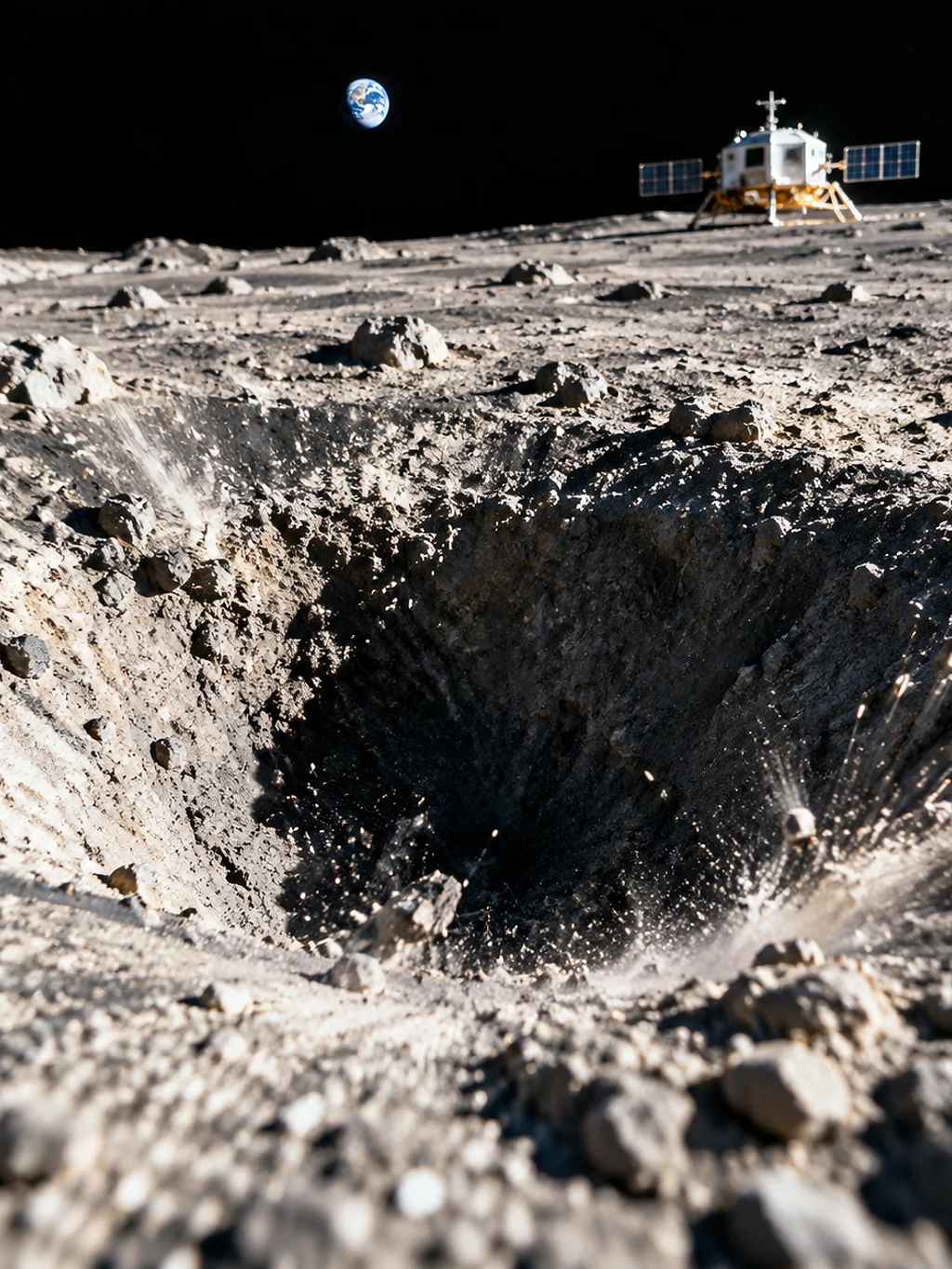
美国航天局发现月球多年来最大的新坑:未来的月球基地要小心了
NASA Spots the Moon's Biggest New Crater in Years — a Warning for Future Moon Bases
About this story
NASA's Lunar Reconnaissance Orbiter has found the largest fresh crater seen on the Moon since at least 2009: McGetchin crater, 222 meters wide, punched in spring 2024 by an object only 9 to 21 meters across. Impacts that big come about once every 132 years, but with the US and China planning bases at the lunar south pole in the 2030s, the crater's 100-kilometer spray of debris shows why small, hard-to-spot rocks are a real risk. Chinese listening practice at four levels. HSK 5-6 Chinese listening practice.
This is an HSK 5-6 Chinese listening episode that runs about 5 minutes. The full Mandarin script is shown with tap-for-pinyin and a line-by-line English translation, so you can listen and read at once — comprehensible input in the sense of Stephen Krashen's i+1 theory. It teaches 12 key vocabulary words such as 速度、规模、注意 and walks through 3 grammar patterns, each explained in English with examples. The same news story is retold at 4 difficulty levels — use the level selector above to find the version that is challenging but still understandable for you.
Read at your level
原文Read the complete story in Chinese. Reveal pinyin and English only when you need them.
English transcript reference
In many people's imagination, the moon is a silvery, silent world.
In reality, it's more like a war zone.
Asteroids and comet fragments keep slamming into it, leaving fresh scars beside the ancient craters.
This week NASA announced it had found the largest fresh impact crater seen on the moon since at least 2009.
The crater is about 222 meters wide — more than twice the length of an American football field.
A planetary geophysicist at the University of Maryland described it as a monster of a crater, at least in modern times.
It was found by NASA's Lunar Reconnaissance Orbiter.
The probe has circled the moon for more than ten years, taking a vast number of photos.
Going through those photos, scientists noticed a crater they had never seen before.
The crater was first spotted in October 2025.
By comparing satellite images from before and after the impact, they narrowed its timing to between April 11 and May 22, 2024.
The object that struck the moon was roughly nine to twenty-one meters across.
It hit the lunar surface at tremendous speed, instantly giving off a dazzling flash.
The energy released in that moment was equal to fifteen thousand five hundred tons of explosives.
The crater was named McGetchin crater, in honor of lunar scientist Tom McGetchin.
It sits at the edge of the Sea of Crises, a plain of frozen lava more than five hundred kilometers long on the moon's eastern side.
The two studies behind the finding were published this week in the journal Science Advances.
By their estimate, an impact of this size happens on average only once every 132 years.
If it's that rare, why does it deserve attention?
Because the United States and China are racing to see who can put astronauts back on the moon first.
If the plans hold, by the 2030s the lunar south pole could have several nuclear-powered bases.
Astronauts would stay there for several weeks, or even several months.
That makes an old question very real: how often does the moon actually get hit?
Earth, too, is constantly bombarded by asteroids and comet fragments.
But the atmosphere slows them down and burns up objects smaller than about nine meters across.
If a bigger object explodes in midair, the shock wave can hurt people and buildings nearby.
The moon has almost no atmosphere, so it is defenseless against visitors of every size.
Spent rocket boosters sometimes fall onto its surface, and space rocks crash down all the time.
Satellites in lunar orbit, telescopes on Earth, even the astronauts of Artemis II have seen brief flashes of light on the moon's surface.
Based on those observations, scientists estimate that objects the size of monster-truck tires blast out around 140 nine-meter craters on the moon each year.
These objects can travel at tens of thousands, or even hundreds of thousands, of kilometers an hour.
The odds of a base being hit by such an object on any given day are low; the odds of a bigger hit are lower still — but not zero.
A physicist who studies impacts at the University of New Mexico said he absolutely thinks this is a significant risk to long-term operations on the moon.
And this new crater reveals something even more unsettling.
An asteroid doesn't need to hit a base directly to cause a catastrophe.
In an impact, rocks of all sizes are thrown out, and when they land they gouge out craters of their own.
The researchers found that most of the debris landed near the crater's rim.
But around the crater there are also splattered streaks, like an ink-splash painting, reaching more than a hundred kilometers away.
In other words, ground far from the impact site was also left badly battered.
Worse, small objects under a few tens of meters are very hard to detect in advance.
That means missions designed to deflect an asteroid or smash it apart might not be able to launch in time.
Put another way, if a moon base sits in the path of a small rock, it may well have no way to dodge it.
That physicist's conclusion is simple: the risk from small stuff is very real.
If humans want to live on the moon for the long haul, they'll have to factor in rocks that could fall from above at any moment.
If you were in charge of designing the first moon base, would you build it underground, or find another way?
Listen again
Try it without the transcript and notice what sounds clearer.
What vocabulary does this episode teach?
词汇HSK 4. 它以极高的速度撞上月面。
HSK 4. 这种规模的撞击,平均每一百三十二年才会发生一次。
HSK 2. 注意到一个过去从没见过的坑.
HSK 3. 如果计划不变 — the conditional the whole risk rests on.
HSK 3. 相关的两篇研究,本周发表在学术期刊上。
HSK 3. 地球其实也一直在被小行星和彗星碎片袭击.
The technical term: 撞击 (impact) + 坑 (pit).
大气层会让它们减速 — and burns up objects under about nine meters.
既然这么罕见,为什么它值得关注? — the pivot of the episode.
概率很低……可不是零 — how scientists talk about rare risks.
小行星不需要直接击中基地,也能造成灾难。
这个新坑,还揭示了另一件更让人不安的事 — the debris finding.
* beyond level超纲词
What grammar patterns appear in this episode?
语法以……
Formal "in order to / in honor of" and "at (a speed)": 以纪念… / 以极高的速度…
这个坑被命名为麦克格钦坑,以纪念月球科学家汤姆·麦克格钦。
它以极高的速度撞上月面。
……,更……的是……
Escalates to the bigger problem: what's worse is…
更麻烦的是,几十米以下的小天体,很难提前被发现。
换句话说
In other words — restates a technical point plainly.
换句话说,如果一座月球基地正好在一颗小石头的路线上,它很可能躲不过去。
Proper Nouns
专有名词Free account
Keep learning from this story
Create a free account to keep saved words and your preferred level together.
- Keep words with their story context
- Remember your preferred level
- Build your vocabulary over time