
A Chinese podcast · Same story, 4 levels
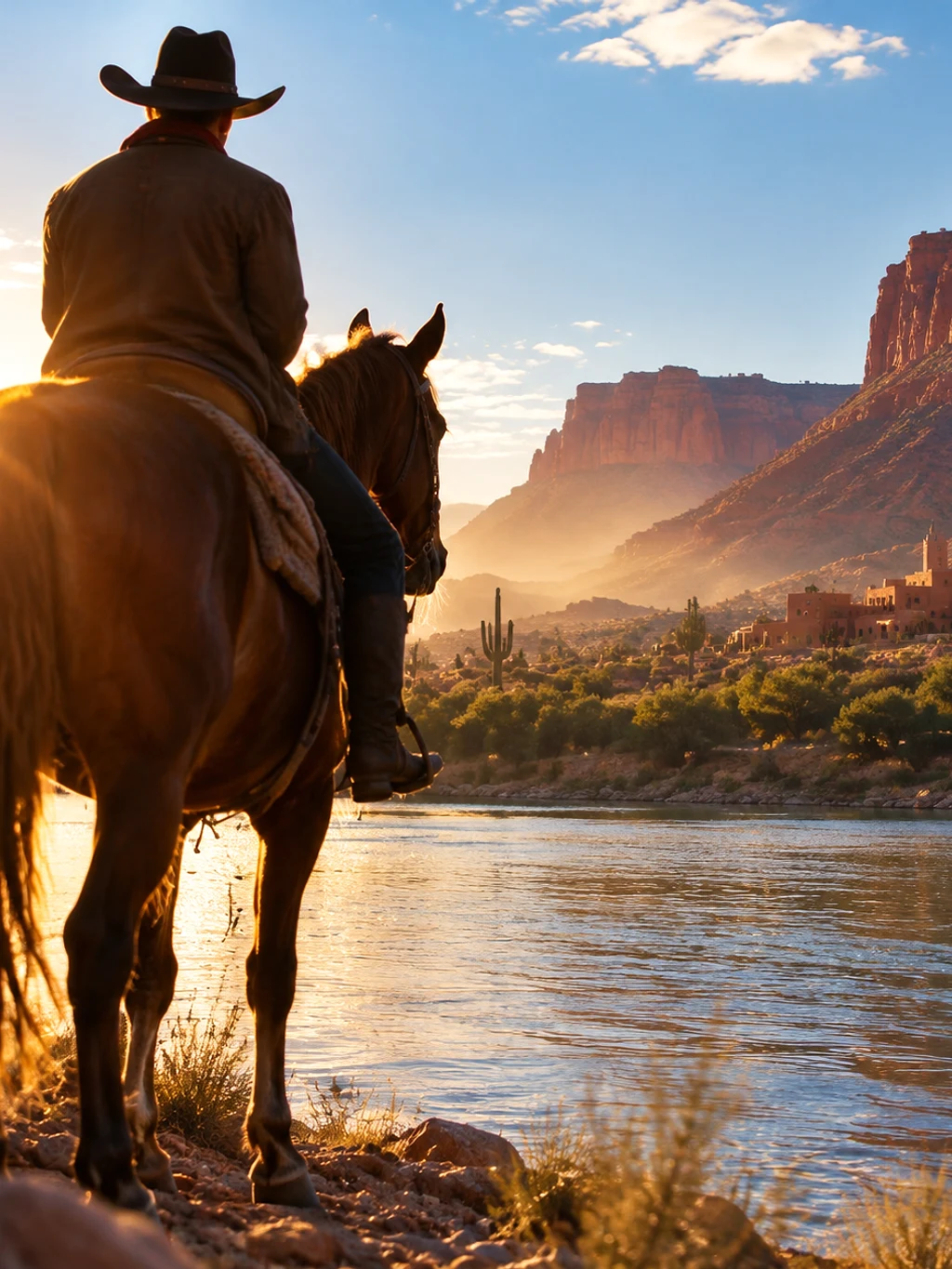
《荒野大镖客二》地图上那块过不去的墨西哥,一个玩家用二十二个月自己补上了,九月十六号免费发布
RDR2 Fan Rebuilds Mexico and Releases It Free
About this story
Red Dead Redemption 2 shipped with Mexico visible across the river and permanently out of reach — terrain half-built, never opened. A single player started rebuilding it in April 2024 and, after twenty-two months of largely solo work, releases it free on 16 September 2026. Chinese listening practice at four levels. HSK 5+ Chinese listening practice.
This is an HSK 5+ Chinese listening episode that runs about 5 minutes. The full Mandarin script is shown with tap-for-pinyin and a line-by-line English translation, so you can listen and read at once — comprehensible input in the sense of Stephen Krashen's i+1 theory. It teaches 12 key vocabulary words such as 密度、结构、逻辑 and walks through 3 grammar patterns, each explained in English with examples. The same news story is retold at 4 difficulty levels — use the level selector above to find the version that is challenging but still understandable for you.
Read at your level
原文Read the complete story in Chinese. Reveal pinyin and English only when you need them.
English transcript reference
This episode is about a small item from the games industry, but the question it touches is not small at all: some things everybody wants, and no party has a reason to build.
Let me set out the subject.
Red Dead Redemption 2 is an open-world game released in 2018, set in the American West around 1900.
The scale and detail density of its map were a step change at the time, and it is still used as an industry reference today.
But that map has a gap that has been discussed for years.
The region at the far southern end, across the river, is Mexico; in-game it is called Nuevo Paraiso.
It is visible.
Stand on the southern ridge and look down: the terrain, the buildings, the light on the far bank are all rendered there.
It is not reachable.
The moment a player tries to ford the river, the game returns you to the north bank one way or another.
Players' fixation on this has a specific source.
In the 2010 predecessor, Mexico was a fully playable region, and is widely regarded as the emotional high point of that game.
So when the sequel shipped, the return of Mexico was very nearly the default expectation.
Players later confirmed by various means that the developer had in fact built a substantial part of that terrain, but never completed it and never opened it.
What was left on the map was a shell: geometry with no content.
The developer is a company of several thousand people; funding, tool chain and technical depth are none of them obstacles.
And yet from 2018 to today, the region has never been filled in.
This is not hard to understand, and I will come back to it.
First, the other thread.
In April 2024, one player began doing this himself.
He is not an employee of the company, and he is not attached to any studio.
The project takes its name from the in-game place name: Nuevo Paraiso.
The magnitude of this work is worth unpacking.
Terrain is only the bottom layer.
Above the terrain you need a traversable road network, building interiors you can enter, non-player characters with behavioural logic, voice work and dialogue, and a triggerable mission structure.
More intractable than any of these is the seam problem.
The new region must join the existing map seamlessly in geometry, lighting, weather system and streaming logic, so that a player riding across the boundary perceives no break.
There is a further constraint of timeline: the second game is set before the first, so this Mexico has to be presented as an earlier version of itself, not lifted wholesale from the predecessor's assets.
Any one of the above would occupy a small team for a considerable stretch.
He worked on it for twenty-two months.
In early September this year the project announced completion, with a release date of 16 September.
The release is free.
The full version, open to anyone who owns the base game, with no time limit and no in-app purchases.
That ends the factual part.
What follows is the part I think is more worth discussing.
News like this is easily written up as "one person pulled off what a big company would not", but that frame is wrong, and it makes people miss the actual mechanism.
The difference is not ability, and it is not sincerity. It is that the two parties are answering different questions.
The company has to answer: does directing engineering resources at this region produce a marginal return higher than directing them elsewhere?
By that standard the answer points fairly clearly to no.
This content cannot be sold on its own, its effect on base-game sales is hard to quantify, and the work it requires is entirely real.
Worse is the opportunity cost: the same labour put into the next title has a far clearer path to return.
So the decision is coherent inside commercial logic, and arguably correct.
The player was answering a completely different question: does he want to ride his horse across that river?
He does not need to calculate a return, because the thing he wanted is the output itself, and the process counts as part of the payoff.
This is why things that "plenty of people genuinely want but that do not pencil out" are so often finished by individuals rather than by the organisations best equipped to finish them.
One realistic note is needed: projects like this sit on unstable legal ground, and whether it survives depends on the rights holder's attitude.
But even if it is taken down, it has already proved one thing — that terrain was never impossible to build. Nobody simply had a reason to build it.
Two questions to leave you with.
The first is concrete: that thing you have been waiting for — if you moved to the supplier's side of the table and did the arithmetic, would it return anything?
The second is bigger: whether something is worth doing and whether it pays are two different judgements.
When they give opposite answers, who does it?
Listen again
Try it without the transcript and notice what sounds clearer.
What vocabulary does this episode teach?
词汇HSK 6. 地图规模与细节密度在当时是断层式的。
HSK 5. 需要可触发的任务结构 — and later, the structure of the decision itself.
HSK 6. 这个决定在商业逻辑内是成立的,甚至可以说是正确的。
HSK 5. 把工程资源投向这块区域 — the question the company actually faced.
HSK 3. 由最有能力完成它的组织完成 — and it was not.
HSK 4. 取决于版权方的态度 — the one thing the project cannot control.
The genre, and the reason an unreachable region is such an offence.
河对岸的地形、建筑、光照,全都渲染在那里 — it is drawn, just not enterable.
One layer above terrain: characters with behavioural logic, voice and dialogue.
The decisive term: the same labour on the next title has a clearer path to return.
What the company had to compute, and what he never had to.
但即使它被下架 — the honest caveat the episode refuses to skip.
* beyond level超纲词
What grammar patterns appear in this episode?
语法这不难理解,我后面会回到这一点
Parks an explanation and promises to return. A structural signpost that lets a talk hold two threads without losing the listener.
这不难理解,我后面会回到这一点。
即使……,也……
Even if X, still Y. Concedes the worst case and then states what survives it — stronger than avoiding the objection.
但即使它被下架,它已经证明了一件事——那块地形不是做不出来,只是没有人有理由去做。
这就是为什么……
This is why. Places the conclusion after the mechanism rather than before it, so the listener arrives at it rather than being told it.
这就是为什么"确实有很多人想要、但算不出回报"的东西,最终常常由个人完成。
Proper nouns
专有名词Sources
来源Free account
Keep learning from this story
Create a free account to keep saved words and your preferred level together.
- Keep words with their story context
- Remember your preferred level
- Build your vocabulary over time