
A Chinese podcast · Same story, 4 levels
《经济学人》的玩笑邮件:一家公司想让员工睡好觉,结果全乱套了
The Economist's Joke Memo: A Company Tries to Fix Its Staff's Sleep, and Everything Goes Wrong
About this story
The Economist's Bartleby column wrote a satirical company memo about a sleep program gone wrong: staff woken at 2 a.m. for "pre-industrial" segmented sleep, bosses' 3 a.m. messages that got everyone up earlier, sleep trackers that made people anxious, and a weighted blanket that needed the fire brigade. The episode says plainly that the memo is a joke — then shows the two real things behind it: historian Roger Ekirch's evidence for "first sleep" and "second sleep", and the 2017 finding that tracker scores can make sleep worse. Chinese listening practice at four levels. HSK 3 Chinese listening practice.
This is an HSK 3-4 Chinese listening episode that runs about 4 minutes. The full Mandarin script is shown with tap-for-pinyin and a line-by-line English translation, so you can listen and read at once — comprehensible input in the sense of Stephen Krashen's i+1 theory. It teaches 12 key vocabulary words such as 适应、压力、相信 and walks through 3 grammar patterns, each explained in English with examples. The same news story is retold at 4 difficulty levels — use the level selector above to find the version that is challenging but still understandable for you.
Read at your level
原文Read the complete story in Chinese. Reveal pinyin and English only when you need them.
English transcript reference
Today's story is a joke, but there are two true things inside it.
Britain's Economist magazine has a column that writes specifically about the workplace.
This week, the columnist wrote a fake internal company email.
The company is made up and so is the email, yet many office workers will find it strangely familiar.
The email opens by saying that a senior executive at the company takes sleep very seriously.
The company believes that when employees sleep well, they perform well.
So the company ran some sleep trials with its team in Canada and its legal department worldwide.
The first trial had volunteers sleep the way people did before the industrial age.
They had to get up at two in the morning, work for two hours, then go back for a second sleep.
It sounds strange, but the history behind it is real.
An American historian found through his research that many people used to sleep in two parts each night.
They'd sleep the first sleep until the middle of the night, wake for about an hour, do a few things, then have a second sleep.
In old diaries and books, he found more than five hundred such records.
Later, as lights in homes and on streets grew brighter, people went to bed later and later.
By about a hundred years ago, the idea of sleeping twice a night had all but disappeared.
Back to the fake company.
Some people adapted to this rhythm; others could never get back to sleep and were too exhausted to speak.
One salesperson slipped into his second sleep during a client meeting, and a big deal was lost just like that.
Even more troublesome was the chain reaction.
Senior managers began sending emails and messages at three a.m., so younger employees who weren't even in the trial had to get up early to reply.
Their early starts then pushed even more colleagues to start work early.
Once you add it all up, sleep quality across the whole company actually went down.
The second trial gave employees all kinds of sleep-tracking devices — rings, wristbands and watches.
One in five colleagues simply couldn't get the devices to work.
Those who could use them were under plenty of stress too.
Many people felt well rested — until the device told them they'd slept terribly the night before.
There's real research on this as well.
In 2017, American sleep doctors published a paper saying some of their patients were exactly like this.
They gave the problem a name, which translates roughly as "perfect-sleep anxiety".
It means that some people care so much about the numbers on their devices that the harder they try to sleep well, the worse they sleep.
In the fake company, the device data also showed the entire leadership team asleep in one meeting.
The company's position: of course that can't possibly be true.
The other small measures had mixed results.
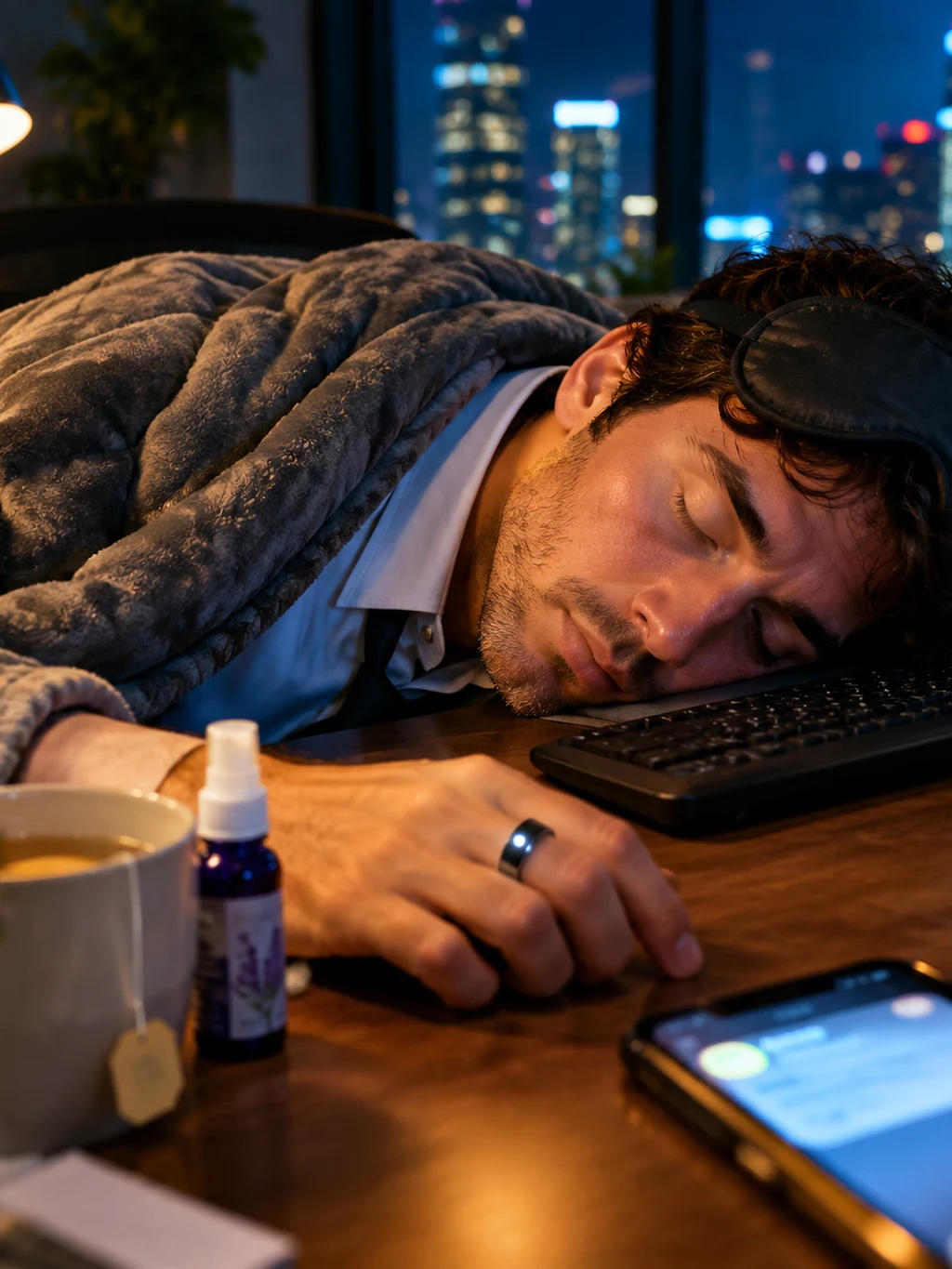
Some people woke up in the night wearing eye masks and thought they'd been kidnapped.
One petite colleague was pinned under a heavy blanket and couldn't get out; in the end the fire brigade rescued her.
A colleague in legal accidentally sprayed himself in the face, went to hospital, and the matter is still in litigation.
So the email said: in future, don't use lawyers in trials.
At the end, the email made a few recommendations.
But before the recommendations, let's look back for a moment.
This email is a joke, but two things in it are true.
One is that people used to sleep twice a night.
The other is that caring too much about sleep numbers can make people sleep worse.
Right, now for the email's recommendations.
Don't force employees to take part in this kind of thing; whoever needs sleep aids can have them.
Tracking employees in the middle of the night is too much of an invasion of privacy.
Making everyone use the same method doesn't work either.
As for whether to roll it out across the whole company, the email's last line was: let's sleep on it.
Do you think a company should have a say in its employees' sleep?
Listen again
Try it without the transcript and notice what sounds clearer.
What vocabulary does this episode teach?
词汇HSK 3. 有些人适应了这种节奏,有些人却再也睡不着。
HSK 3. 能用的人,压力也不小 — the tracker creates new stress.
HSK 2. 公司相信,员工睡得好,工作状态才会好。
HSK 3. 越想睡好,结果越睡不好 — the irony in one line.
HSK 3. 领导们半夜三点开始发邮件、发消息.
HSK 2. 它背后的历史是真的 — the first real fact.
The formal noun: 睡眠质量, 睡眠试验. The everyday verb is 睡觉.
做了一些睡眠试验 — every one of them goes wrong.
HSK 4. 睡眠追踪设备,比如戒指、手环和手表.
Bosses' 3 a.m. messages → juniors up early → everyone up early.
“完美睡眠焦虑” — the 2017 doctors' name for tracker-driven sleep worry.
半夜追踪员工,太侵犯隐私 — the memo's serious point.
* beyond level超纲词
What grammar patterns appear in this episode?
语法越……,越……
The more X, the more Y — perfect for the tracker irony.
意思是,有人太在意设备上的数字,结果越想睡好,越睡不好。
……反而……
On the contrary; the opposite of what was expected happened.
算下来,整个公司的睡眠质量反而下降了。
至于……
As for… — turns to a final, separate question.
至于要不要在全公司推广,邮件的最后一句是:我们还是睡一觉再说吧。
Proper Nouns
专有名词Free account
Keep learning from this story
Create a free account to keep saved words and your preferred level together.
- Keep words with their story context
- Remember your preferred level
- Build your vocabulary over time