
A Chinese podcast · Same story, 4 levels
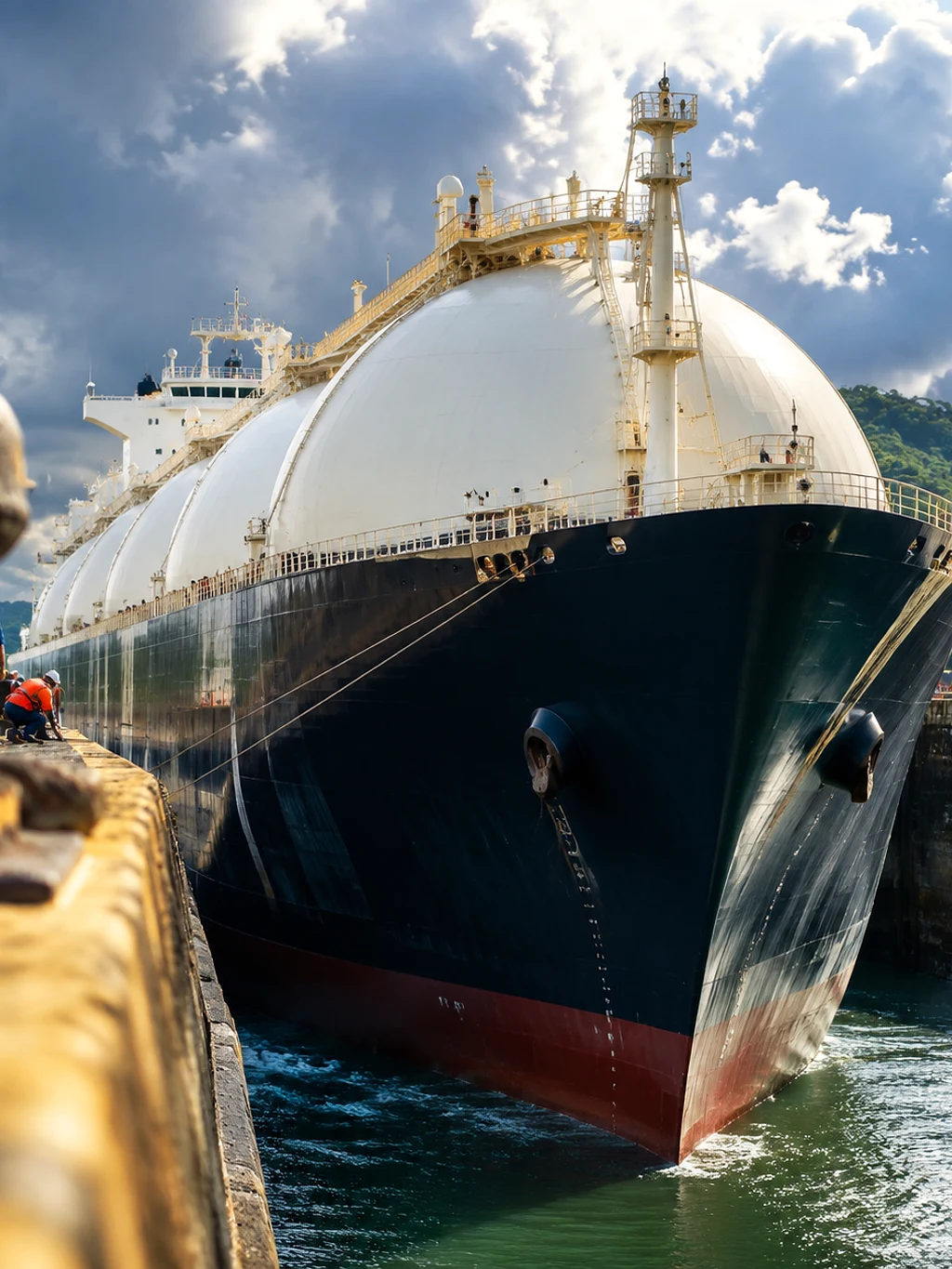
穿过巴拿马运河要花五百万美元:战争和干旱让船票贵到创纪录
Crossing the Panama Canal Now Costs Up to $5 Million, as War and Drought Push Prices to a Record
About this story
Some cargo ships have recently paid up to $5 million to cross the Panama Canal, a record, against an auction average of about $150,000 last winter. Two forces collided: the Iran war rerouted energy, sending Asia-bound LNG tankers from the US Gulf through the canal, while El Niño-linked extreme weather cut daily transits to 32. The canal's locks run on rainwater from Gatún Lake, which also supplies Panamanians' drinking water, and the canal provides 20 cents of every dollar Panama's government takes in. Chinese listening practice at four levels. HSK 5-6 Chinese listening practice.
This is an HSK 5-6 Chinese listening episode that runs about 5 minutes. The full Mandarin script is shown with tap-for-pinyin and a line-by-line English translation, so you can listen and read at once — comprehensible input in the sense of Stephen Krashen's i+1 theory. It teaches 12 key vocabulary words such as 价格、市场、经济 and walks through 3 grammar patterns, each explained in English with examples. The same news story is retold at 4 difficulty levels — use the level selector above to find the version that is challenging but still understandable for you.
Read at your level
原文Read the complete story in Chinese. Reveal pinyin and English only when you need them.
English transcript reference
Five million dollars for a ticket through the Panama Canal.
Recently, some big cargo ships really have paid that much.
In an interview, the canal's new administrator, Ilya Espino de Marotta, said some ships had paid four million or even five million dollars, calling it a record price.
The Panama Canal is about eighty kilometers long, links the Pacific and the Atlantic, and carries nearly six percent of the world's trade.
Oil and liquefied natural gas from the US Gulf Coast, bulk American grain, Chilean wine and Chinese consumer goods bound for big markets like New York all pass through it.
The canal's biggest user is the United States, followed by China.
So how did the price get this high?
First, look at how it charges.
About ninety percent of ships use a reservation system to book transit slots months ahead, with prices usually depending on the type and volume of cargo.
The canal also holds back a few slots to auction off to ships with urgent, last-minute needs.
The starting auction price is a hundred thousand dollars, and this season's average winning bid is about three hundred and eighty thousand.
Between October 2025 and March 2026, the average auction price was only around a hundred and fifty thousand dollars.
This summer, some bids already topped a million dollars.
Espino de Marotta explains that the recent sky-high prices came from ships that had to transit on a specific date and so bid very aggressively.
She says the market sets the price, and if bids of two or three million dollars show up here and there again, she won't be surprised.
The first force pushing prices up is the Iran war.
Since the conflict between the US and Iran escalated this year, global energy routes have been forced to shift.
Shipments from the Middle East to Asia have been disrupted, and Asian demand for LNG from the US Gulf of Mexico has risen as a result.
Peter Sand, chief analyst at an Oslo-based maritime data platform, says the energy shortage is getting worse by the day, especially in Asia.
He points out that gas carriers rarely book canal transits in advance.
Interestingly, after Russia invaded Ukraine in 2022, LNG carriers left the Panama Canal to meet demand from Europe.
Espino de Marotta says that now, because the war has disrupted shipping from the Middle East to Asia, those ships are back.
Earlier this year, canal traffic rose for three or four months, to thirty-eight to forty-one ships a day, from thirty-four to thirty-six before the war.
The second force is the weather.
Recently, the canal authority cut daily transits to thirty-two ships because of extreme weather tied to the El Niño cycle.
That weather is causing serious disruption to global energy markets and coastal infrastructure, and adding further upward pressure on canal prices.
The Panama Canal runs on rainwater.
It has a complex system of locks that lifts ships almost twenty-seven meters above sea level onto a navigable waterway, then lowers them at the other end.
Gatún Lake is the canal's main reservoir, and also the artificial lake ships cross for about thirty kilometers of their transit.
When El Niño brings severe drought, the lake gets shallower, and ships can't pass fully loaded; they have to cut their cargo so they don't run aground.
The canal authority also has to keep enough rainwater in its reservoirs to fill the locks, so it can only cut the number of ships.
Even more crucially, these reservoirs are an important source of drinking water for Panamanians.
José Ramón Icaza, the canal's chairman and Panama's Minister for Canal Affairs, says the lower the lake level, the higher the freshwater surcharge, which ranges from one to six percent of the toll.
The canal publishes a three-month forecast so shipping companies know how deep their ships can sit in the water and how much they'll pay — auctions excepted.
Higher transit costs ripple outward like dominoes, through freight rates and commodities, and finally to the consumer goods ordinary people buy.
For Panama, the canal is practically the nation's lifeline.
Canal business makes up six percent of Panama's economy, and of every dollar the government takes in, twenty cents comes from the canal — more than three billion dollars a year.
The fact that an eighty-kilometer waterway is being pulled around by both war and weather shows just how fragile global trade is today.
If you owned the ship, with a five-million-dollar auction price on one side and penalties for missing your delivery date on the other, which would you choose?
Listen again
Try it without the transcript and notice what sounds clearer.
What vocabulary does this episode teach?
词汇HSK 4. 她称这是创纪录的价格.
HSK 4. 价格由市场决定.
HSK 4. 运河业务占巴拿马经济的百分之六.
HSK 4. 政府每收入一美元,就有二十美分来自运河.
HSK 3. 给运河的价格带来了更大的上涨压力.
HSK 3. 严重干旱 / 严重混乱.
拿出来拍卖,给那些临时有急需的船.
通过预约机制,提前几个月订好通行时段.
全球能源航线被迫调整.
加通湖是运河的主要水库.
沿海基础设施.
这条运河几乎是国家的命脉.
* beyond level超纲词
What grammar patterns appear in this episode?
语法取决于……
Depends on — formal.
大约百分之九十的船,会通过预约机制,提前几个月订好通行时段,价格通常取决于货物的种类和体积。
随之 + verb
Follows as a consequence.
中东运往亚洲的货物受到干扰,亚洲对美国墨西哥湾液化天然气的需求随之上升。
以免……
So as to avoid.
遇到厄尔尼诺带来的严重干旱,湖水变浅,船就不能满载通过,只能减少货物,以免搁浅。
Proper Nouns
专有名词Free account
Keep learning from this story
Create a free account to keep saved words and your preferred level together.
- Keep words with their story context
- Remember your preferred level
- Build your vocabulary over time