
A Chinese podcast · Same story, 4 levels
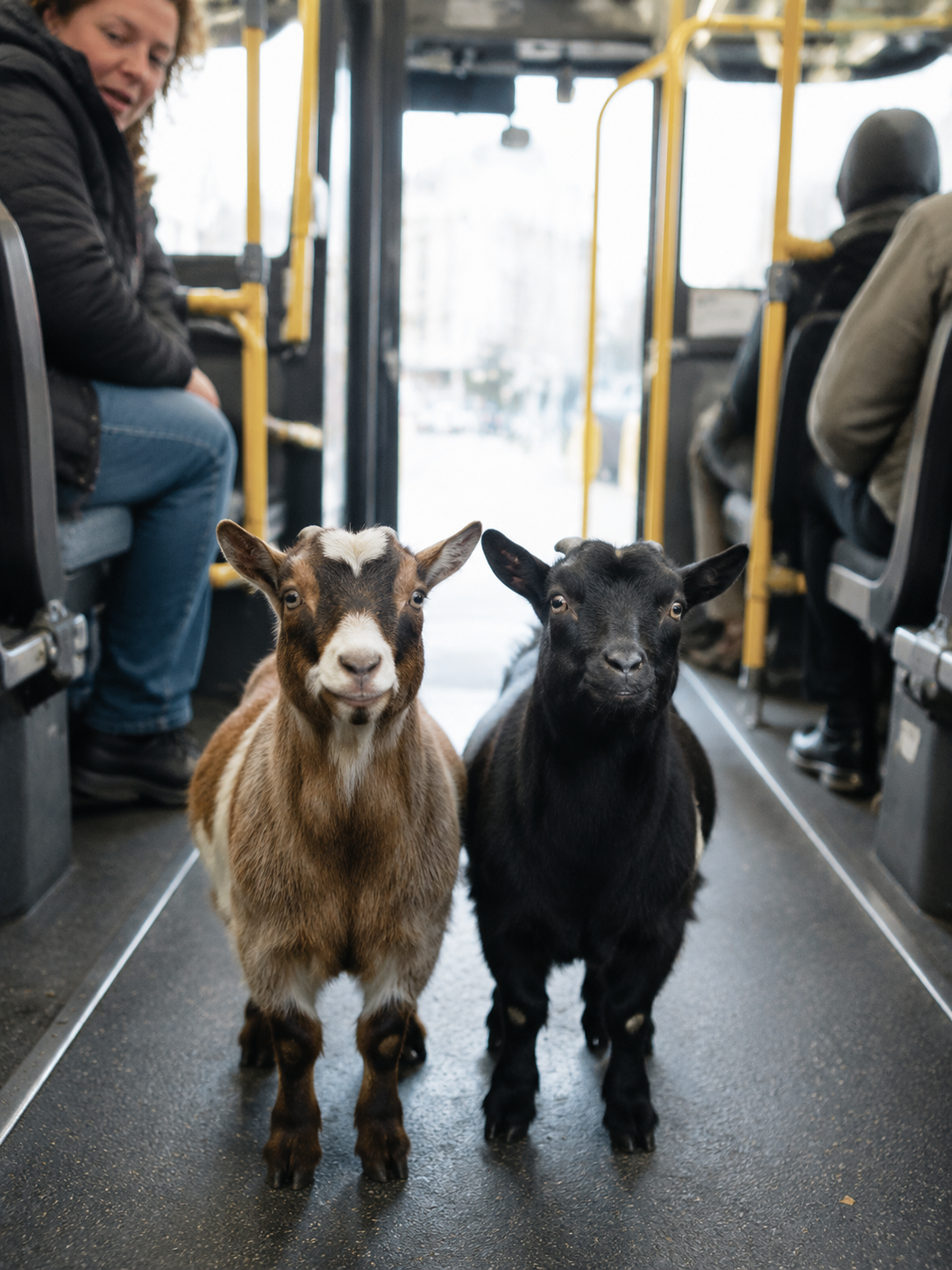
波特兰两只侏儒山羊误上公交车,低头看手机的乘客全程没察觉
Two Pygmy Goats Board Portland Bus Unnoticed
About this story
Two Pygmy Goats Board Portland Bus Unnoticed. HSK 5-6 Chinese listening practice.
This is an HSK 5-6 Chinese listening episode that runs about 3 minutes. The full Mandarin script is shown with tap-for-pinyin and a line-by-line English translation, so you can listen and read at once — comprehensible input in the sense of Stephen Krashen's i+1 theory. It teaches 13 key vocabulary words such as 受伤、耽误、犹豫 and walks through 3 grammar patterns, each explained in English with examples. The same news story is retold at 4 difficulty levels — use the level selector above to find the version that is challenging but still understandable for you.
Read at your level
原文Read the complete story in Chinese. Reveal pinyin and English only when you need them.
English transcript reference
First, let us be clear about how small this story is.
On the twelfth of August, in Portland, Oregon, two goats boarded a city bus and were escorted off a few minutes later.
Nobody was hurt, nothing was broken, and barely any time was lost.
And yet the video went round the entire internet afterwards, and it really is worth telling.
The two goats were pygmy goats — very small, standing about knee-high on an adult, and a common pet in America.
That day, somehow, they had got loose.
They were not running and not panicking; they were simply walking along the roadside, one step at a time.
Someone saw them, thought something was off, and called the police, saying there were two goats on the road with nobody with them.
But by the time the police got there, the goats were no longer where they had been.
They had walked to a bus stop by themselves.
At that moment a bus arrived, the doors opened, and the people at the stop began to board.
The people waiting on the platform started up the steps.
The two goats went up with them.
The first stepped onto the stair, hooves landing on the floor of the bus.
The second followed right behind, without hesitating for a single step, and got on too.
Then the doors closed.
From that moment, this bus was carrying two passengers who had not paid a fare.
There were, of course, people in the bus.
Some noticed almost immediately — first frozen, then reaching for their phones to film.
Others kept their heads down over their own phones the entire time.
The doors opened, the goats came aboard, stood beside them, and were escorted off again.
They did not see a second of it.
That is the genuinely funny part of this video.
Later the driver noticed as well, and said no.
He and several passengers together saw the two goats off the bus.
Once off, the goats were neither annoyed nor in any rush, and ambled off toward a shopping centre nearby.
After that, the transit company’s cameras lost them.
To this day nobody knows where they finally went, or whose they were.
So how did the whole world come to hear about this?
The transit company put it out themselves.
After they received the report, they pulled the platform camera footage, found this stretch of it, and posted the video to their own social account.
A transit company voluntarily publishing footage of two goats getting aboard one of its buses is itself rather good.
But once the laughing stops, there is one detail worth keeping.
On that bus that day, some people witnessed something they will probably encounter once in their lives.
Others missed it completely.
The two groups were on the same bus, along the same stretch of road, through the same span of time.
The only difference came down to one small thing: in those few minutes, whether or not they looked up once.
Think about it: what happened near you today that you missed entirely, because your head was down?
Listen again
Try it without the transcript and notice what sounds clearer.
What vocabulary does this episode teach?
词汇没有人受伤 = nobody was hurt.
没有耽误多少时间 = barely any time was lost.
一步也没有犹豫 = without hesitating for a single step.
先是愣住 = first frozen.
两名没有买票的乘客 = two passengers who had not paid a fare.
这两只羊是侏儒山羊 = the two goats were pygmy goats.
蹄子落在车厢的地板上 = hooves landing on the floor of the bus.
它们自己,走到了一个公交站台 = they walked to a bus stop by themselves.
它们不知道从哪里走失了 = somehow they had got loose.
调取了站台的监控 = pulled the platform camera footage.
有的人目击了一件…的事 = some people witnessed something.
有没有抬一次头 = whether or not they looked up once.
A commute — the ordinary ride this happened on.
What grammar patterns appear in this episode?
语法从这一刻起
"from this moment on". Marks the exact instant a situation changes.
从这一刻起,这辆公交车上有两名没有买票的乘客。
既没有……也没有……
"neither A nor B". Two absences at once.
两只羊下车以后既没有生气也没有着急。
差别只在于……
"the only difference is…". Reduces a contrast to one variable.
差别只在于一件小事:那几分钟里,有没有抬一次头。
Proper Nouns
专有名词Sources
来源Free account
Keep learning from this story
Create a free account to keep saved words and your preferred level together.
- Keep words with their story context
- Remember your preferred level
- Build your vocabulary over time