
A Chinese podcast · Same story, 4 levels
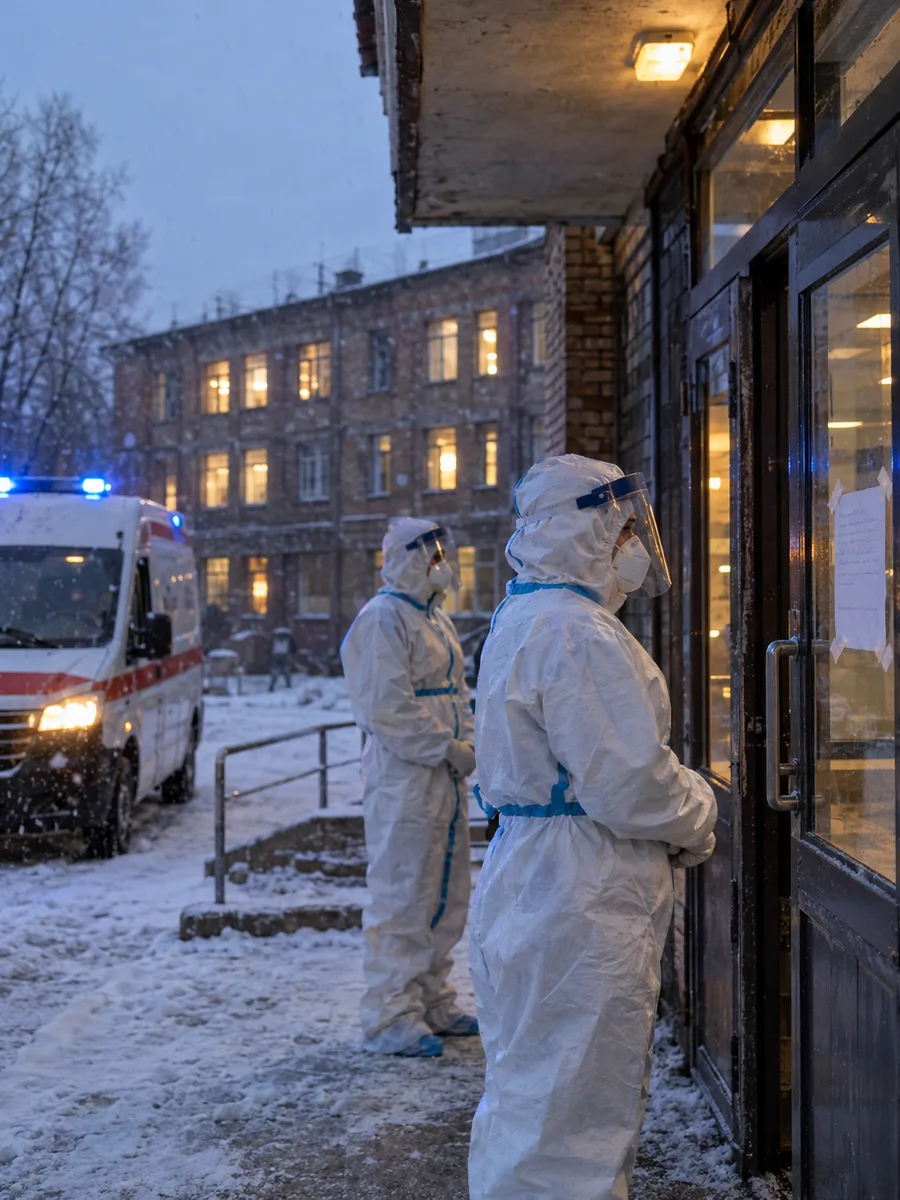
俄罗斯鼠疫研究所研究员实验事故后死亡,官方否认是鼠疫,却隔离了近两百人
A Russian Lab Worker Died After a Test Tube Broke at a Plague Institute. Russia Says It Wasn't Plague, but Quarantined 200 People.
About this story
Russia's Irkutsk plague-lab death: official denial, 200 quarantined, Yersinia pestis, and the 1979 Sverdlovsk precedent. HSK 5-6 Chinese listening practice.
This is an HSK 5-6 Chinese listening episode that runs about 4 minutes. The full Mandarin script is shown with tap-for-pinyin and a line-by-line English translation, so you can listen and read at once — comprehensible input in the sense of Stephen Krashen's i+1 theory. It teaches 16 key vocabulary words such as 研究、实验、组织 and walks through 6 grammar patterns, each explained in English with examples. The same news story is retold at 4 difficulty levels — use the level selector above to find the version that is challenging but still understandable for you.
Read at your level
原文Read the complete story in Chinese. Reveal pinyin and English only when you need them.
English transcript reference
A test tube broke, a young researcher died, two hundred people were quarantined, more than sixty colleagues were shut inside a building—yet officials say none of it has anything to do with plague.
This happened over the past two weeks in Irkutsk, Siberia, Russia.
Let's first lay out the facts we can be sure of.
Darya Shipilova, 28, was a researcher at the Irkutsk Anti-Plague Research Institute.
According to local media citing security-service sources, on September 25th she broke a test tube containing the pneumonic plague pathogen in the lab.
On September 29th she was hospitalized with severe pneumonia, and she died overnight between October 1st and 2nd.
Up to here, the story is still only 'reportedly.'
What really raised outside suspicion is that there are two official versions.
Russia's public health agency said she died of 'pneumonia of unknown cause,' unrelated to her work, and tests found no microorganisms linked to her research.
Yet at the same time, authorities put nearly two hundred contacts under medical observation, kept more than sixty colleagues inside the institute, and restricted access at several Irkutsk hospitals—even a maternity hospital.
If it really were ordinary pneumonia, measures like these would be hard to explain.
A scholar who studies how information spreads put it well: the most reliable signal about a government is usually what it does, with what it says a distant second.
Why does the word 'plague' make people so nervous?
Plague is caused by the bacterium Yersinia pestis, which normally circulates among rodents and fleas.
The Black Death of the 14th century was this; about a third of Europe's population died from it.
Plague takes several forms, and pneumonic plague is the most dangerous: the bacteria enter the lungs, and when a patient coughs, it spreads directly from person to person through droplets.
Untreated, the death rate is between 30% and 100%.
By the way, many Chinese and English reports have called this a 'virus,' but plague is a bacterium, which is also why antibiotics work against it.
That leads to the second key fact: plague today is treatable.
With early antibiotics, the vast majority of patients survive.
And judging from current data, the situation is not out of control.
No contacts have shown plague symptoms; tests found only two COVID cases and two rhinovirus cases—the common cold.
An American public health expert noted that pneumonic plague's incubation period is usually only one to two days; if it were spreading, new cases should have appeared long ago.
His judgment: this will either quickly die down or be contained locally.
So why are so many countries still watching closely?
The White House says it is monitoring closely, the US has formally requested information from Russia, Trump says he plans to discuss it with Putin, and the WHO is waiting for an explanation.
The reason is history.
During the Cold War, the Soviet Union built a whole network of anti-plague institutes studying the most dangerous pathogens, and when that system had accidents, it often chose silence.
The most famous example is the 1979 Sverdlovsk anthrax leak: a military lab leaked anthrax, at least 64 people died, and Soviet officials insisted they had eaten contaminated meat, until 1992,
when Yeltsin finally admitted the truth.
So this time, beyond one person's cause of death, the world cares about a bigger question: if a high-level lab has an accident, can we find out in time?
Infectious disease surveillance rests on a simple premise: countries must report early and tell the truth.
Viruses and bacteria don't respect borders, but information does.
One last question: if you led the WHO, facing a country unwilling to explain clearly, what would you do?
Listen again
Try it without the transcript and notice what sounds clearer.
What vocabulary does this episode teach?
词汇HSK 3. 研究所的研究员.
HSK 4. 实验室.
HSK 4. 世卫组织.
HSK 4/5. 提供信息; 信息是有国界的.
HSK 4. 很难解释; 等一个解释.
HSK 5. 研究信息传播的学者.
HSK 5. 他的判断是…
HSK 3. 原因在于历史.
研究的都是最危险的病原体.
两百人被隔离.
肺鼠疫的潜伏期.
鼠疫是细菌.
苏联在冷战时期 = the Soviet Union during the Cold War.
军事实验室泄漏了炭疽.
在啮齿动物和跳蚤之间传播.
通过飞沫直接人传人.
* beyond level超纲词
What grammar patterns appear in this episode?
语法据……(援引……)
According to… (citing…).
据当地媒体援引安全部门的消息,九月二十五号,她在实验室里打破了一支装有肺鼠疫病原体的试管。
与此同时,……却……
At the same time, … contrary to expectation.
可与此同时,当局却把近两百个接触者纳入医学观察。
连……也不例外
Even … is no exception.
伊尔库茨克多家医院限制进出,连一家妇产医院也不例外。
由……引起
Caused by….
鼠疫由鼠疫耶尔森菌引起。
直到……才……
Not until….
直到一九九二年,
原因在于……
The reason lies in….
原因在于历史。
Proper nouns
专有名词Free account
Keep learning from this story
Create a free account to keep saved words and your preferred level together.
- Keep words with their story context
- Remember your preferred level
- Build your vocabulary over time