
A Chinese podcast · Same story, 4 levels
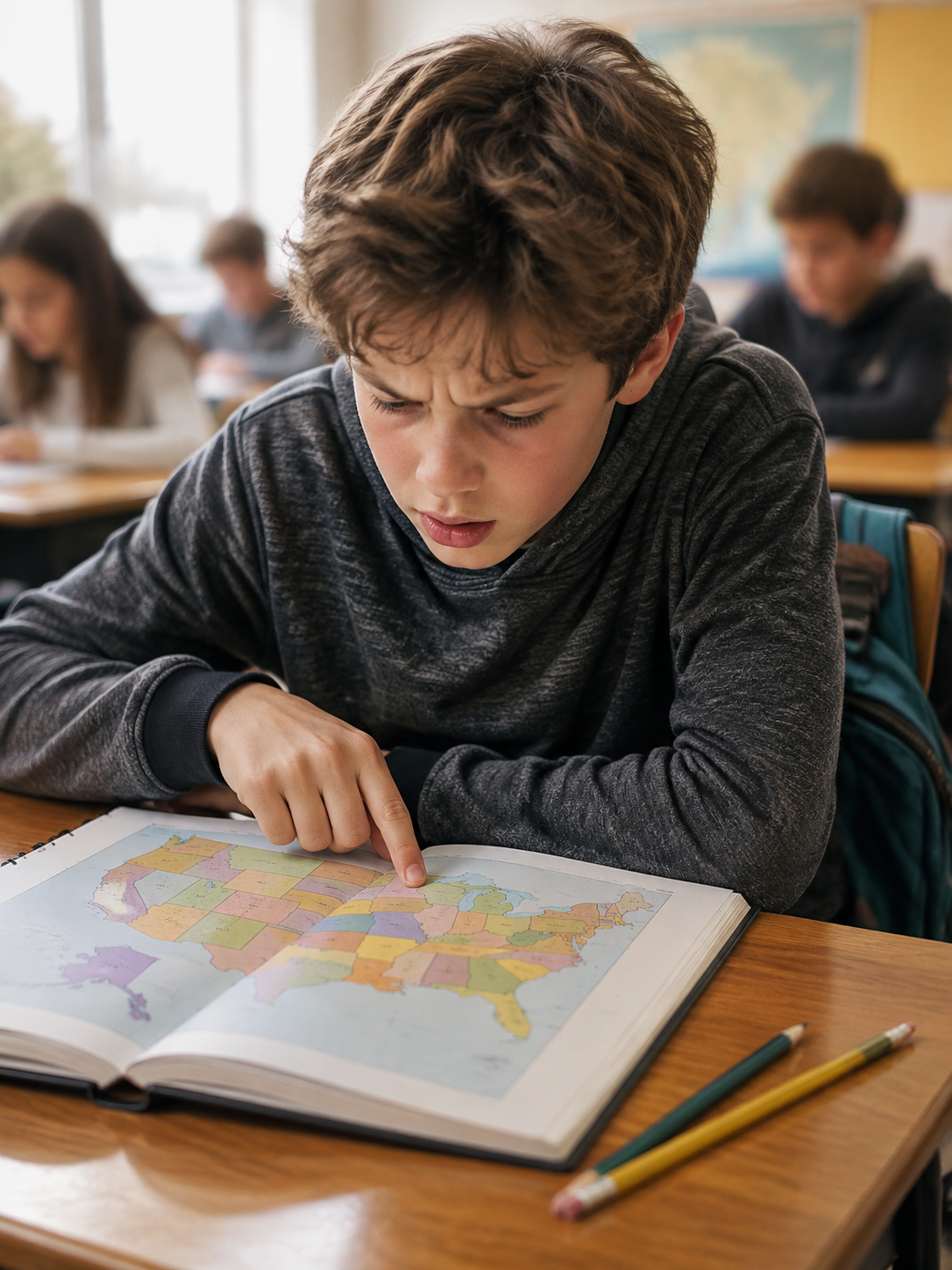
一所肯塔基中学发的学生手册,把 Kentucky 印成了 Venecky。开学第一天,一个学生就发现了。
Kentucky School Planners Misspell State Name
About this story
Kentucky School Planners Misspell State Name. HSK 5-6 Chinese listening practice.
This is an HSK 5-6 Chinese listening episode that runs about 3 minutes. The full Mandarin script is shown with tap-for-pinyin and a line-by-line English translation, so you can listen and read at once — comprehensible input in the sense of Stephen Krashen's i+1 theory. It teaches 12 key vocabulary words such as 离谱、手滑、兜底 and walks through 3 grammar patterns, each explained in English with examples. The same news story is retold at 4 difficulty levels — use the level selector above to find the version that is challenging but still understandable for you.
Read at your level
原文Read the complete story in Chinese. Reveal pinyin and English only when you need them.
English transcript reference
When American middle schools open the year, students are handed a planner: timetable, calendar, plus a few pages of reference content for everyday use.
Among them is a map of America, fifty states, each with its name printed on it.
Pages like these are not decoration — a student will turn to them all year.
The planner is not free: each family pays ten dollars a year.
On the first day of school this year, a student at one middle school opened the planner and turned to that map.
And then he found that the state names were wrong.
Not one of them wrong — a whole swathe of them.
Louisiana had been printed as a string of letters nobody can read.
Arizona was missing a letter.
South Carolina had been spelled as another word.
Illinois had turned into something unreadable.
Alabama did not escape either.
On a map of fifty states, the errors covered a large area.
The one that leaves you speechless is the state he lives in himself.
This school is in Kentucky.
On the map, Kentucky had been printed as a word nobody has ever heard of.
A Kentucky school spelled Kentucky wrong, and then handed it to several hundred students.
Parents later found that it was not only the map that was wrong.
The periodic table in the planner is skewed, its rows and columns out of line.
The page on the phases of the moon has diagrams too small to tell which day is a full moon.
In other words, almost every so-called "reference" page in this planner is either wrong or unusable.
And this planner is charged to every family at ten dollars.
To put it another way: what parents paid for is a booklet in which no page can be trusted.
Put those together and a lot of parents reached the same judgement: these pages look machine-generated.
That suspicion is not far-fetched.
One misspelled state name could be a slip of the hand, but a whole map and a whole periodic table going wrong at once looks more like somebody took generated output straight to the printer.
But the real problem is not there.
It is worth stopping to think about how this planner reached a student’s hands.
First somebody made these pages.
Then, by process, somebody should have reviewed them.
Then they went to a printer, several hundred copies.
Then the school handed them to every student.
What stands on that route is not one person, it is a row of them.
The people who made the pages, reviewed them, sent them to print and handed them out in class are all adults.
And a teenager, on the first day of school, within minutes, saw what all of them missed.
The person who first told this story was a parent.
She said her son found it on the first day of school.
What parents are now pressing is the same thing: who made this, and did anyone at the school proofread it?
The district says it is in contact with parents about it.
But as of today, the district has not confirmed whether AI was used, nor explained who produced it.
If this content really was machine-generated, then the machine only did what it always does: fill in the parts it is unsure about.
What actually failed is the row of people behind it who were supposed to catch this.
Think about it: how many things around you go unchecked a second time, because "the last person must have looked"?
Listen again
Try it without the transcript and notice what sounds clearer.
What vocabulary does this episode teach?
词汇这个怀疑,不算离谱 = that suspicion is not far-fetched.
可以是手滑 = could be a slip of the hand.
本该兜底的人 = the people supposed to catch this.
学校有没有人校对过 = did anyone at the school proofread it.
真正失灵的,是那一排人 = what actually failed is that row of people.
学生会拿到一本手册 = students are handed a planner.
这所学校,就在肯塔基 = this school is in Kentucky.
手册里的元素周期表是歪的 = the periodic table is skewed.
讲月相的那一页 = the page on the phases of the moon.
应该有人审一遍 = somebody should have reviewed them.
这些页面,像是机器生成的 = these pages look machine-generated.
The chain of steps a planner passes through.
What grammar patterns appear in this episode?
语法换句话说
"in other words". Restates a list as a single conclusion.
换句话说,这本手册里几乎每一页……都是错的。
……只是做了它一贯会做的事
Shifts blame off the tool by describing exactly what the tool does.
那机器只是做了它一贯会做的事:把不确定的地方填满。
本该
"ought to have". Marks a duty that was not carried out.
真正失灵的,是它后面那一排本该兜底的人。
Proper nouns
专有名词Sources
来源Free account
Keep learning from this story
Create a free account to keep saved words and your preferred level together.
- Keep words with their story context
- Remember your preferred level
- Build your vocabulary over time