
A Chinese podcast · Same story, 4 levels
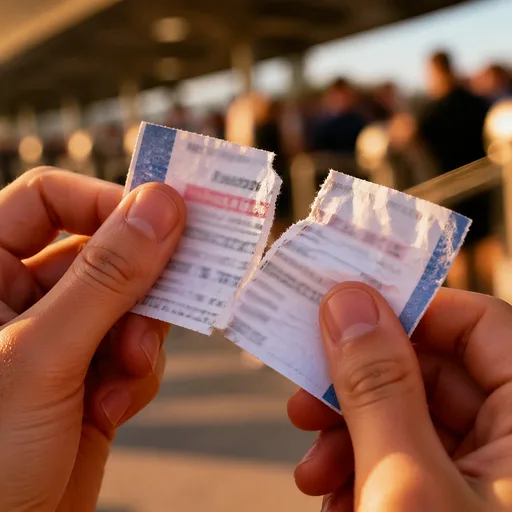
Ticketmaster垄断了:法院说你被多收钱了
Ticketmaster Monopoly Ruling Orders Refunds
About this story
A US court finds Ticketmaster and Live Nation violated the Sherman Antitrust Act — Eras Tour buyers were overcharged. HSK 3 Chinese listening practice.
This is an HSK 3-4 Chinese listening episode that runs about 6 minutes. The full Mandarin script is shown with tap-for-pinyin and a line-by-line English translation, so you can listen and read at once — comprehensible input in the sense of Stephen Krashen's i+1 theory. It teaches 12 key vocabulary words such as 世界、机会、结果 and walks through 3 grammar patterns, each explained in English with examples. The same news story is retold at 4 difficulty levels — use the level selector above to find the version that is challenging but still understandable for you.
Read at your level
原文Read the complete story in Chinese. Reveal pinyin and English only when you need them.
English transcript reference
Speaking of the news that made ordinary Americans happiest these past few days, it's probably Ticketmaster being ruled a monopoly.
If you've ever bought concert tickets in America.
You've definitely used Ticketmaster.
Because you had almost no other choice.
That's the problem.
On April 15th.
A jury at the Manhattan federal court reached a verdict.
Live Nation and its subsidiary Ticketmaster violated antitrust law.
They constituted an illegal monopoly in the concert ticket market.
And they overcharged consumers.
This case was brought by 33 states plus Washington DC together.
The trial lasted five weeks total.
The jury deliberated for four days.
In the end they ruled for the plaintiffs on every key legal question.
This was a total defeat.
Almost catastrophic for Live Nation.
Let's first talk about why this case is so important.
What kind of company is Live Nation?
It's the biggest live entertainment company in the world.
It does three things.
First, it organizes concerts.
It's the world's largest concert promoter.
Second, it manages venues.
Many of America's best amphitheaters belong to it.
Third, it sells tickets.
Ticketmaster controls about 80% of America's primary ticketing market.
The primary market means selling tickets for the first time.
Not resale.
Eighty percent.
What does this number mean?
It means if you're a singer.
You want to hold a concert at a big venue.
You almost have to work with Live Nation.
Because the good venues are theirs.
If you use their venue you must use Ticketmaster to sell tickets.
Because the venue is tied to it.
If you're a ticket buyer.
You want to see this singer.
You can only go to Ticketmaster.
Because tickets are only sold there.
This is called "vertical monopoly."
Control from top to bottom.
The venue is mine.
The promotion is mine.
The ticket selling is also mine.
Every link in this chain goes through me.
What do people hate most about Ticketmaster?
Service fees.
You might see a ticket priced at one hundred dollars.
But when you go to pay you discover.
With service fees it's actually one hundred thirty.
Even one hundred fifty.
What's that extra thirty to fifty dollars?
It's "convenience fee" "processing fee" "facility fee."
All sorts of different names.
But the essence is the same.
It's extra money Ticketmaster charges you.
Are these charges reasonable?
The jury said no.
They calculated that each ticket was overcharged by an average of one dollar and seventy-two cents.
One seventy-two doesn't sound like much.
But America sells hundreds of millions of tickets through Ticketmaster every year.
Times one seventy-two.
That's an astronomical figure.
What triggered this case?
Taylor Swift.
November 2022.
Taylor Swift's Eras Tour started presales.
Ticketmaster's system crashed.
Millions of people flooded in at once.
Waited for hours.
Many people still couldn't buy tickets in the end.
Social media was full of anger.
The US Senate even held a hearing about it.
That was the darkest day in Ticketmaster's PR history.
And the starting point of this antitrust case.
May 2024.
The US Department of Justice and over thirty states filed a joint lawsuit against Live Nation.
The charge was violating the Sherman Antitrust Act.
This law has existed since 1890.
It's America's oldest antitrust law.
It says a company cannot use unfair means to control a market.
The case started trial in March this year.
Lasted five weeks.
There was an interesting twist.
During the first week of trial.
The DOJ and some states reached a separate settlement with Live Nation.
Live Nation agreed to pay 280 million dollars.
Agreed to limit service fees at certain venues.
Agreed to give venues more freedom in choosing ticketing platforms.
But the remaining 33 states didn't accept the settlement.
They said it wasn't enough.
What they wanted was a jury verdict.
What they wanted was legal confirmation: you are a monopoly.
On April 15th they got that confirmation.
The jury voted "yes" on every key question.
Yes, Live Nation monopolized the primary ticketing market.
Yes, it monopolized the large amphitheater market.
Yes, it illegally bundled venue use with ticketing services.
Complete victory for the plaintiffs.
New York Attorney General Letitia James said.
"Live Nation and Ticketmaster broke the law."
"Costing consumers millions of dollars."
Now the most critical question is what happens next.
Judge Arun Subramanian must decide on remedies.
What's the most likely outcome?
A breakup.
Meaning forcing Live Nation to sell off Ticketmaster.
Making the ticket seller and the concert organizer not the same entity.
This is what many critics have called for over the years.
If it really gets broken up.
Other ticketing companies would have a chance to compete.
With competition, prices could drop.
Service fees could come down.
Live Nation says they will appeal.
They say the verdict isn't final yet.
They don't admit they're a monopoly.
But regardless of the appeal outcome.
This verdict has sent a very clear signal.
You control eighty percent of the market.
You bundle venues with ticketing.
You overcharge consumers.
The law doesn't allow it.
For everyone who has ever bought a ticket.
They've been waiting a long time for this day.
Listen again
Try it without the transcript and notice what sounds clearer.
What vocabulary does this episode teach?
词汇HSK 1-3. world.
HSK 1-3. chance.
HSK 1-3. result; outcome.
HSK 1-3. law.
HSK 1-3. to discover / to find.
HSK 1-3. to agree / to consent.
Illegal market dominance by one company.
Controlling multiple stages of a supply chain.
First sale of tickets (not resale).
An outdoor performance venue.
One of many extra charges on ticket purchases.
The event that set off a larger chain of events.
* beyond level超纲词
What grammar patterns appear in this episode?
语法Proper Nouns
专有名词Sources
来源Free account
Keep learning from this story
Create a free account to keep saved words and your preferred level together.
- Keep words with their story context
- Remember your preferred level
- Build your vocabulary over time