
A Chinese podcast · Same story, 4 levels
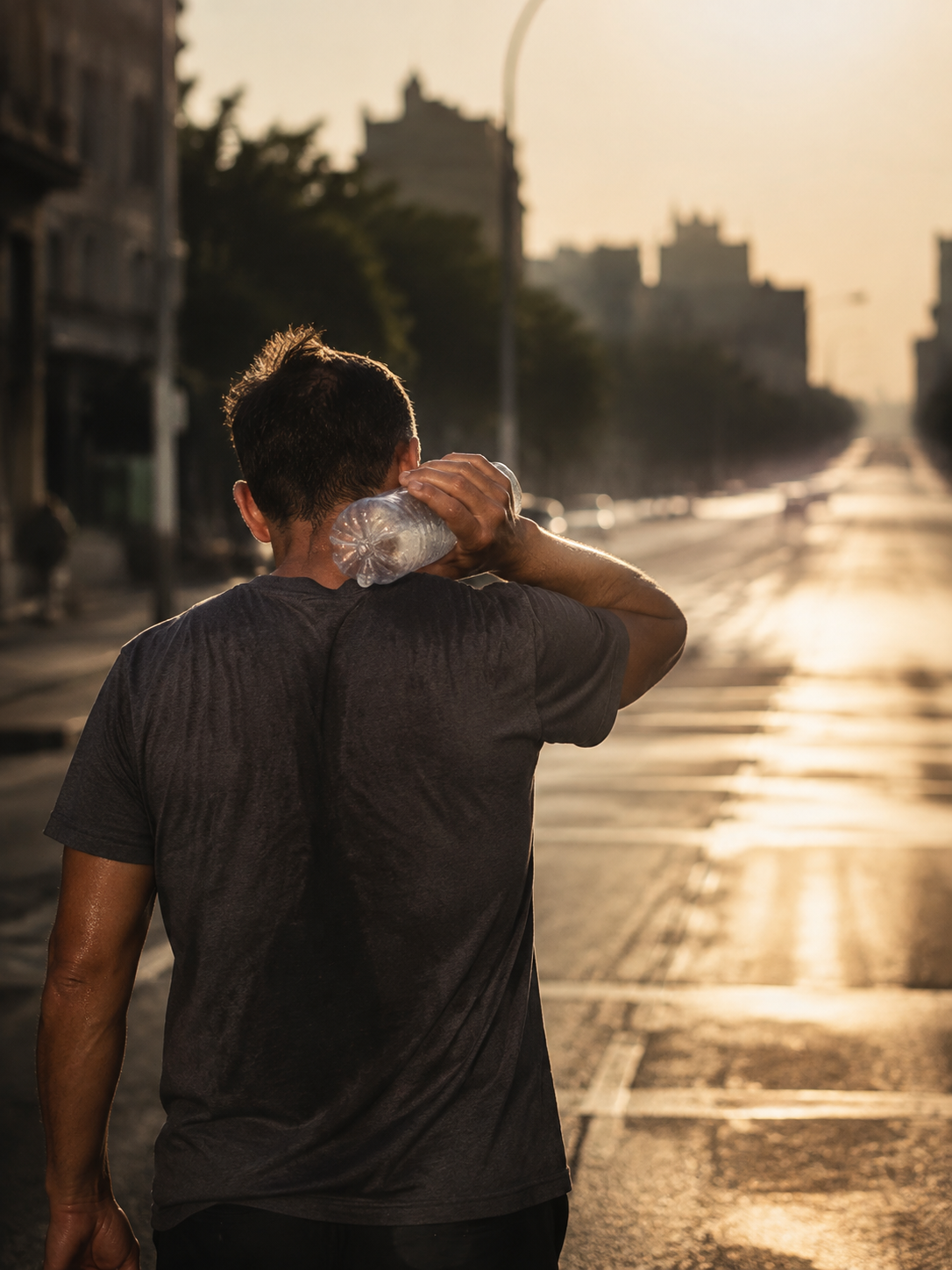
拉斯维加斯111度,纽约93度:数字更低的纽约,却更危险
Humidity Makes NYC Heat More Dangerous Than Vegas
About this story
Humidity Makes NYC Heat More Dangerous Than Vegas. HSK 3 Chinese listening practice.
This is an HSK 3-4 Chinese listening episode that runs about 3 minutes. The full Mandarin script is shown with tap-for-pinyin and a line-by-line English translation, so you can listen and read at once — comprehensible input in the sense of Stephen Krashen's i+1 theory. It teaches 11 key vocabulary words such as 恒温、区别、关键 and walks through 3 grammar patterns, each explained in English with examples. The same news story is retold at 4 difficulty levels — use the level selector above to find the version that is challenging but still understandable for you.
Read at your level
原文Read the complete story in Chinese. Reveal pinyin and English only when you need them.
English transcript reference
On the same day: Las Vegas a hundred and eleven degrees, New York ninety-three.
By the numbers, Las Vegas is far hotter.
But if you ask a doctor which of the two is more likely to put someone in hospital, the answer may be New York.
That sounds wrong, which is why it is worth explaining.
One note first: the degrees here are Fahrenheit.
A hundred and eleven Fahrenheit is roughly forty-four Celsius; ninety-three Fahrenheit is roughly thirty-four.
Right — now the human body.
Humans hold a constant temperature; the body has to stay around thirty-seven degrees.
The hotter it is outside, the harder the body has to work to push the excess heat out.
There is really only one method: sweating.
But what actually cools you is not the sweat itself; it is the moment the sweat evaporates.
When a liquid turns into a gas it carries heat away. That is a physical process, called evaporation.
So sweat sitting on your skin does nothing. It has to evaporate to be worth anything.
And here is the key: evaporation needs air to take that water.
If the air is dry it can take a great deal of water, sweat evaporates the instant it appears, and heat leaves fast.
If the air is already humid — already full of water — it cannot take much more.
The sweat just hangs on your skin and runs down. The body loses water for nothing, and the heat stays in.
That is the difference between Las Vegas and New York.
Las Vegas sits in a desert, and the air is extremely dry.
A hundred and eleven sounds terrifying, but as long as you have water to drink, your body can still shed heat.
New York is on the coast, and the summer air is damp.
Ninety-three plus high humidity pushes the felt temperature up, and makes shedding heat very hard.
The 'feels like' temperature in a forecast is calculating exactly this: temperature plus humidity, and what a person actually endures.
These days New York feels like ninety-three, Washington reached a hundred, and Philadelphia is close to a hundred as well.
So what happens when the body cannot shed heat?
The core temperature starts to climb.
The body sends more blood to the skin, trying to release heat through the surface — which means less blood reaching the organs and the brain.
You get dizzy, nauseous, weak. That is the early stage of heatstroke.
Further along, past forty degrees Celsius, organs begin to fail, and at that point it is an emergency.
Last Saturday, at an outdoor event in Colorado Springs, seventy-two people saw a doctor because of the heat, and seven were hospitalised.
These days, from California all the way to the Midwest, heat warnings are up.
The forecast says New York drops back into the eighties by Wednesday, but there are a few days to get through first.
One practical thing to close on: to judge how hot it is, do not just look at the temperature number. Look at the felt temperature.
Think about it: where you live, is the summer dry heat or humid heat?
Which one is harder to bear?
Listen again
Try it without the transcript and notice what sounds clearer.
What vocabulary does this episode teach?
词汇人是恒温的 = humans hold a constant body temperature.
这就是两地的区别 = that is the difference between the two.
关键就在这儿 = here is the key.
主要的办法只有一个 = there is really only one method.
人实际承受的是多少 = what a person actually endures.
一个物理过程 = a physical process.
The mechanism at the centre of the episode.
高湿度 = high humidity.
体感温度 = what the temperature feels like, once humidity is counted.
散 (disperse) + 热 (heat). What the body is trying to do.
中暑的前期 = the early stage of heatstroke.
* beyond level超纲词
What grammar patterns appear in this episode?
语法A 才 B
"only then". Marks the necessary condition.
汗必须蒸发掉才有用。
这样一来
"as a result of that". Links a consequence to what was just said.
身体会把更多血液送到皮肤,想靠皮肤散热,这样一来,送到内脏和大脑的血就少了。
Proper nouns
专有名词Sources
来源Free account
Keep learning from this story
Create a free account to keep saved words and your preferred level together.
- Keep words with their story context
- Remember your preferred level
- Build your vocabulary over time