
A Chinese podcast · Same story, 4 levels
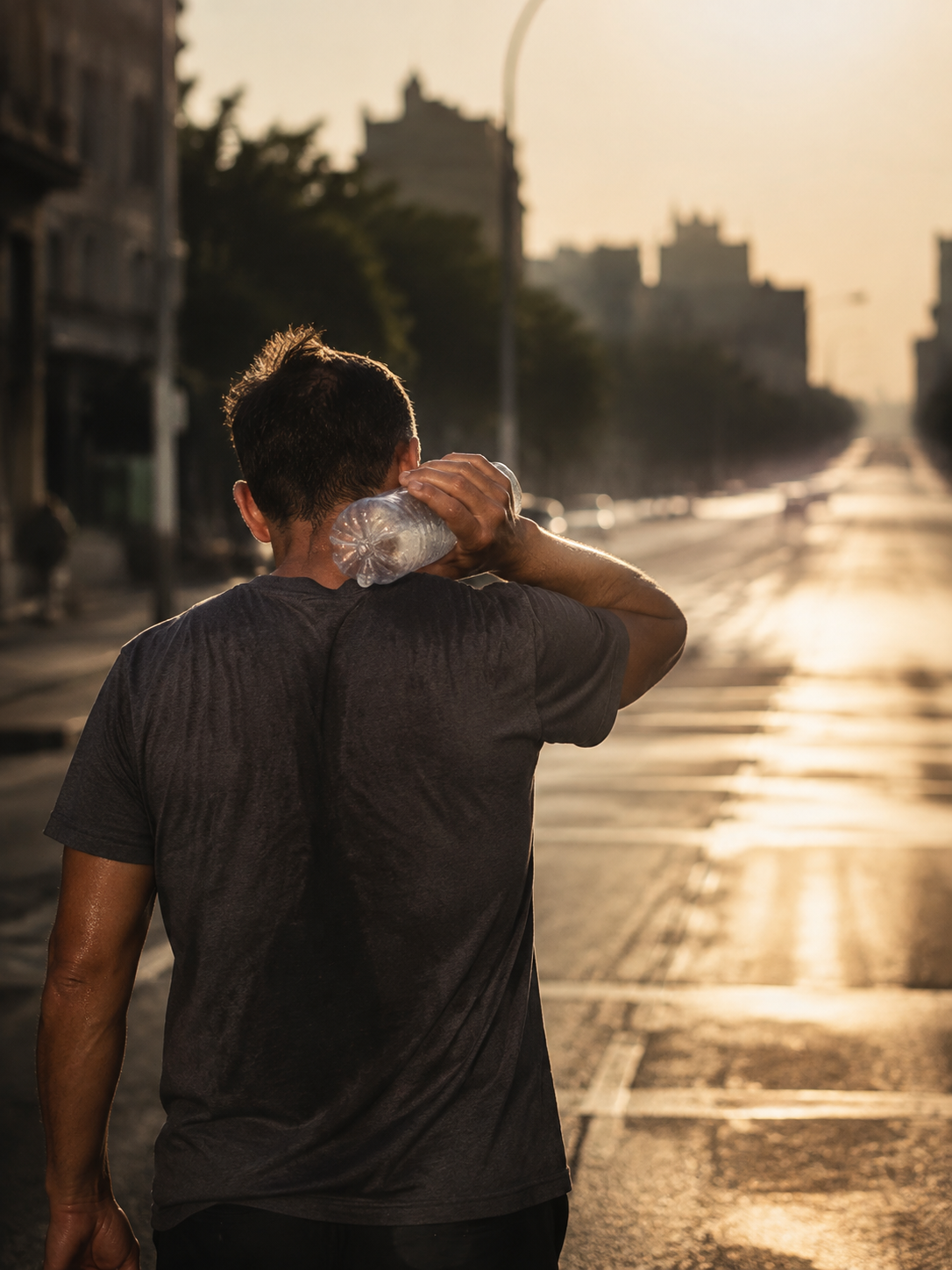
拉斯维加斯111度对纽约93度:数字更低的纽约,反而更危险
Humidity Makes NYC Heat More Dangerous Than Vegas
About this story
Humidity Makes NYC Heat More Dangerous Than Vegas. HSK 5-6 Chinese listening practice.
This is an HSK 5-6 Chinese listening episode that runs about 4 minutes. The full Mandarin script is shown with tap-for-pinyin and a line-by-line English translation, so you can listen and read at once — comprehensible input in the sense of Stephen Krashen's i+1 theory. It teaches 13 key vocabulary words such as 反直觉、效率、代价 and walks through 3 grammar patterns, each explained in English with examples. The same news story is retold at 4 difficulty levels — use the level selector above to find the version that is challenging but still understandable for you.
Read at your level
原文Read the complete story in Chinese. Reveal pinyin and English only when you need them.
English transcript reference
On the same day: Las Vegas a hundred and eleven degrees, New York ninety-three.
By the numbers that is an eighteen-degree gap. The winner looks obvious.
But ask an emergency physician which of those two cities was more likely to put someone in hospital that day, and the answer is probably New York.
The conclusion is counterintuitive, so it is worth taking apart properly.
First, units: these are Fahrenheit.
A hundred and eleven Fahrenheit is about forty-four Celsius; ninety-three is about thirty-four.
Now the human side.
Humans are warm-blooded. Core temperature has to hold around thirty-seven degrees, with very little room to drift.
Once the outside air is hotter than your body, you can no longer cool down by shedding heat into the air, because heat flows from hot to cold.
That leaves one route: sweating.
But what actually cools you is the instant the sweat evaporates. The sweat coming out does nothing by itself.
Turning a liquid into a gas takes energy, and that energy is drawn straight off the skin, which lowers skin temperature.
Put another way: sweat sitting on you does not cool you. Sweat evaporating does.
And here is where it breaks: the rate of evaporation is not up to you. It is up to the air.
There is a ceiling on how much water air can hold, and how close you are to that ceiling is what relative humidity means.
Dry air is nowhere near full, so sweat is carried off the moment it appears. Sweating is extremely efficient.
Humid air is already near saturation and cannot take much more, so the sweat just runs down your skin.
The result is a body continuously losing water and salt while buying almost no cooling with it.
That is the difference between Las Vegas and New York.
Las Vegas is in a desert, and the air is extremely dry.
A hundred and eleven sounds appalling, but with water and shade, the body's cooling channel is still open.
New York is coastal, and summer humidity is high.
Ninety-three plus high humidity means that cooling channel is essentially blocked.
The 'feels like' figure in a forecast is calculating exactly this: temperature and humidity combined into the load a body actually carries.
These days New York feels like ninety-three, Washington reached a hundred, Philadelphia is close behind.
So what happens when the heat cannot leave?
The body's first response is to divert large volumes of blood to the skin, trying to release heat at the surface.
The cost is less blood to the organs and the brain — hence dizziness, nausea and weakness, the early warnings of heatstroke.
If the core keeps climbing past forty degrees Celsius, proteins begin to denature and organ function is damaged. At that point it stops being uncomfortable and becomes fatal.
It is worth stressing that this does not require extreme heat.
At high humidity, the low thirties Celsius is enough.
Last Saturday, at an outdoor event in Colorado, seventy-two people were treated for heat and seven were taken to hospital.
The temperature there that day was nowhere near a hundred and eleven.
Heat warnings currently run from California through the Midwest, and the east coast is broadly four to eight degrees above normal.
The forecast has New York falling back into the eighties by Wednesday, but there are a few days to get through first.
Which lands on one practical rule: to decide whether to go outside, do not read the temperature alone. Read the felt temperature.
Dry heat and humid heat are two different things, and the second one is the one people underestimate.
Think about it: where you live, is the summer dry heat or humid heat?
Which do you find harder to take?
Listen again
Try it without the transcript and notice what sounds clearer.
What vocabulary does this episode teach?
词汇这个结论反直觉 = this conclusion is counterintuitive.
排汗效率极高 = sweating is extremely efficient.
代价是内脏分到的血变少 = the cost is less blood reaching the organs.
更容易被低估 = the one people underestimate.
空气能装多少水,是有上限的 = there is a ceiling on how much water air holds.
散热通道 = the cooling channel — open in Vegas, blocked in New York.
人体实际承受的负荷 = the load a body actually carries.
How close the air is to its water ceiling — the core concept here.
The only thing that actually cools you.
散热通道 = the route heat takes out of the body.
四十度这个阈值 = the forty-degree threshold, past which organs fail.
蛋白质开始变性 = proteins begin to denature — why high fever is fatal.
接近饱和 = close to saturation; the air cannot take more water.
* beyond level超纲词
What grammar patterns appear in this episode?
语法换句话说
"put another way" — restates a technical point in plainer terms. A host's tool.
换句话说,汗挂在身上不降温,蒸发掉才降温。
不由……,由……
"is not up to A, it is up to B" — reassigns control.
蒸发的速度,不由你决定,由空气决定。
Proper nouns
专有名词Sources
来源Free account
Keep learning from this story
Create a free account to keep saved words and your preferred level together.
- Keep words with their story context
- Remember your preferred level
- Build your vocabulary over time