
A Chinese podcast · Same story, 4 levels
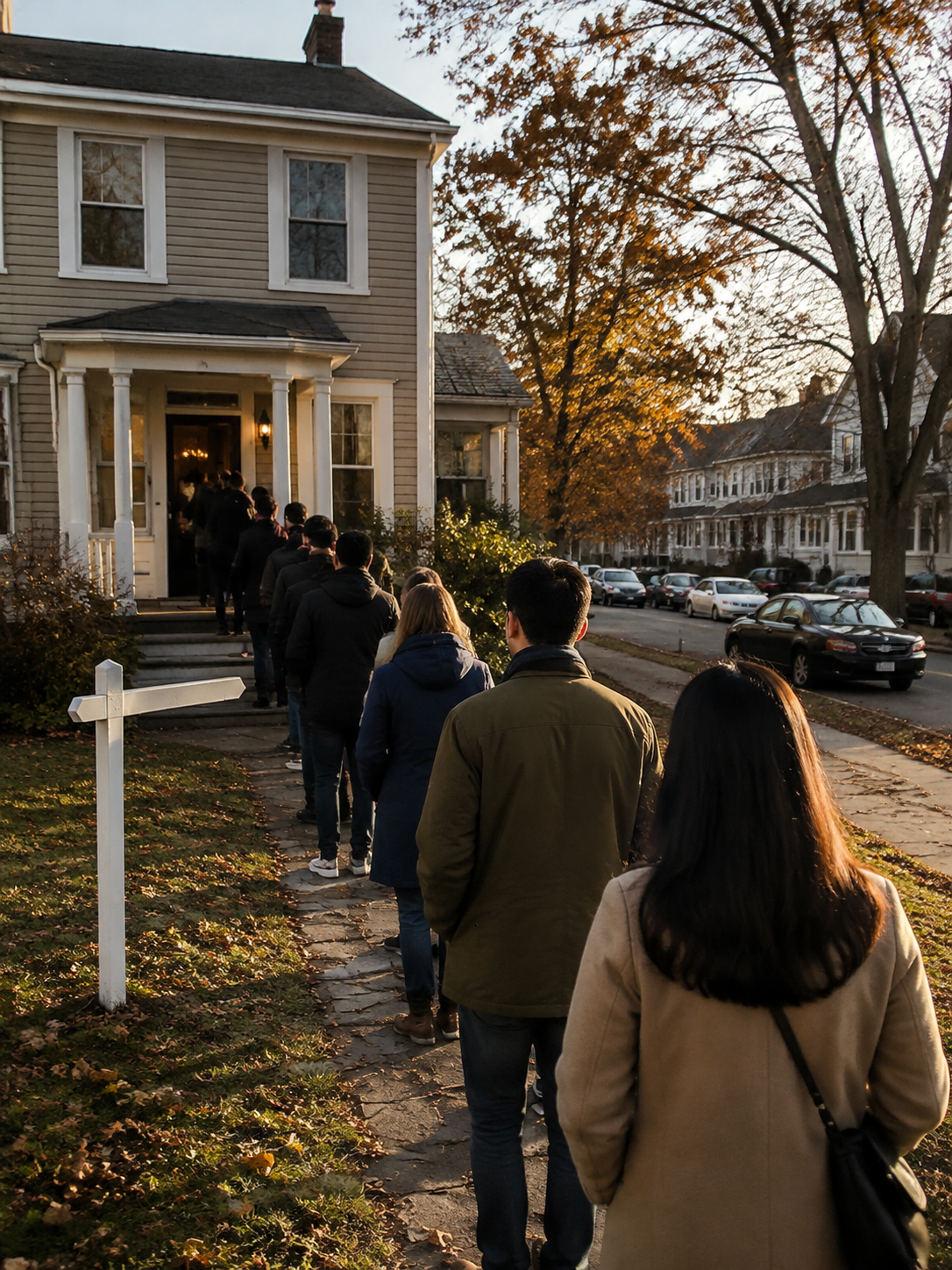
全美最抢手的十个邮编区,房价并不低,根源是房源几乎枯竭
Housing Shortage Drives America's Hottest ZIPs
About this story
Housing Shortage Drives America's Hottest ZIPs. HSK 3 Chinese listening practice.
This is an HSK 3-4 Chinese listening episode that runs about 3 minutes. The full Mandarin script is shown with tap-for-pinyin and a line-by-line English translation, so you can listen and read at once — comprehensible input in the sense of Stephen Krashen's i+1 theory. It teaches 10 key vocabulary words such as 供给、挂牌、成交 and walks through 3 grammar patterns, each explained in English with examples. The same news story is retold at 4 difficulty levels — use the level selector above to find the version that is challenging but still understandable for you.
Read at your level
原文Read the complete story in Chinese. Reveal pinyin and English only when you need them.
English transcript reference
Start with a number: five hundred and forty thousand dollars.
That is the median price of an ordinary home in the US Northeast this year, up about four percent on last year.
Across the country, prices are rising in eighty percent of urban areas; a year ago that figure was only seventy percent.
So yes, housing has got more expensive again.
But what I want to talk about today is a different question: where is the competition fiercest?
Every year an organisation ranks which ZIP codes have the most sought-after homes.
'Most sought-after' measures two things: how long a house sits before it sells, and how many people view the listing online.
This year's ranking is out, and number one is Peabody, a small place next to Boston.
The other nine are all in the Northeast and Midwest too, mostly in the suburbs of Boston, New York and Philadelphia.
This is the fourth year running that the entire top ten has come from those two regions.
So the question: why these places?
The intuitive answer is that the most fought-over places should be the cheapest ones, because people priced out of the city centre have to look further out.
But the data does not support that. Houses in these areas are not cheap.
The real reason is supply.
The number of homes for sale in these ten areas is sixty percent below what it was before the pandemic.
The national average is only ten percent below.
That is an enormous gap.
When listings get that scarce, market behaviour changes completely.
A house comes on the market and a lot of people go to see it at the same time, and then bid at the same time.
The result: in nine of these ten areas, homes finally sell above the asking price, by about four percent on average.
Nationally, an ordinary home usually sells about two percent below asking.
One above asking, one below — that is the line between fought-over and not.
So why the Northeast and Midwest specifically?
One reason often cited is that these places built too few new homes for many years.
The South and West have been building heavily, supply keeps up, and prices are less strained.
The Northeast is different: developable land around many cities was limited to begin with, permitting is slow, and new housing never catches up.
So when a wave of people starts looking, there simply are not enough houses on the market to absorb them.
There is one more thing these suburbs have in common: an easy commute.
Most sit within an hour of a big city, letting you live with more space while keeping the job in town.
That also explains why this ranking has not changed in four years.
What it really records is: where the housing shortage is worst.
Think about it: if homes were scarce enough that you had to fight for one, would you bid higher, or move further out?
Listen again
Try it without the transcript and notice what sounds clearer.
What vocabulary does this episode teach?
词汇真正的原因,是供给 = the real reason is supply. The episode's thesis.
一套房子刚上市 = a house has just come on the market.
一般人的直觉是…… = the intuitive answer is…, and then it gets overturned.
这个差距非常大 = that is an enormous gap.
这就是抢和不抢的区别 = that is the line between fought-over and not.
没有足够的房子接住他们 = not enough houses to absorb them.
挂牌要价 = the listed asking price.
成交价 = the final sale price, as opposed to the asking price.
审批慢 = permitting is slow — one cause of the shortage.
通勤方便 = an easy commute.
* beyond level超纲词
What grammar patterns appear in this episode?
语法但数据不支持这个说法
A host's move: state the intuitive answer, then knock it down with evidence.
但数据不支持这个说法:这些地区的房子,并不便宜。
一个……,一个……,这就是……
Sets two facts side by side, then names the distinction they draw.
一个高于要价,一个低于要价,这就是"抢"和"不抢"的区别。
所以当……,……
"so when …, …". Draws the consequence of a condition just established.
所以当一批人开始找房,市场上,根本没有足够的房子接住他们。
Proper Nouns
专有名词Sources
来源Free account
Keep learning from this story
Create a free account to keep saved words and your preferred level together.
- Keep words with their story context
- Remember your preferred level
- Build your vocabulary over time