
A Chinese podcast · Same story, 4 levels
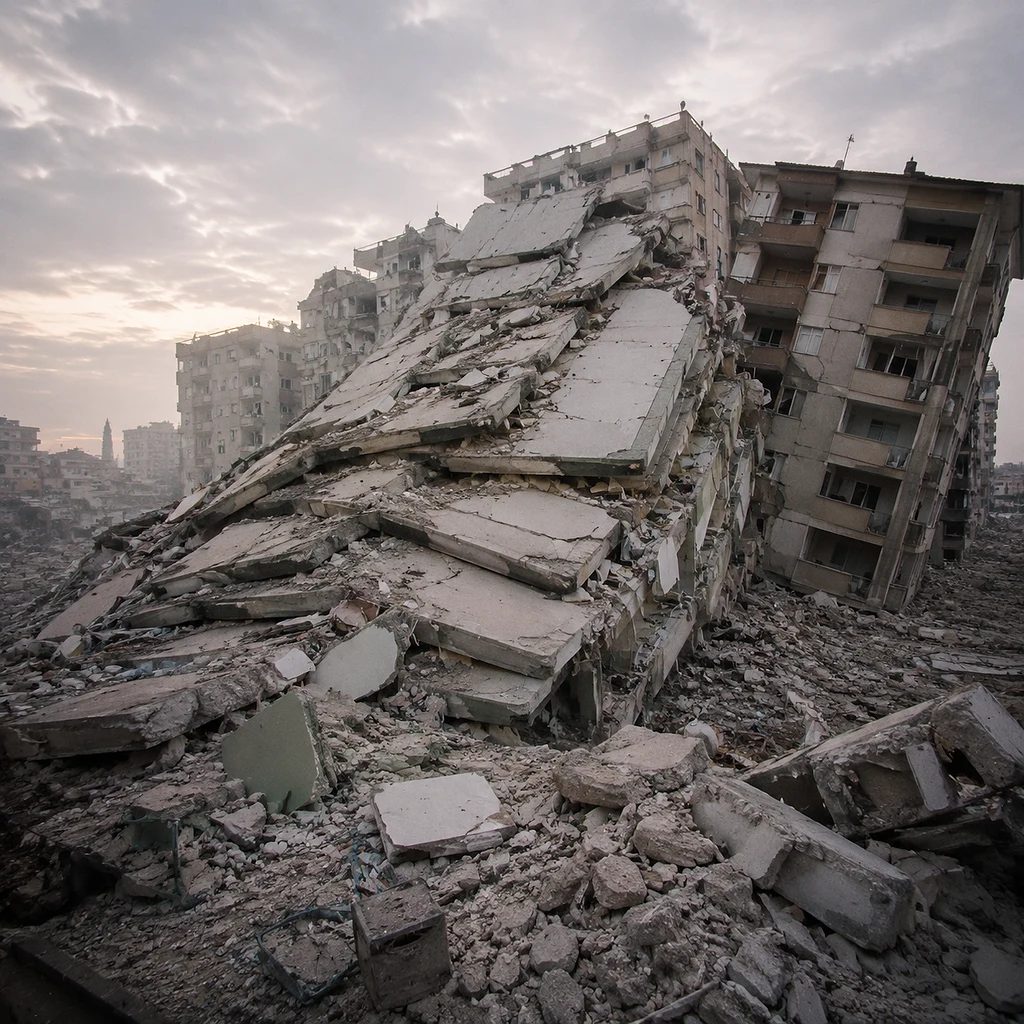
39秒,两次强震:委内瑞拉大地震,为什么夺走了上千条生命?
Venezuela Earthquake: Two Quakes in 39 Seconds
About this story
The June 24 2026 Venezuela earthquakes: twin Mw 7.2 and 7.5 quakes 39 seconds apart, Caracas high-rises pancaking, the man-made fragility behind the death toll, the golden 72 hours, and the worldwide rescue — including eight Chinese victims. HSK 3 Chinese listening practice.
This is an HSK 3-4 Chinese listening episode that runs about 4 minutes. The full Mandarin script is shown with tap-for-pinyin and a line-by-line English translation, so you can listen and read at once — comprehensible input in the sense of Stephen Krashen's i+1 theory. It teaches 14 key vocabulary words such as 严重、城市、国家 and walks through 7 grammar patterns, each explained in English with examples. The same news story is retold at 4 difficulty levels — use the level selector above to find the version that is challenging but still understandable for you.
Read at your level
原文Read the complete story in Chinese. Reveal pinyin and English only when you need them.
English transcript reference
Today we'll talk about a very heavy event that just happened — the Venezuela earthquake.
Venezuela is a country in northern South America, far from China.
But this earthquake was so severe that the whole world is watching.
It happened on the evening of June 24th.
Many people had just gotten home from work and were about to have dinner.
Just then, the earth suddenly began to shake violently.
The most terrifying part is that it wasn't one quake, but two in a row.
The first was magnitude 7.2; just thirty-nine seconds later, the second came, reaching 7.5.
The two quakes stacked together, shaking the ground for a full minute and more.
It is the strongest earthquake Venezuela has faced in over a hundred years.
Hardest hit were the capital, Caracas, and the nearby port city of La Guaira.
Caracas is a big city, its downtown full of high-rises.
When the quake hit, several high-rises collapsed entirely — like toy blocks.
One of them, a building of more than twenty floors, was leveled in mere seconds.
The people living inside had no time at all to escape.
So far, the quake has killed more than 1,400 people.
Over three thousand more were injured, and tens of thousands left homeless.
Even more wrenching, tens of thousands remain buried under the rubble, still missing.
So an unavoidable question: why were the casualties so devastating?
The sheer strength of the quake is, of course, one reason.
But experts point to another, more painful reason: the buildings themselves.
Many local buildings were simply not built solidly.
Some were very old; others were built too fast, in too much of a rush, with quality falling behind.
There's also a dangerous kind of building with an open, hollow ground floor used as a garage or shopfront.
When a strong quake hits such a building, the upper floors crash straight down and the whole thing 'stacks' together.
So what truly takes lives is often not the quake, but these flimsy buildings.
After an earthquake, time is life.
For the buried, every extra hour means a little less hope of survival.
So the first three days after the disaster — the so-called 'golden 72 hours' — are critical.
To seize these three days, the whole world sprang into action.
Mexico, Spain, France, Chile and many other countries urgently sent rescue teams.
With search dogs and instruments, they comb the rubble bit by bit for those still alive.
Speaking of this, I want to say one more thing to you.
A disaster like this, on the other side of the globe, seems far from us.
But this time, among the dead were eight Chinese compatriots.
In that moment you realize the so-called 'far away' is, in fact, tightly bound to us.
Finally, I want to leave you two questions.
First, we always say 'natural disaster' — but in this tragedy, how much was really 'man-made'?
Second, if one day an earthquake really happens near you, are you and your family prepared?
These two questions have no standard answer, but they're worth thinking about seriously.
Listen again
Try it without the transcript and notice what sounds clearer.
What vocabulary does this episode teach?
词汇这次地震,实在太严重了 = this earthquake was truly too severe.
HSK 1-3. city.
HSK 1-3. country.
HSK 1-3. world.
HSK 1-3. the Earth; the planet.
HSK 1-3. reason; cause.
HSK 1-3. dangerous.
一件非常沉重的大事 = a very grave event.
委内瑞拉,是南美洲北部的一个国家 = Venezuela is a country in northern South America.
大地,突然剧烈地动了起来 = the earth suddenly shook violently.
第一次,是七点二级 = the first was magnitude 7.2.
两次强震叠加 = the two strong quakes stacking together.
旁边的港口城市拉瓜伊拉 = the nearby port city of La Guaira.
几乎是在几秒钟内,被夷为平地 = leveled in mere seconds.
* beyond level超纲词
What grammar patterns appear in this episode?
语法最 ... 的地方在于 ... (the most ... part is that...)
Singles out the most striking aspect.
最可怕的地方在于,这次不是一次地震,而是接连两次。
仅仅 ... 之后 (only ... later)
Stresses how little time passed.
仅仅三十九秒之后,第二次来了。
像 ... 一样 (like..., simile)
A vivid comparison.
好几栋高楼,竟然像积木一样,整个塌了下去。
往往不是 X,而是 Y (often not X, but Y)
Corrects to the true cause.
真正夺走生命的,往往不是地震,而是这些不结实的房子。
每多 ... ,就 ... (each additional..., then...)
Co-varying with each increment.
被埋的人,每多等一个小时,生还的希望就少一分。
所谓的 X,其实 ... (the so-called X is, in fact, ...)
Reframes a common notion.
所谓的远方,其实和我们紧紧相连。
这两个问题,没有标准答案,但是值得 ... 想一想
The channel's reflective close.
这两个问题,没有标准答案,但是值得我们认真想一想。
Proper Nouns
专有名词Free account
Keep learning from this story
Create a free account to keep saved words and your preferred level together.
- Keep words with their story context
- Remember your preferred level
- Build your vocabulary over time