
A Chinese podcast · Same story, 4 levels
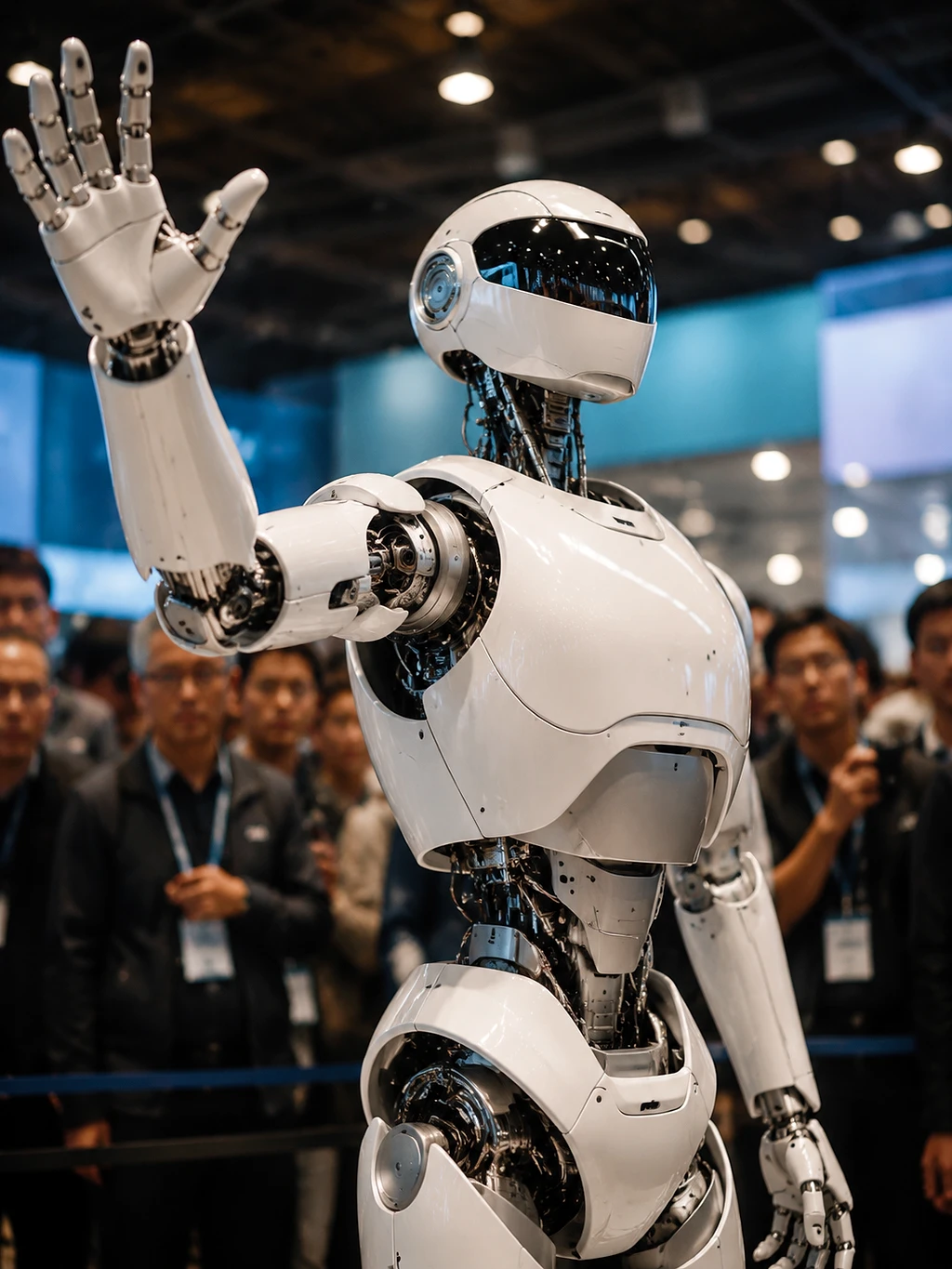
世界人工智能大会:上海,为什么挤满了机器人?
Shanghai World AI Conference Showcases Robots
About this story
Shanghai World AI Conference Showcases Robots. HSK 2 Chinese listening practice.
This is an HSK 2 Chinese listening episode that runs about 3 minutes. The full Mandarin script is shown with tap-for-pinyin and a line-by-line English translation, so you can listen and read at once — comprehensible input in the sense of Stephen Krashen's i+1 theory. It teaches 8 key vocabulary words such as 公司、医院、工作 and walks through 2 grammar patterns, each explained in English with examples. The same news story is retold at 4 difficulty levels — use the level selector above to find the version that is challenging but still understandable for you.
Read at your level
原文Read the complete story in Chinese. Reveal pinyin and English only when you need them.
English transcript reference
Today, we're talking about a conference.
This conference just wrapped up, right here in Shanghai.
It's called the World Artificial Intelligence Conference.
Artificial intelligence is what we call AI.
This conference is big, and very lively.
Very, very many people came.
They came from many countries.
This year's conference is very, very big.
It's one of the biggest AI conferences in the world.
More than a thousand companies came, each bringing something new.
This year, over 1,400 guests attended.
Among all these new things, the most interesting are the robots.
This year, there were over 200 robots at the conference.
These robots look more and more like humans.
They can walk, can talk, and can even help people do things.
Some robots can work in restaurants and hotels.
They can carry things for guests, and answer guests' questions.
You can see that AI is no longer just something inside computers.
It is slowly moving into our real lives.
Now, AI has already entered many places.
In factories, AI helps make things.
In hospitals, AI helps doctors treat patients.
Even the cars we drive every day have started using AI.
In fact, this is the biggest change at this year's conference.
Before, people competed over whose AI was smarter.
Now, people compete over whose AI is more useful — whose can really help people.
Besides these robots, the conference had many other new things.
For example, many new chips, and many new large AI models.
Speaking of which, there's one more very important thing.
China's leader, Xi Jinping, also came and gave a speech at this conference.
He said AI is a great opportunity, and the whole world should make good use of it together.
He also said some countries are poorer and don't yet have the ability to build AI.
China is willing to help these countries, so everyone can use AI.
He specially mentioned one word: "open source."
"Open source" means: I make the technology public, and everyone can use it for free.
China wants to use this approach to make AI more fair.
Besides Xi Jinping, many other important people came, too.
For example, the Secretary-General of the United Nations also came to Shanghai.
In recent years, China and the United States have been competing on AI.
This conference also showed the world that China's AI is developing very well, and very fast.
From all this, we can see that AI is now no longer just a technology.
It has also become a big deal that many countries care about.
OK, today we talked about this conference.
One conference let us see AI's present, and also its future.
Listen again
Try it without the transcript and notice what sounds clearer.
What vocabulary does this episode teach?
词汇一千多家公司都带来了新东西 — Over a thousand companies brought new things.
在医院里,AI 帮医生看病 — In hospitals, AI helps doctors.
有的机器人可以在饭馆、酒店里工作 — Some robots can work in restaurants and hotels.
机器人可以回答客人的问题 — Robots can answer guests’ questions.
我们开的车,也开始用 AI 了 — Even the cars we drive have started using AI.
Beyond HSK 1-2. The most eye-catching exhibit at the conference.
Beyond HSK 1-2. 把技术公开,大家都可以免费用 — making the tech public so everyone can use it for free.
Beyond HSK 1-2. 很多新的芯片 — many new chips were shown.
* beyond level超纲词
What grammar patterns appear in this episode?
语法不只是 A,...
"Not just A (but more)" — used to expand beyond a simple statement.
AI 已经不只是电脑里的东西了。
AI 现在,已经不只是技术了。
Proper nouns
专有名词Free account
Keep learning from this story
Create a free account to keep saved words and your preferred level together.
- Keep words with their story context
- Remember your preferred level
- Build your vocabulary over time