
A Chinese podcast · Same story, 4 levels
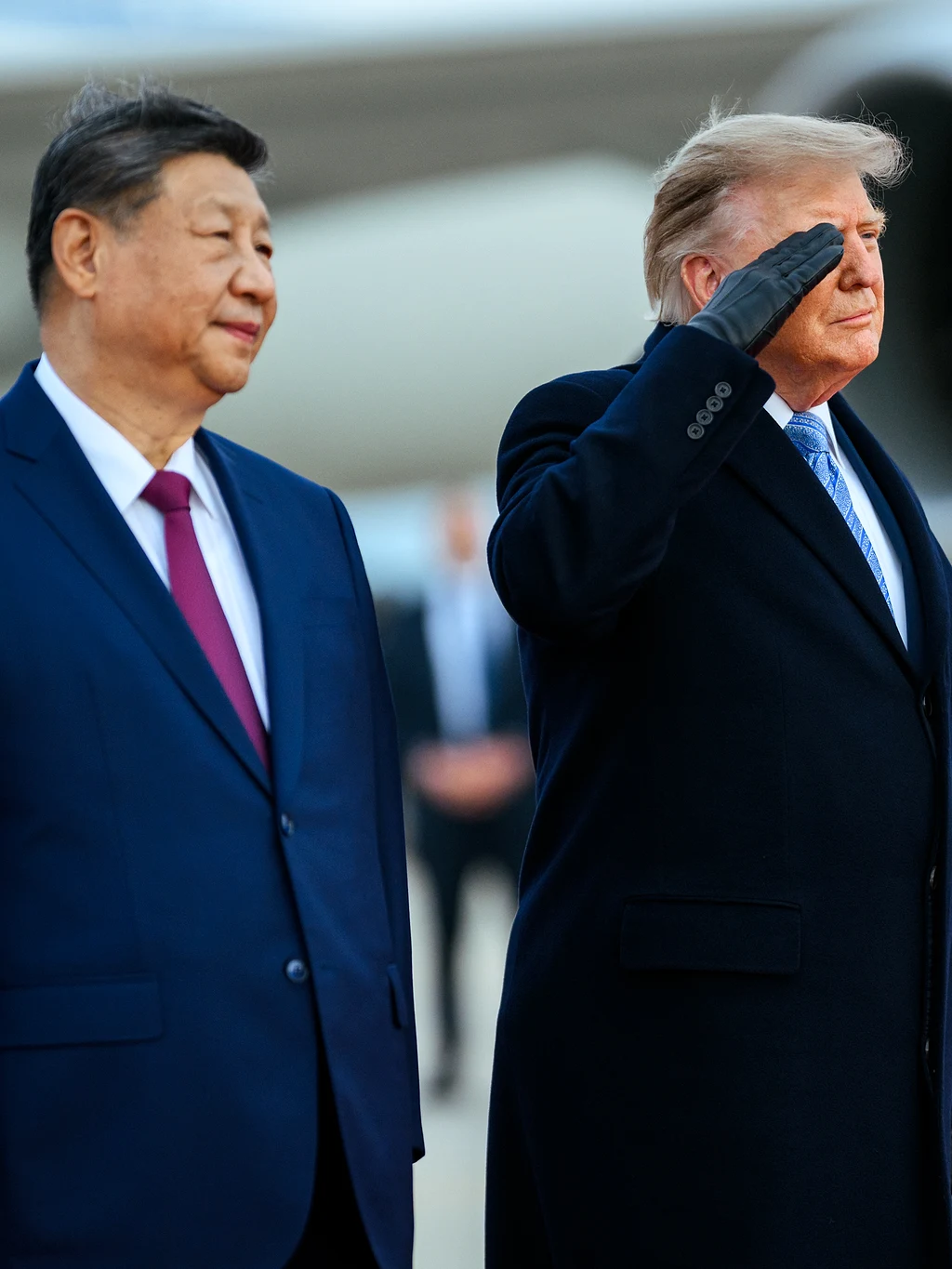
Photo: The White House · Public domain
习近平十一年来首访华盛顿:隆重欢迎、一对大熊猫,和延长两个月的贸易休战
Xi's First Washington Visit in 11 Years: Pageantry, a Pair of Pandas and a Two-Month Trade Truce
About this story
Chinese President Xi Jinping's three-day state visit to Washington (Sept 23–25, 2026) returned Donald Trump's May trip to Beijing. Trump met him at the plane; Xi said AI must stay under human control and competition should be a race, not a wrestling match; a harpist played 'The Moon Represents My Heart' at the state dinner. China's foreign ministry listed eight points, including a two-month trade-truce extension, an AI dialogue and incident hotline, and two pandas loaned to Zoo Atlanta — while US analysts called it big on spectacle, light on substance. Chinese listening practice at four levels. HSK 5-6 Chinese listening practice.
This is an HSK 5-6 Chinese listening episode that runs about 5 minutes. The full Mandarin script is shown with tap-for-pinyin and a line-by-line English translation, so you can listen and read at once — comprehensible input in the sense of Stephen Krashen's i+1 theory. It teaches 12 key vocabulary words such as 尊重、公平、稳定 and walks through 3 grammar patterns, each explained in English with examples. The same news story is retold at 4 difficulty levels — use the level selector above to find the version that is challenging but still understandable for you.
Read at your level
原文Read the complete story in Chinese. Reveal pinyin and English only when you need them.
English transcript reference
From September 23 to 25, Chinese President Xi Jinping made a three-day state visit to the United States.
It was his first formal visit to Washington in eleven years, returning President Trump's visit to China in May.
It was the first time in the history of China-US relations that the two heads of state had made state visits to each other in the same year.
On the 23rd, Xi and his wife Peng Liyuan arrived on a special flight at Joint Base Andrews near Washington.
Trump and First Lady Melania met them in person on the tarmac, with a red carpet, a military band and a 21-gun salute, as two bombers flew overhead.
It's very unusual for an American president to meet a foreign leader at the airport in person.
On the morning of the 24th, the White House held a formal welcome ceremony.
Trump said that since his first election in 2016, he and Xi had built a truly great friendship.
Xi said he was ready to work with Trump to steer the great ship of China-US relations toward a stable future.
He said China and the US are different, but through candid, in-depth and continued dialogue the two countries can understand each other better.
On artificial intelligence, he said both countries have the ability and the responsibility to make AI do good, and to keep it under human control at all times.
He also offered a comparison: competition between the two countries should be like a race, each chasing the other, everyone running forward together.
It shouldn't be like a gladiator fight, where if one side wins, the other loses.
The two leaders then held talks in the Oval Office.
According to Xinhua, Xi asked the US side in the talks to oppose "Taiwan independence," and called for reconciliation between the US and Iran.
That evening the White House held a state banquet; guests included the US vice president, many cabinet secretaries and Supreme Court justices, as well as the heads of big companies such as Nvidia, Apple, Tesla and Amazon.
While guests waited for the two leaders' remarks, a harpist played "The Moon Represents My Heart," because the Mid-Autumn Festival was coming.
In his toast, Trump said relations between the two countries had never been better.
On the 25th, the two leaders had tea in the White House Red Room, then visited the National Archives together to see the Declaration of Independence and the US Constitution.
Trump said: ours goes back two hundred and fifty years, theirs six thousand — there's a bit of a difference between the two.
After the visit, China's foreign ministry published the eight-point consensus reached by China and the US; let's go through it point by point.
First, the two sides agreed to build a stable relationship based on mutual respect, fairness and reciprocity.
Second, China is hosting this year's APEC meeting and the US is hosting the G20 summit; each country supports the other, and both leaders will attend.
Third, on Iran, the two leaders agreed that Iran should keep its commitment not to develop nuclear weapons, and that no country may charge ships for passing through international waterways.
Fourth, the two sides recalled the history of the Second World War, when China and the US were allies who won the war together.
Fifth, on the economy and trade, the two sides agreed to set up a trade council and reached a thirty-billion-dollar reciprocal tariff-cut arrangement.
US Treasury Secretary Bessent announced that the trade truce reached last year in Busan, South Korea, would be extended by two months from November 10, to January 10 next year.
Sixth, the two countries are fighting drugs together; working jointly, they have recently cracked several cases and arrested dozens of suspects in both countries.
Seventh, the two sides agreed to set up an AI dialogue to discuss AI's risks and benefits, with the next round this November.
The two countries will also set up a communication channel so that if something goes wrong with AI, they can contact each other right away.
Eighth, China is lending a pair of giant pandas to Zoo Atlanta, and the US side welcomed them.
As planned, the two leaders will meet twice more this year: at the APEC meeting in Shenzhen in November, and at the G20 summit in Miami in December.
But views of the visit inside the US are divided.
James Lindsay, a scholar at the Council on Foreign Relations, believes the visit will extend the current truce without producing any major new agreements.
American financial media concluded that the summit was big on spectacle and light on substance.
On Taiwan, China's imports of Iranian oil and the Russia-Ukraine war, clear differences between the two sides remain.
In addition, because the White House had earlier barred some news outlets, media coverage of the visit was also restricted.
A single visit can use a grand welcome to bring two sides a little closer, but it can hardly resolve many years of differences in one go.
In your view, what do two great powers need more: frequent meetings, or concrete agreements?
Listen again
Try it without the transcript and notice what sounds clearer.
What vocabulary does this episode teach?
词汇HSK 3. 互相尊重、公平、对等的稳定关系.
HSK 4. 互相尊重、公平、对等.
HSK 4. 把中美关系这艘大船引向稳定的未来.
HSK 4. 两国都有能力、也有责任.
HSK 3. 最近合作破了好几个案子.
HSK 4. 贸易理事会 / 贸易休战.
The highest level of official visit.
两国元首.
那时候中国和美国是盟友.
二十国集团峰会.
沟通渠道 — the AI incident hotline.
双方的分歧依然明显.
* beyond level超纲词
What grammar patterns appear in this episode?
语法据……报道
According to a report by — attributes a claim.
据新华社报道,习近平在会谈中要求美方反对“台独”,并呼吁美国和伊朗实现和解。
……,则……
Whereas — contrasts two views.
美国的财经媒体则说,这次峰会场面很大,实际的内容不多。
可以……,可是很难……
Can do X, but hardly Y.
一次访问,可以用隆重的欢迎让关系近一点,可是很难一下子解决很多年的分歧。
Proper Nouns
专有名词Free account
Keep learning from this story
Create a free account to keep saved words and your preferred level together.
- Keep words with their story context
- Remember your preferred level
- Build your vocabulary over time