
A Chinese podcast · Same story, 4 levels
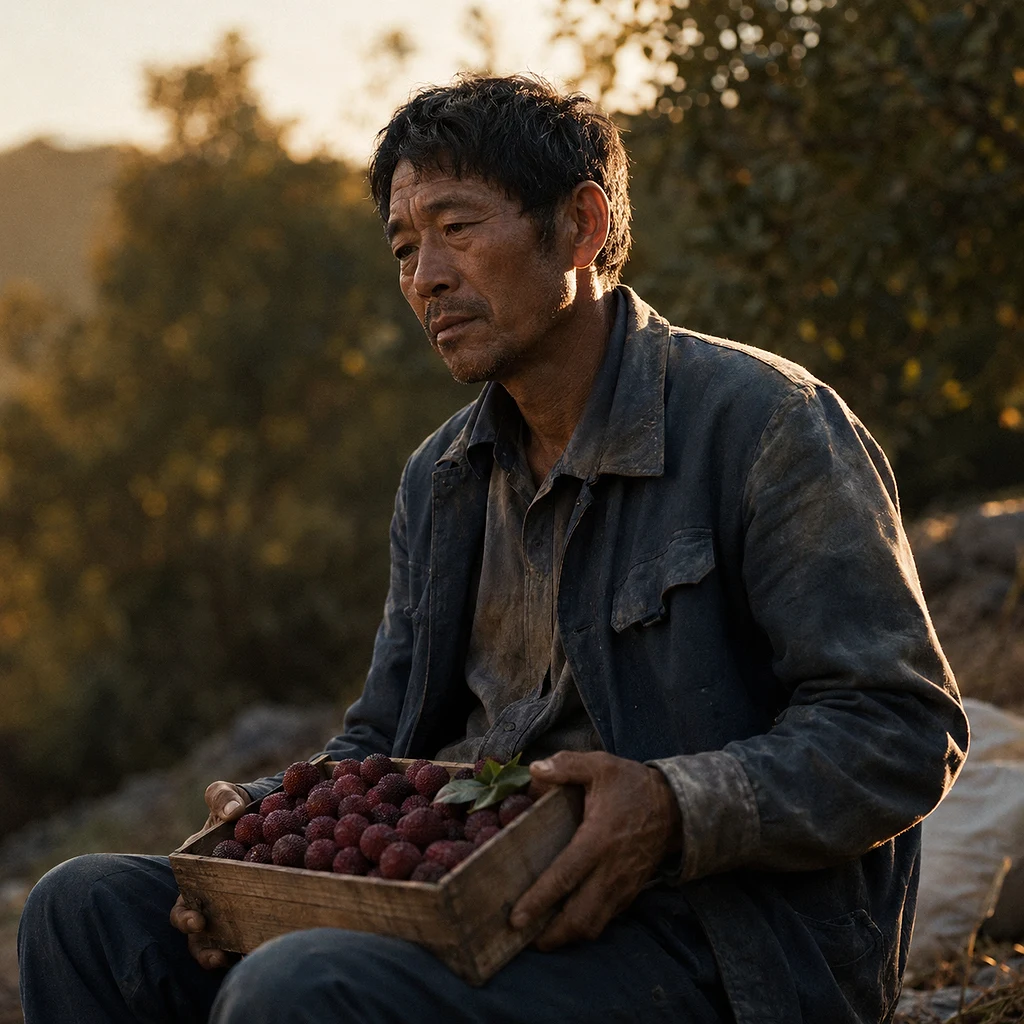
杨梅泡水风波:果农为什么哭了
The Bayberry Soaking Scandal: Why a Farmer Is Crying
About this story
The Bayberry Soaking Scandal: Why a Farmer Is Crying. HSK 2 Chinese listening practice.
This is an HSK 2 Chinese listening episode that runs about 4 minutes. The full Mandarin script is shown with tap-for-pinyin and a line-by-line English translation, so you can listen and read at once — comprehensible input in the sense of Stephen Krashen's i+1 theory. It teaches 12 key vocabulary words such as 今天、吃、知道 and walks through 4 grammar patterns, each explained in English with examples. The same news story is retold at 4 difficulty levels — use the level selector above to find the version that is challenging but still understandable for you.
Read at your level
原文Read the complete story in Chinese. Reveal pinyin and English only when you need them.
English transcript reference
Today we'll tell a story.
This story
is about yangmei (bayberry).
What is yangmei?
Yangmei is a kind of fruit.
It's red,
small,
very sweet,
and a little sour.
Every May
and June
is yangmei season.
This is a
very short season.
Only a few weeks.
Yangmei has one trait:
it cannot be kept long.
After being picked,
in two or three days
it starts to go bad.
So
the farmers who grow yangmei
wait all year long
just for these two or three weeks.
That is what makes the yangmei business
special.
Now,
let's talk about
the recent news.
In mid-May
there was a news story
that made everyone angry.
In southern China,
in a place called Zhangzhou,
there are some yangmei merchants.
They did something
that was not allowed.
They took the yangmei
and soaked it in a chemical liquid.
In this "chemical liquid"
there were two things.
One
was to make the yangmei
not spoil easily.
The other
was to make the yangmei
taste sweeter.
But both of these things,
the state has said:
"They may not be put
"in fresh fruit.
So
what they did
was illegal.
"Illegal"
means doing
what the law does not allow.
As soon as the news came out,
things got big.
The authorities, very quickly,
began to investigate.
They found five such places,
and five people in them
were taken by the police.
But
the story was not over.
After the news came out,
many people no longer dared
to buy yangmei.
Not just Zhangzhou yangmei —
Zhejiang yangmei
also couldn't be sold.
Zhejiang has many farmers
who have grown yangmei for decades.
They had nothing
to do with this matter at all.
But
their yangmei
also had no buyers.
On May 23,
a Zhangzhou farmer
was selling yangmei online.
As he spoke,
he cried.
He said
his yangmei
had been honestly grown.
He never used any bad thing.
But because of this news,
none of it could be sold.
He didn't know
what he should do.
This is the part of this matter
that hurts the most.
The people who did wrong
were only a few.
But the people who got hurt
were very many.
I read this news,
and I thought of one thing.
In doing business,
the most important thing, really,
is "trust."
"Trust"
means others believing you.
Many years of trust
can — because of a few bad people —
all at once be gone.
Building trust
takes many years;
losing trust,
very fast.
Finally I ask you:
When you buy things,
what do you fear the most?
That it's too expensive?
Or that you don't know
whether you can trust
the one selling?
Think about it.
Okay.
That's all for today.
Talk tomorrow.
Listen again
Try it without the transcript and notice what sounds clearer.
What vocabulary does this episode teach?
词汇Today. The narrator opens 今天我们说一个故事 — 'today we'll tell a story.'
To eat. The reflex after the news: people no longer dared to buy yangmei to eat.
To know. The farmer's despair: 他不知道,自己应该怎么办 — 'he didn't know what he should do.'
To cry. The image at the episode's heart: 他一边说,一边哭 — 'as he spoke, he cried.'
Important. The closing point: 做生意,其实最重要的一个东西,是"信任" — 'in business, the most important thing is trust.'
Sweet. The fruit and the scandal: 杨梅很甜,也有一点酸 — naturally sweet; but the sellers used a sweetener to make it sweeter still.
A small, dark-red, sweet-and-sour southern Chinese fruit. Beyond HSK2. The episode glosses it: 红色的、小小的、很甜、也有一点酸.
Farmer. Beyond HSK2. Many 农民 grew yangmei honestly for decades but couldn't sell a thing after the news.
Season. Beyond HSK2. Yangmei has 一个很短的季节 — 'a very short season,' only a few weeks each year.
Illegal. Beyond HSK2. The episode glosses it: 做了法律不让做的事 — 'doing what the law does not allow.'
Trust. Beyond HSK2. The closing reflection's keyword: 别人相信你. Trust takes years to build, can be lost fast.
Sad, upset. Beyond HSK2. 最让人难过的地方 — 'the part that hurts the most': honest farmers got hurt too.
* beyond level超纲词
What grammar patterns appear in this episode?
语法X,就是 Y
A simple definition pattern: say the word, then 就是, then a plain explanation. The episode uses it to unpack 违法 and 信任.
"违法",就是做了法律不让做的事。
"信任",就是别人相信你。
因为 introduces the cause. The episode uses it to explain why honest farmers' yangmei went unsold.
但是因为这个新闻,全部都卖不出去。
但是因为这件事,没有人敢再买杨梅。
一边 A,一边 B
一边…一边… describes two actions happening together. The episode uses it for the farmer who was selling AND crying.
他一边说,一边哭。
完全 + 没/不
完全 sharpens a negation to mean 'entirely.' The episode uses it to stress that Zhejiang farmers had nothing to do with the scandal.
他们和这件事,完全没有关系。
Proper nouns
专有名词Free account
Keep learning from this story
Create a free account to keep saved words and your preferred level together.
- Keep words with their story context
- Remember your preferred level
- Build your vocabulary over time