
A Chinese podcast · Same story, 4 levels
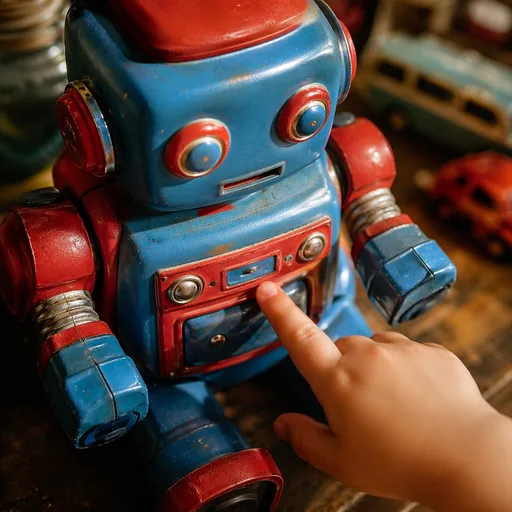
手机聪明吗?
Luc Julia Questions Whether AI Really Thinks
About this story
A simple story: Xiaoming asks if his phone is really smart, and what Luc Julia says about AI not truly thinking. HSK 1 Chinese listening practice.
This is an HSK 1 Chinese listening episode that runs about 3 minutes. The full Mandarin script is shown with tap-for-pinyin and a line-by-line English translation, so you can listen and read at once — comprehensible input in the sense of Stephen Krashen's i+1 theory. It teaches 10 key vocabulary words such as 手机、聪明、懂 and walks through 4 grammar patterns, each explained in English with examples. The same news story is retold at 4 difficulty levels — use the level selector above to find the version that is challenging but still understandable for you.
Read at your level
原文Read the complete story in Chinese. Reveal pinyin and English only when you need them.
English transcript reference
Today we are going to talk about whether AI is smart or not.
Xiaoming really likes using his mobile phone.
His mobile phone is very good.
A mobile phone can do many things.
Xiaoming says, the mobile phone is really smart.
But is the mobile phone smart?
The mobile phone is not smart.
A mobile phone is a tool.
Tools cannot think.
Tools cannot ponder.
Xiaoming asks his mom.
Mom, is AI smart?
Mom says, it is not smart.
AI is not a human.
AI is a tool.
Tools can do things.
But tools cannot think.
Xiaoming does not quite understand.
He says, AI can speak.
AI can write.
AI is very smart, right?
Mom smiled.
Mom says, no, it is not.
Look, a calculator can do math.
A calculator calculates very fast.
But is a calculator smart?
It is not smart.
A calculator is a tool.
AI is also a tool.
AI calculates very fast.
AI does things very fast.
But AI cannot think.
Humans can think.
AI cannot.
Xiaoming thought for a moment.
He says, I understand.
My mobile phone is a tool.
AI is also a tool.
Tools can help us.
But tools are not smart.
Mom says, correct.
Tools are very good.
We use tools to do things.
But tools are not humans.
Xiaoming is very happy.
He understands.
He says, AI is very useful.
But AI is not smart.
Humans are smart.
AI is not smart.
There is a person named Luc Julia.
He wrote a book.
He says AI is not smart.
AI is a tool.
Tools do things very fast.
But tools cannot think.
We need to remember.
AI is a good tool.
But AI is not a human.
Listen again
Try it without the transcript and notice what sounds clearer.
What vocabulary does this episode teach?
词汇A common noun for a cell phone or smartphone. The measure word is 部 (bù) or 个 (gè).
An adjective used to describe someone or something that is intelligent.
A verb meaning to comprehend or grasp a concept.
A verb used to indicate assisting someone or something.
A separable verb (verb-object compound) meaning to speak words.
A noun referring to an instrument or device used to accomplish a task.
A formal verb for deep thinking or cognitive processing, compared to the simpler 想 (xiǎng).
A noun for the electronic device used for mathematical calculations.
A verb-object compound meaning to perform mathematical operations.
A verb with a resultative complement (住) indicating that something is firmly fixed in the memory.
* beyond level超纲词
What grammar patterns appear in this episode?
语法A不A (Affirmative-Negative Question)
A common way to form a yes/no question by placing the affirmative and negative forms of a verb or adjective side by side.
今天我们说一说AI聪明不聪明。
会 (huì) for Ability
The modal verb 会 is used before a verb to express an acquired skill or an inherent capability to do something.
工具不会想。
AI会说话。
计算器会算数。
Verb + 得 + Adverb/Adjective (Degree Complement)
The structural particle 得 connects a verb to a descriptive word or phrase that explains how well or in what manner the action is performed.
计算器算得很快。
AI算得很快。
AI做得很快。
Verb Reduplication (Verb + 一 + Verb / Verb + 了 + Verb)
Repeating a verb softens the tone, indicates a short duration, or implies a casual attempt at the action.
今天我们说一说AI聪明不聪明。
小明想了想。
Proper nouns
专有名词Free account
Keep learning from this story
Create a free account to keep saved words and your preferred level together.
- Keep words with their story context
- Remember your preferred level
- Build your vocabulary over time