
A Chinese podcast · Same story, 4 levels
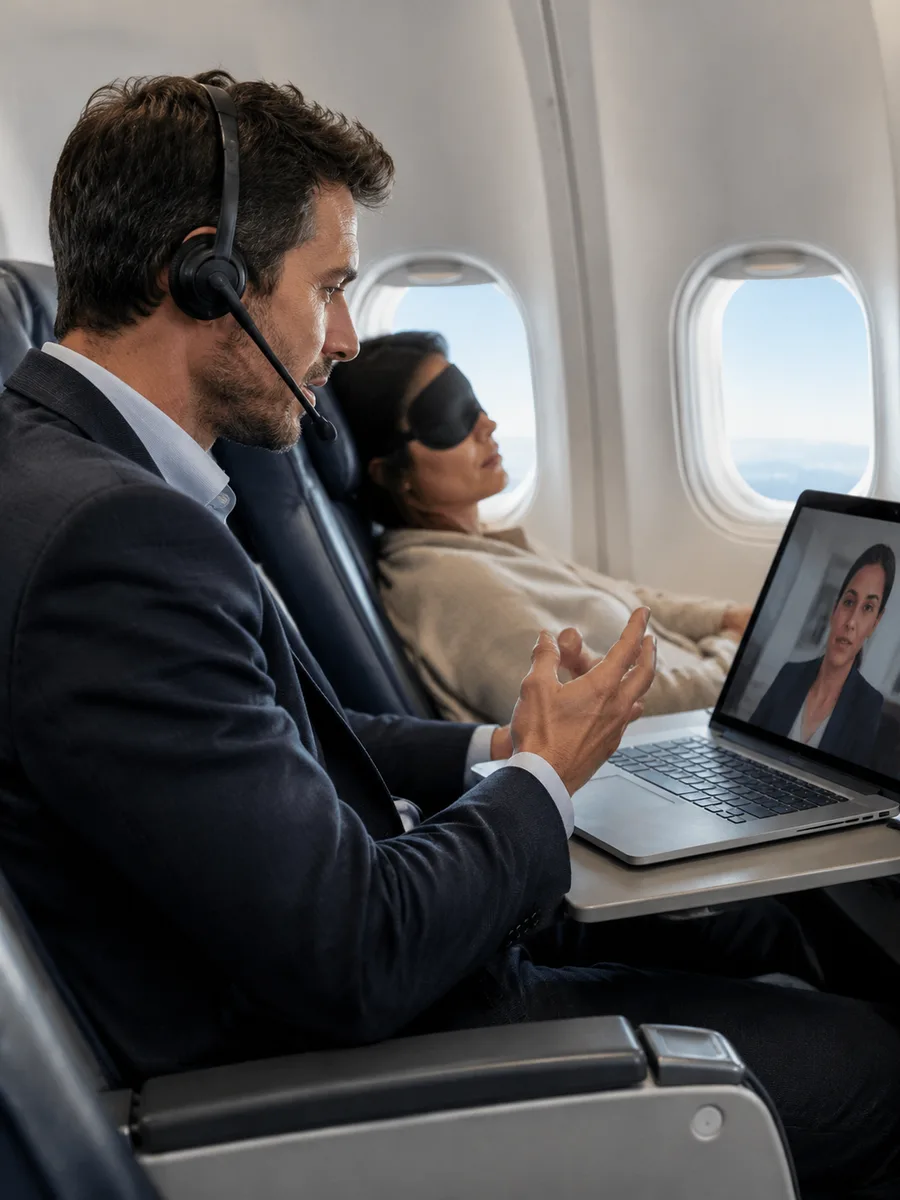
飞机能上网了,旁边的人开始开会了
Fast Plane Wi-Fi Brings Noisy Work Calls
About this story
HSK 5 Chinese listening. Fast airplane Wi-Fi enables work calls, raising questions about airline rules and other passengers wanting quiet.
This is an HSK 5-6 Chinese listening episode that runs about 2 minutes. The full Mandarin script is shown with tap-for-pinyin and a line-by-line English translation, so you can listen and read at once — comprehensible input in the sense of Stephen Krashen's i+1 theory. It teaches 12 key vocabulary words such as 飞机、电话、工作 and walks through 4 grammar patterns, each explained in English with examples. The same news story is retold at 4 difficulty levels — use the level selector above to find the version that is challenging but still understandable for you.
Read at your level
原文Read the complete story in Chinese. Reveal pinyin and English only when you need them.
English transcript reference
Starlink makes internet on planes faster, but passengers have also started hearing the people next to them hold meetings.
Christopher Mosby was on a United flight from Chicago to Denver, and fifteen minutes after takeoff, he heard a work call.
Someone asked, "Can you see my screen?" But Mosby did not want the entire cabin to join someone else's meeting.
Another passenger, Oliver Louie, on a Qatar Airways flight, encountered a work call that lasted two hours.
That person was sitting several rows behind him; many passengers wanted to sleep, but they heard the work content from the call.
Fast internet lets people work, and it also lets one person's voice enter many people's rest time.
Airlines' rules about calls are not the same.
United prohibits passengers from making voice or video calls, including using the plane's wireless internet.
Qatar Airways allows calls, but requires passengers to wear headphones and speak softly, showing consideration for the people nearby.
Emirates and British Airways also allow calls under these conditions.
U.S. restrictions on in-flight cellular mobile network calls do not directly cover calls over airplane wireless internet, so airline policies are important.
Some lawmakers proposed the "Quiet Skies Act," hoping to ban in-flight voice calls, but it is still just a proposal.
Some people also oppose a blanket ban, arguing that rules should target behavior that disturbs others, distinguishing work meetings from brief "I'm safe" check-ins.
Boeing displayed the E-Lounge concept at an expo, like a small phone booth, intending to give people making calls a space and reduce sound leaking out.
This space is still only a design; travelers cannot now get on a plane and go to a room like this to make a call.
Starlink has brought convenience, and airlines and passengers still have to decide how to share a quiet cabin.
If your colleague asked you to join a meeting on a plane, while the people around you were all sleeping, how would you reply?
Listen again
Try it without the transcript and notice what sounds clearer.
What vocabulary does this episode teach?
词汇HSK 1. Common noun for airplane; appears in 飞机上 (on the plane).
HSK 1. Used in 工作电话 (work call) and 打电话 (make a phone call).
HSK 1. Appears in 工作电话 and 工作内容 (work content).
HSK 5. Used in 无线网络 (wireless network) and 移动网络 (mobile network).
HSK 4. Formal verb; often takes a verb phrase, as in 禁止乘客打语音电话.
HSK 4. Used for airline rules: 允许通话 (allow calls).
HSK 4. Appears in 对通话的规定 (rules about calls).
HSK 3. Used in 休息时间 (rest time).
Proper noun: SpaceX's satellite internet service; central to the story.
Aviation term; refers to the passenger area of an aircraft.
Formal term for a call; used in 语音通话 (voice call) and 视频通话 (video call).
Political/legal term; refers to a proposed law or motion.
* beyond level超纲词
What grammar patterns appear in this episode?
语法让 + person/thing + verb phrase
The causative 让 means 'let/make/cause someone or something do something.'
Starlink让飞机上网更快,可是乘客,也开始听旁边的人开会。
快网络让人可以工作,也让一个人的声音,进入许多人的休息时间。
从 + place + 去 + place
Expresses movement from one place to another: 'from ... to ...'.
Christopher Mosby坐United的飞机,从芝加哥去丹佛,起飞十五分钟后,就听到了工作电话。
对 + object + 的 + noun
The preposition 对 marks the topic or target: 'rules about calls,' 'restrictions on calls.'
各家航空公司,对通话的规定,并不相同。
美国对飞行中手机移动网络通话的限制,并不直接涵盖飞机无线网络通话,所以航空公司的政策很重要。
却 + verb phrase
The adverb 却 marks contrast: 'but/yet' something unexpected happens.
有人问,能看到我的屏幕吗,Mosby却不想让整个客舱,都加入别人的会议。
那个人坐在他后面几排,许多乘客想睡觉,却听到了电话里的工作内容。
Proper nouns
专有名词Sources
来源Free account
Keep learning from this story
Create a free account to keep saved words and your preferred level together.
- Keep words with their story context
- Remember your preferred level
- Build your vocabulary over time