
A Chinese podcast · Same story, 4 levels
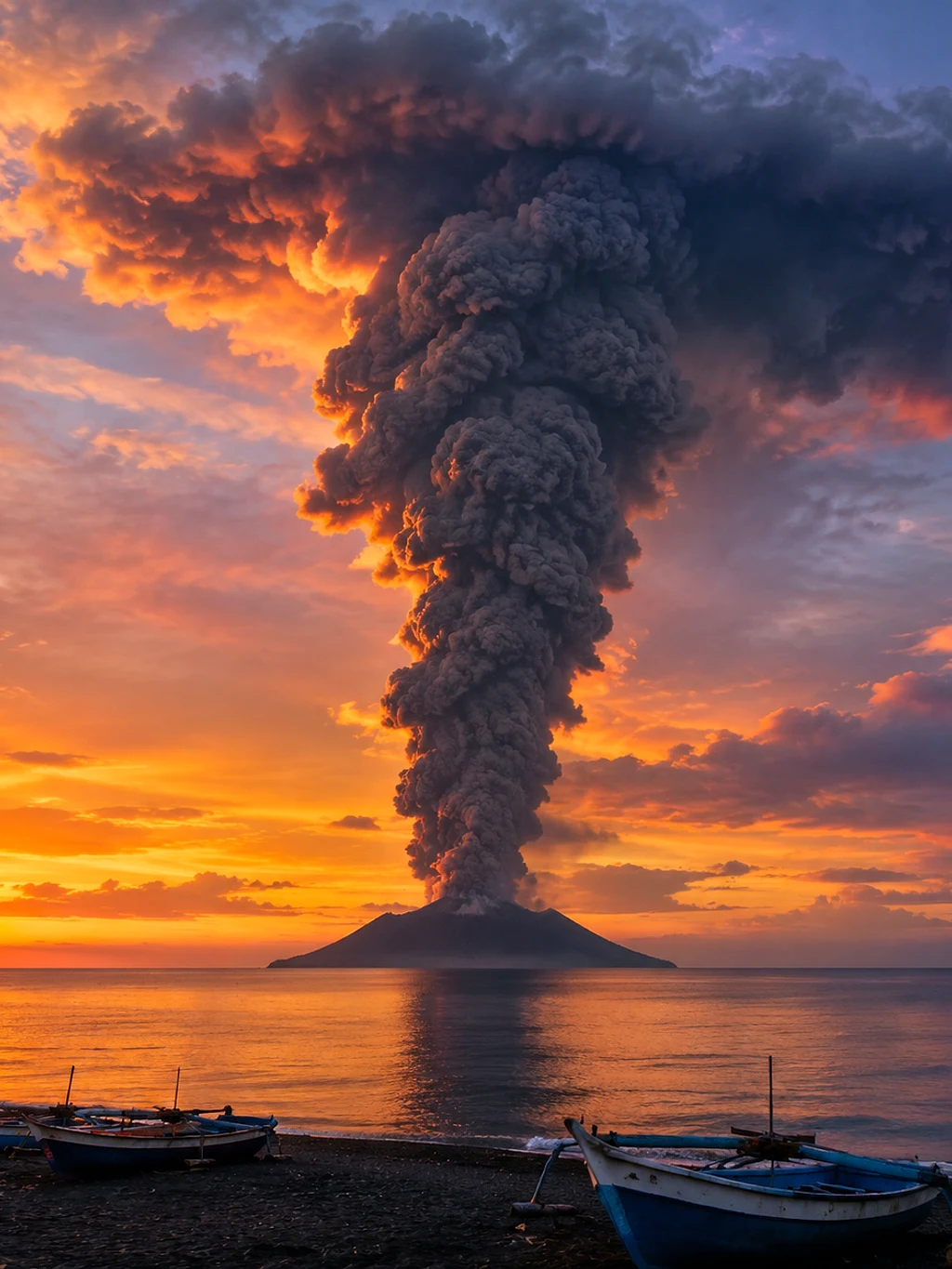
喀拉喀托之子在半夜醒了:七百公里外都听得见,八个机场关闭,二十七万人走不了,地面上没有一个人死
Anak Krakatau Eruption Strands 270,000 Travelers
About this story
Anak Krakatau erupted late on a Friday night in early September 2026, throwing ash to 15,000 metres and booming 700 km away. Eight Indonesian airports closed, 1,558 flights were cancelled and 270,000 passengers were stranded — and nobody died and no village was evacuated. The entire cost landed in the air. Chinese listening practice at four levels. HSK 2 Chinese listening practice.
This is an HSK 2 Chinese listening episode that runs about 4 minutes. The full Mandarin script is shown with tap-for-pinyin and a line-by-line English translation, so you can listen and read at once — comprehensible input in the sense of Stephen Krashen's i+1 theory. It teaches 12 key vocabulary words such as 山、水、孩子 and walks through 3 grammar patterns, each explained in English with examples. The same news story is retold at 4 difficulty levels — use the level selector above to find the version that is challenging but still understandable for you.
Read at your level
原文Read the complete story in Chinese. Reveal pinyin and English only when you need them.
English transcript reference
Today we are talking about a mountain.
This mountain is not in front of your house.
This mountain is in the water.
The water is big — very, very big.
In the water there are small places where people can live.
This mountain is right there.
This mountain has a name.
It is a good name.
The name is: the big mountain's child.
You are thinking: do mountains have children?
Let us talk about it.
Many years ago, there was a very big mountain there.
More than a hundred years ago, something happened to that big mountain.
Fire came out of the mountain.
A great deal came out of it — a very great deal.
After that day, the big mountain was gone.
Many people died.
That was a very big event.
A hundred years ago, a small mountain came up out of the water.
This small mountain was where the big one had been.
So everyone calls it: the big mountain's child.
This mountain is in a country, and that country is called Indonesia.
Today, that child has grown up.
This September, on a Friday.
It was very late that night, and everyone was at home.
Something happened to this mountain.
Fire came out of the mountain.
And a great deal of black stuff came out too.
The black stuff went up.
It went up very, very high into the sky.
How high?
Fifteen kilometres.
Planes fly in the sky, and even they do not go that high.
Late that night, many people heard a great sound.
People far away heard it too.
How far?
Seven hundred kilometres.
Seven hundred kilometres is very, very far.
You are at home.
You hear it.
You do not know what it is.
But on this day, one thing was different.
Nobody died.
Not one person.
And nobody had to leave.
Everyone stayed at home.
So then, what happened?
The planes could not fly.
There was all that black stuff in the sky.
If a plane goes up into it, something very bad happens.
So eight airports all shut.
Eight airports.
There were a great many people there.
They wanted to fly, and they could not fly.
How many people?
Two hundred and seventy thousand.
Two hundred and seventy thousand people, inside the airports.
Some of them wanted to go home.
Some of them wanted to go somewhere far away.
But they could not go.
They stayed there, looking at the sky.
Here is what I want to say about this.
The mountain is in the water.
The people are in the airports.
Between the mountain and the people there are seven hundred kilometres.
But the moment the mountain acts, the people cannot leave.
Think about it:
You are at an airport.
You want to go home.
But the planes are not flying.
What do you do?
Listen again
Try it without the transcript and notice what sounds clearer.
What vocabulary does this episode teach?
词汇The subject of the whole episode, introduced before the word "volcano" is ever needed.
HSK 1. 这个山在水里 — how the episode places an island without the word for island.
HSK 2. The name of the volcano, and the hook the episode is built on.
HSK 1. 这个山有一个名字 — the name carries the entire back story.
HSK 2. 上到很高很高的天上 — repeated, then given a number.
HSK 2. 人就走不了了 — the one thing 270,000 people could not do.
山里出来了火 — the eruption described with a word a beginner already owns.
The strongest image in the episode: heard seven hundred kilometres away.
HSK 3. 一个大的声音 — you hear it at home and do not know what it is.
HSK 4. The unit that carries both numbers: fifteen up, seven hundred out.
Where the damage actually landed. Eight of them shut.
二十七万人 — Chinese counts in units of ten thousand, so this is the number to learn.
* beyond level超纲词
What grammar patterns appear in this episode?
语法有多 + adjective?
How + adjective is it? Chinese asks with 有多, and here the answer is always a bare number on the next line.
有多高?
有多远?
有多少人?
A 一……,B 就……
The moment A happens, B follows. The episode saves this for its last claim, where the two clauses are seven hundred kilometres apart.
可是山一出事,人就走不了了。
一个……都没有
Not a single one. 都 with a negative is far stronger than plain 没有, which is why the episode uses it for the death toll.
一个人都没有。
Proper nouns
专有名词Sources
来源Free account
Keep learning from this story
Create a free account to keep saved words and your preferred level together.
- Keep words with their story context
- Remember your preferred level
- Build your vocabulary over time