
A Chinese podcast · Same story, 4 levels
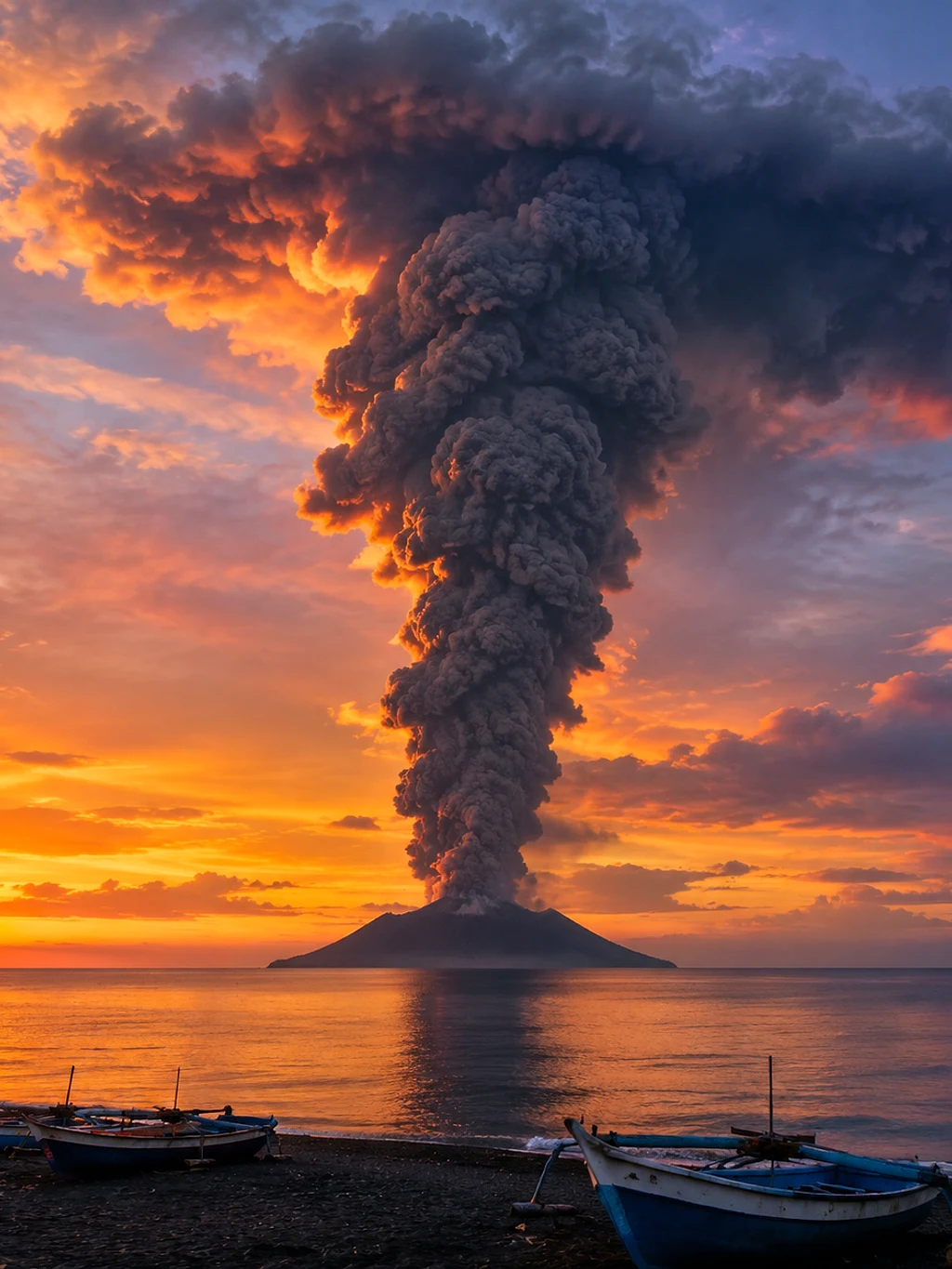
喀拉喀托之子在半夜醒了:七百公里外都听得见,八个机场关闭,二十七万人走不了,地面上没有一个人死
Anak Krakatau Eruption Strands 270,000 Travelers
About this story
Anak Krakatau erupted late on a Friday night in early September 2026, throwing ash to 15,000 metres and booming 700 km away. Eight Indonesian airports closed, 1,558 flights were cancelled and 270,000 passengers were stranded — and nobody died and no village was evacuated. The entire cost landed in the air. Chinese listening practice at four levels. HSK 3 Chinese listening practice.
This is an HSK 3 Chinese listening episode that runs about 3 minutes. The full Mandarin script is shown with tap-for-pinyin and a line-by-line English translation, so you can listen and read at once — comprehensible input in the sense of Stephen Krashen's i+1 theory. It teaches 12 key vocabulary words such as 国家、声音、石头 and walks through 3 grammar patterns, each explained in English with examples. The same news story is retold at 4 difficulty levels — use the level selector above to find the version that is challenging but still understandable for you.
Read at your level
原文Read the complete story in Chinese. Reveal pinyin and English only when you need them.
English transcript reference
Today's story is a big event from the start of September.
The place is Indonesia.
Indonesia is a very large country, but it is not one solid piece of land.
It is more than ten thousand islands.
People live on the islands, and going anywhere often means flying.
Between two of the big islands there is a stretch of sea.
In that sea there is a small mountain.
The name of this small mountain is unusual: "Child of Krakatoa".
"Child of" is exactly what it sounds like.
Why a child?
Because a very long time ago there was a big mountain here called Krakatoa.
In 1883, that big mountain blew up.
That time was terrible, and a great many people died.
After it blew, the big mountain was gone — only the sea was left.
Forty years later, a new small mountain slowly grew back up out of the sea.
It stood right where the old one had been, so everyone called it "the old mountain's child".
Now that child has grown up.
Early this September, on a Friday night, close to midnight, it started to erupt.
Fire came out of the mountain, and so did a great deal of ash.
The ash went upward, higher and higher.
On one side, the ash reached six thousand metres.
On the other side, the ash reached fifteen thousand metres.
Fifteen thousand metres is higher than where planes fly.
There was something else that night.
A great many people heard the sound from far away.
How far?
About seven hundred kilometres.
What does seven hundred kilometres mean?
It is roughly Beijing to Shanghai.
You are at home in Shanghai, and you hear something happening in Beijing.
But what came next is the interesting part.
This time, nobody died.
No village had to be moved.
They only drew a three-kilometre circle around the mountain, and boats could not go in.
That was all.
Where the real trouble happened was in the air.
The thing planes fear most is volcanic ash.
Ash is tiny, but it is stone.
A plane that flies into it breaks.
So for those few days, eight airports shut.
Among them was the biggest airport in Indonesia.
Over one thousand five hundred flights could not fly.
How many people could not leave?
More than two hundred and seventy thousand.
Two hundred and seventy thousand people sitting in airports, looking out of the windows.
There was no rain in the sky, and no wind.
The weather was fine. The planes just were not flying.
Most of them will never in their lives go anywhere near that mountain.
But that mountain kept them from getting home.
What I find interesting about this is the following.
In 1883, the mountain hurt people with water and with fire.
This time, what the mountain hurt was the sky.
The people were fine, the villages were fine, and two hundred and seventy thousand people were left standing on the ground.
Think about it:
You are at an airport, the planes are not flying, and nobody can tell you when they will.
Do you wait, or do you leave?
Listen again
Try it without the transcript and notice what sounds clearer.
What vocabulary does this episode teach?
词汇HSK 3. 印尼是一个很大的国家,可是它不是一整块地。
HSK 3. Heard 700 km away — the episode converts that into Beijing to Shanghai.
HSK 3. 灰很小,可是它是石头 — the one sentence that explains why planes stop.
七百公里是什么概念?— a spoken move for turning a number into something you can feel.
HSK 3. 这座小山的名字很特别 — the name is the way into the story.
HSK 3. 也没有村子要搬走 — what did not have to happen, which is the point.
Literally "fire mountain" — the characters do the explaining.
它开始喷 — used for the volcano and for what comes out of it.
HSK 5. The thing that closed eight airports without touching the ground.
HSK 5. 它是一万多个岛 — why flying is how people get around there.
HSK 2 word, but the plural scale is the story: eight of them at once.
HSK 4. 一千五百多个航班飞不了。
* beyond level超纲词
What grammar patterns appear in this episode?
语法……是什么概念?
What does that actually mean in practice? A spoken device for converting an abstract figure into something the listener can picture.
七百公里是什么概念?
只 + verb + 了 + object
只 before the verb narrows the action to exactly one thing and no more — here, one circle drawn and nothing else done.
山旁边只画了一个三公里的圈,船不能进去。
……最怕的就是……
What X fears most is precisely Y. 就 pins the answer down, and Chinese happily gives an inanimate subject 怕 in this idiom.
飞机最怕的就是火山灰。
Proper nouns
专有名词Sources
来源Free account
Keep learning from this story
Create a free account to keep saved words and your preferred level together.
- Keep words with their story context
- Remember your preferred level
- Build your vocabulary over time