
A Chinese podcast · Same story, 4 levels
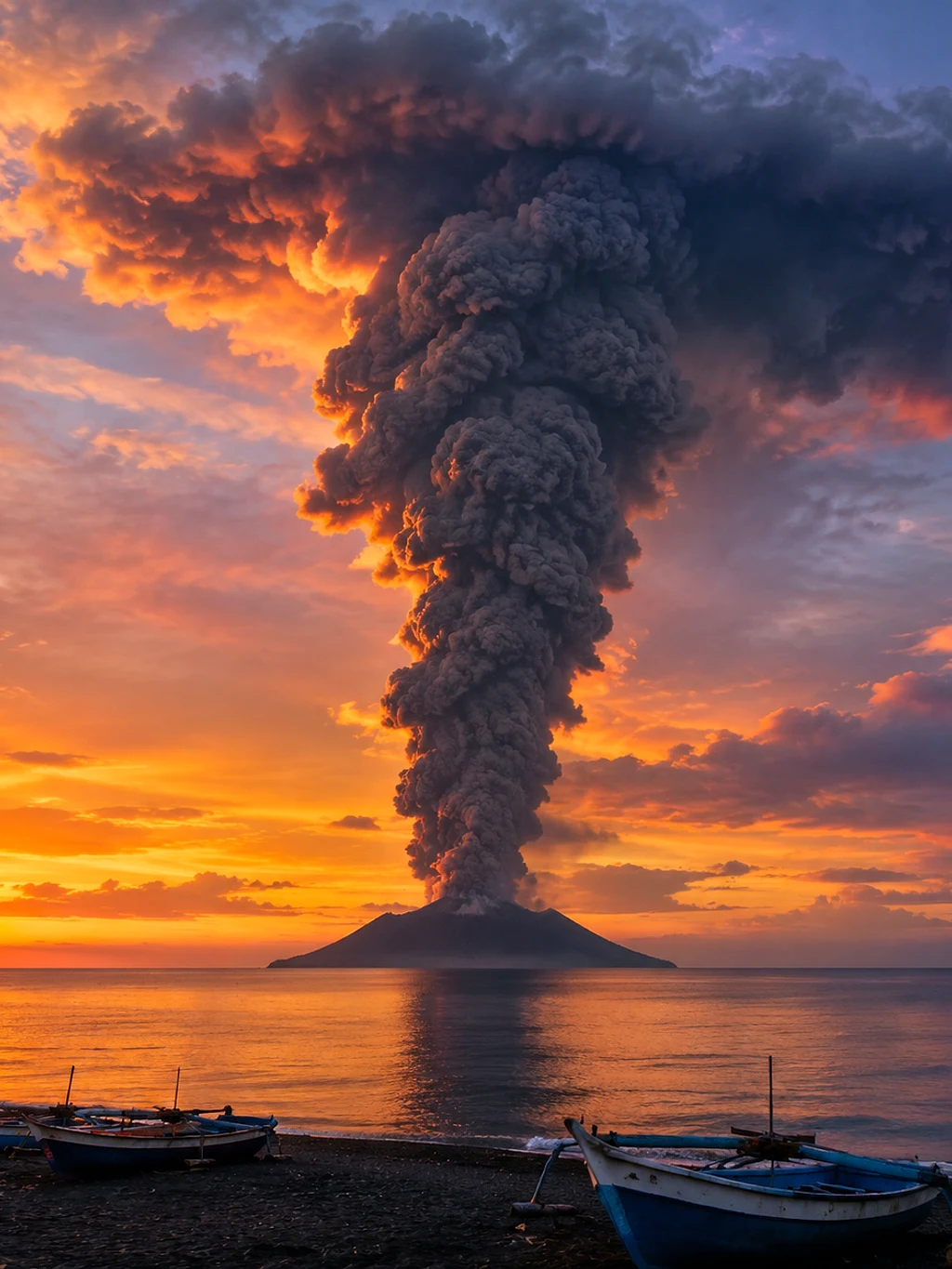
喀拉喀托之子在半夜醒了:七百公里外都听得见,八个机场关闭,二十七万人走不了,地面上没有一个人死
Anak Krakatau Eruption Strands 270,000 Travelers
About this story
Anak Krakatau erupted late on a Friday night in early September 2026, throwing ash to 15,000 metres and booming 700 km away. Eight Indonesian airports closed, 1,558 flights were cancelled and 270,000 passengers were stranded — and nobody died and no village was evacuated. The entire cost landed in the air. Chinese listening practice at four levels. HSK 4 Chinese listening practice.
This is an HSK 4 Chinese listening episode that runs about 4 minutes. The full Mandarin script is shown with tap-for-pinyin and a line-by-line English translation, so you can listen and read at once — comprehensible input in the sense of Stephen Krashen's i+1 theory. It teaches 12 key vocabulary words such as 规模、影响、决定 and walks through 3 grammar patterns, each explained in English with examples. The same news story is retold at 4 difficulty levels — use the level selector above to find the version that is challenging but still understandable for you.
Read at your level
原文Read the complete story in Chinese. Reveal pinyin and English only when you need them.
English transcript reference
Start with a number: two hundred and seventy thousand.
That is how many people were stuck inside Indonesian airports in early September this year.
There was no typhoon in Indonesia those days, and no strike at the airports.
The reason was that a volcano woke up.
The volcano is called Anak Krakatau, and it sits in the Sunda Strait between Java and Sumatra.
"Anak" in the name is simply the Indonesian word for "child".
So its full name, translated directly, is "Child of Krakatoa".
The name has a source.
In 1883, the old Krakatoa volcano erupted, one of the most violent eruptions on record.
The sound of the explosion carried thousands of kilometres, the ash drifted to great heights, and for a year or two afterwards weather around the world was affected.
After that, the old mountain had essentially blown itself away, leaving only a few remnant islands above the sea.
By the 1920s, on the site of the old mountain, the sea floor had slowly built up a new small mountain.
That is the one standing there now, which is why it is called the child.
This child is not a quiet one.
In 2018 a large piece of it collapsed into the sea, setting off a tsunami in which more than four hundred people died.
So Indonesia has watched it closely; back in early July this year the alert level was already raised to the third of four — the second highest.
This September's eruption began late on a Friday night.
The scale was considerable.
The ash column reached six thousand metres on the Java side, and at its highest fifteen thousand metres over Sumatra and Banten.
What does fifteen thousand metres mean?
Airliners cruise at roughly ten to twelve thousand metres — which is to say the ash column stood higher than planes normally fly.
The explosion that night could be heard seven hundred kilometres away.
But what is genuinely notable this time is the casualty figure.
Nobody died.
No village was evacuated.
The authorities drew a three-kilometre exclusion zone and barred boats from approaching. That was it.
This was a large eruption that caused almost no damage on the ground.
All of the damage happened in the air.
The reason is not complicated.
Volcanic ash is not smoke; it is extremely fine rock particles and shards of volcanic glass.
Once it is drawn into an aircraft engine it melts, and then hardens again inside.
The engine loses its power, and in bad cases shuts down outright.
It will also scour the windows at the front of the aircraft opaque.
Not one of these failures can be repaired in the air.
So civil aviation's approach to volcanic ash is blunt: go around it, or do not fly.
On 6 September, Indonesia closed eight airports at once, including the largest in the country.
More than one thousand five hundred and fifty flights were cancelled or delayed in total.
At the largest airport alone, over nine hundred were affected.
More than two hundred and seventy thousand passengers were stranded.
The great majority of those people will never in their lives go near that volcano.
Many of them could not even tell you its name.
But that mountain decided whether they got home those few days.
And that is the point I want to make.
In 1883, the volcano killed directly, with a tsunami and pyroclastic flows.
In 2018, it was a tsunami.
This time, it did not touch a single person.
All it did was put a column of ash into the sky, and the whole region's air network stopped.
Same mountain, same kind of eruption, striking something completely different in a different era.
Because what changed over these hundred-odd years is not the mountain. It is us.
Think about it:
In the life you have now, how many things only work because the road through the sky is open?
Listen again
Try it without the transcript and notice what sounds clearer.
What vocabulary does this episode teach?
词汇HSK 5. 喷发的规模不小 — stated before any of the numbers arrive.
HSK 3. Used twice: global weather in 1883, and nine hundred flights this time.
HSK 3. 但那座山决定了他们那几天能不能回家。
HSK 4. 严重的时候会直接停下来 — the failure mode that makes ash non-negotiable.
HSK 4. Never stated for the ground, only implied for the air.
HSK 5. 民航对火山灰的处理方式非常干脆 — avoidance, not tolerance.
A direct translation of Anak Krakatau — and a literal description of how it formed.
Used for 1883; the 2026 event gets the milder 喷发, which is the distinction the episode draws.
How it killed in 2018 — and what it conspicuously did not do this time.
Raised to the third of four in early July, months before the eruption.
被困旅客超过二十七万人 — the actual damage figure of the event.
Where ash melts and then hardens again, which is why nobody flies through it.
* beyond level超纲词
What grammar patterns appear in this episode?
语法先说一个数字:……
Opens with the figure and withholds the explanation. A common spoken-analysis hook — the listener carries the number while you build the story around it.
先说一个数字:二十七万。
……,就这样。
And that was all. A flat two-character close that undercuts the expectation of more, used here where a reader expects casualties.
官方划了一个半径三公里的禁区,禁止船只靠近,就这样。
变的不是 A,是 B
What changed is not A but B. Chinese can drop 而 entirely and let the two clauses sit side by side, which lands harder.
因为这一百多年里变的不是山,是我们。
Proper nouns
专有名词Sources
来源Free account
Keep learning from this story
Create a free account to keep saved words and your preferred level together.
- Keep words with their story context
- Remember your preferred level
- Build your vocabulary over time