
A Chinese podcast · Same story, 4 levels
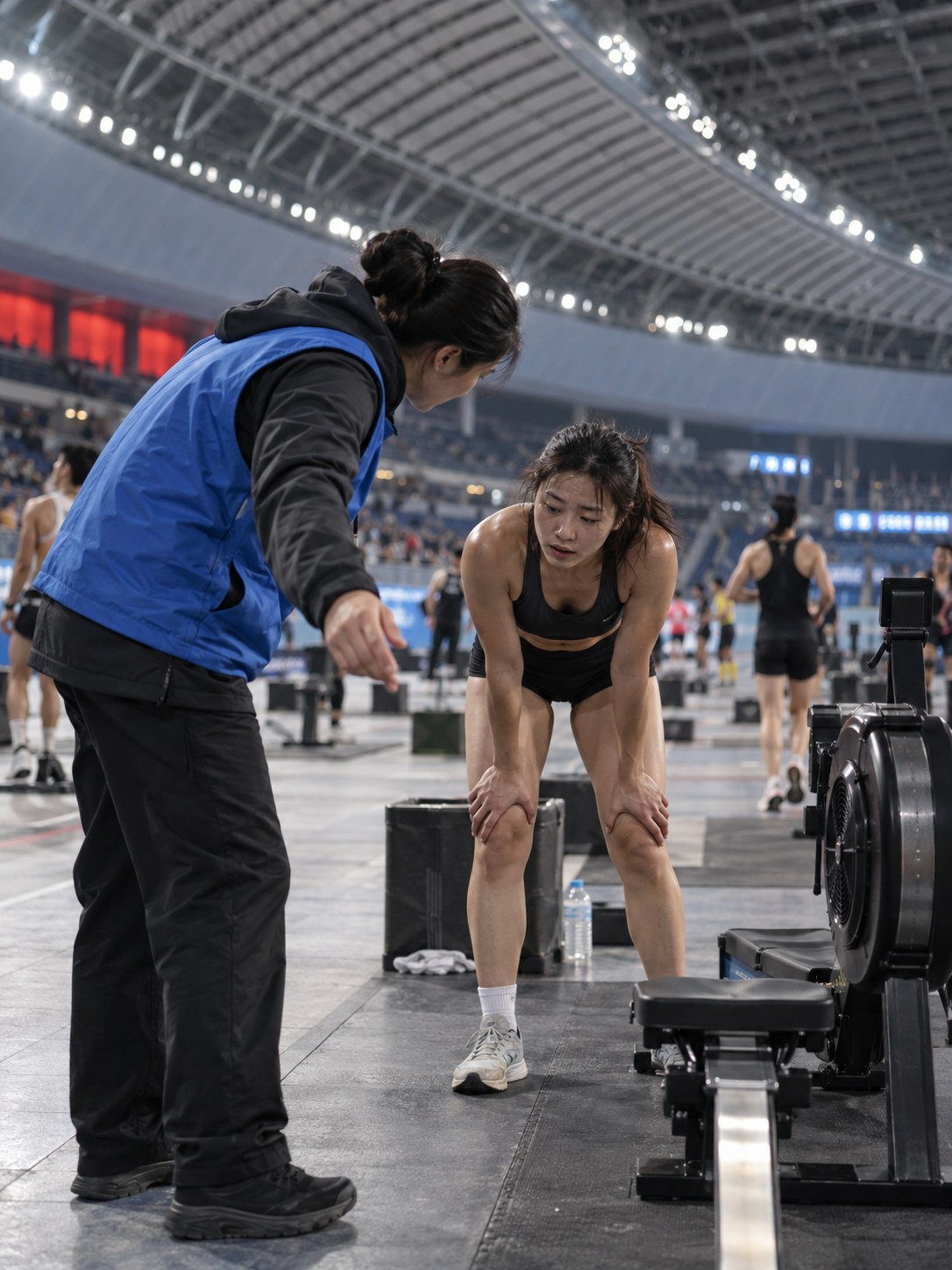
北京 HYROX 失禁事故后修改比赛规则
HYROX Changes Rules After Beijing Bowel Accident
About this story
How a fecal contamination incident at the Beijing HYROX race led to new hygiene rules and organizer accountability. HSK 5-6 Chinese listening practice.
This is an HSK 5-6 Chinese listening episode that runs about 4 minutes. The full Mandarin script is shown with tap-for-pinyin and a line-by-line English translation, so you can listen and read at once — comprehensible input in the sense of Stephen Krashen's i+1 theory. It teaches 20 key vocabulary words such as 选手、继续、讨论 and walks through 6 grammar patterns, each explained in English with examples. The same news story is retold at 4 difficulty levels — use the level selector above to find the version that is challenging but still understandable for you.
Read at your level
原文Read the complete story in Chinese. Reveal pinyin and English only when you need them.
English transcript reference
At the Beijing HYROX competition, a top athlete suffered fecal incontinence but continued to complete the event and won first place in the women's professional division.
After footage spread, discussion quickly shifted from her willpower to another question: In an indoor race with shared equipment, why wasn't the event stopped immediately?
The HYROX format alternates running with eight strength training exercises.
Athletes pass through the track, sled push, rowing machine, and other training zones in sequence; as soon as one person leaves, the next quickly uses the same equipment.
This structure makes hygiene issues different from long-distance running on open roads, because contact does not end as the athlete runs forward.
On September 12, an Australian professional athlete competed in the Beijing leg of the race.
During the event, she suddenly lost control of her body, leaving waste on herself and in the areas she passed through.
This was a sudden physical accident, and public discussion should not shame her.
But she continued running and using the equipment, ultimately winning the race; referees and staff did not make her withdraw during the process.
For subsequent athletes, the risk came not only from the track but also from the equipment handles they were about to grab.
Public reports have not proven that anyone contracted an illness as a result, but clear signs of contamination appeared on site, requiring immediate inspection and isolation.
Organizers could have done two things simultaneously: had medical personnel check the athlete and temporarily closed off the affected area.
These two actions do not conflict with each other.
An athlete sprinting may only be thinking about completing the next exercise; whether to continue competing should not be left entirely to her own judgment.
Staff members, who manage the venue, medical support, and subsequent crowd flow, are better positioned to assess safety for both the individual and others.
HYROX China later stated that they isolated and disinfecting the affected areas after the race, removed relevant equipment, and planned to replace some flooring materials.
These measures addressed the aftermath but failed to explain why there was no timely intervention during the race.
Critics also pointed out that old rules already penalized behaviors like spitting or littering, yet more obvious biological contamination did not trigger a unified response.
HYROX Global initially stated that the procedural boundary between professional and mass-participation races was unclear in this incident.
In plain language, staff did not decide who should stop and which areas to close before the next athletes arrived.
Co-founder Moritz Fürst subsequently apologized publicly, admitting that organizers did not react correctly and immediately.
The updated rules specify powers and responsibilities more clearly.
If an athlete's blood, vomit, urine, or feces endanger their own or others' health, or contaminate the venue, officials can remove them from the race for medical reasons.
Referees can also call for medical intervention, seal off areas, inspect equipment, and instruct others on how to bypass the zone.
The rules use 'can' rather than 'must,' meaning on-site judgment is still required; but at least the decision is no longer left to the athlete experiencing physical distress.
A written rule certainly cannot automatically solve the problem.
The next time a similar situation occurs, whether staff can see and act in time will determine if the reform has any meaning.
This incident also serves as a reminder for rapidly expanding events: as participant numbers increase, safety procedures cannot rely solely on the improvised experience of a few individuals.
Standardized events allow results from different cities to be compared, which also requires different cities to use equally clear hygiene standards.
Sympathy for the athlete and protection of other participants can coexist.
She needed timely help, while those behind her had the right to know if shared areas were safe; organizers must care for both sides simultaneously.
If you were about to sit on a rowing machine just used by the previous athlete, what actions would you hope the referee completes within seconds?
Listen again
Try it without the transcript and notice what sounds clearer.
What vocabulary does this episode teach?
词汇HSK 5. Commonly used in sports contexts to refer to competitors.
HSK 4. Used to indicate an action proceeds without stopping.
HSK 4. Can be a noun or verb.
HSK 5. Often used to describe reacting quickly enough to prevent negative outcomes.
HSK 4. Used for scheduling or organizing events/tasks.
HSK 5. Formal term for a specific designated space.
HSK 5. Can refer to physical fighting or logical incompatibility.
HSK 5. Formal term for judging the value or status of something.
HSK 5/6. Common in health and hygiene contexts.
HSK 5. Often used in formal contexts regarding solutions or policies.
Beyond HSK 5. Medical term for loss of bladder or bowel control.
Beyond HSK 5. Refers to mental strength and determination.
Beyond HSK 5. Specific sports equipment in HYROX (sled push).
Beyond HSK 5. Compound noun for gym equipment.
Beyond HSK 5. Formal term for dirty substances or excrement.
Beyond HSK 5. Strong verb indicating causing disgrace.
Beyond HSK 5. Common in medical or safety contexts.
Beyond HSK 5. Technical term for contamination by organic matter.
Beyond HSK 5. Often used metaphorically for limits between concepts.
Beyond HSK 5. Specific medical/biological term.
* beyond level超纲词
What grammar patterns appear in this episode?
语法从 A 转向 B
Shifts focus or direction from point A to point B. Often used in discussions or physical movement.
讨论很快从她的意志力转向另一个问题
不只……也……
Not only... but also... Used to add emphasis to a second point that is equally important.
风险不只来自跑道,也来自马上要握住的器材把手
本来可以……
Could have originally... Used to express a missed opportunity or something that was possible but didn't happen.
组织者本来可以同时做两件事
与其……不如…… (implied contrast)
While not explicitly using the conjunctions, the structure contrasts two options, implying one is better or more logical.
是否继续比赛不该完全由她独自判断
把 + Object + Verb + Complement
The 'Ba' construction emphasizes the handling or disposal of an object. Here used to describe how rules are written or areas are closed.
更新后的规则把权力和责任写得更具体
暂时封闭相关区域
意味着……
Means that... / Implies that... Used to explain the consequence or significance of a previous statement.
规则使用“可以”而不是“一律”,意味着现场仍然需要判断
Proper Nouns
专有名词Sources
来源Free account
Keep learning from this story
Create a free account to keep saved words and your preferred level together.
- Keep words with their story context
- Remember your preferred level
- Build your vocabulary over time