
A Chinese podcast · Same story, 4 levels
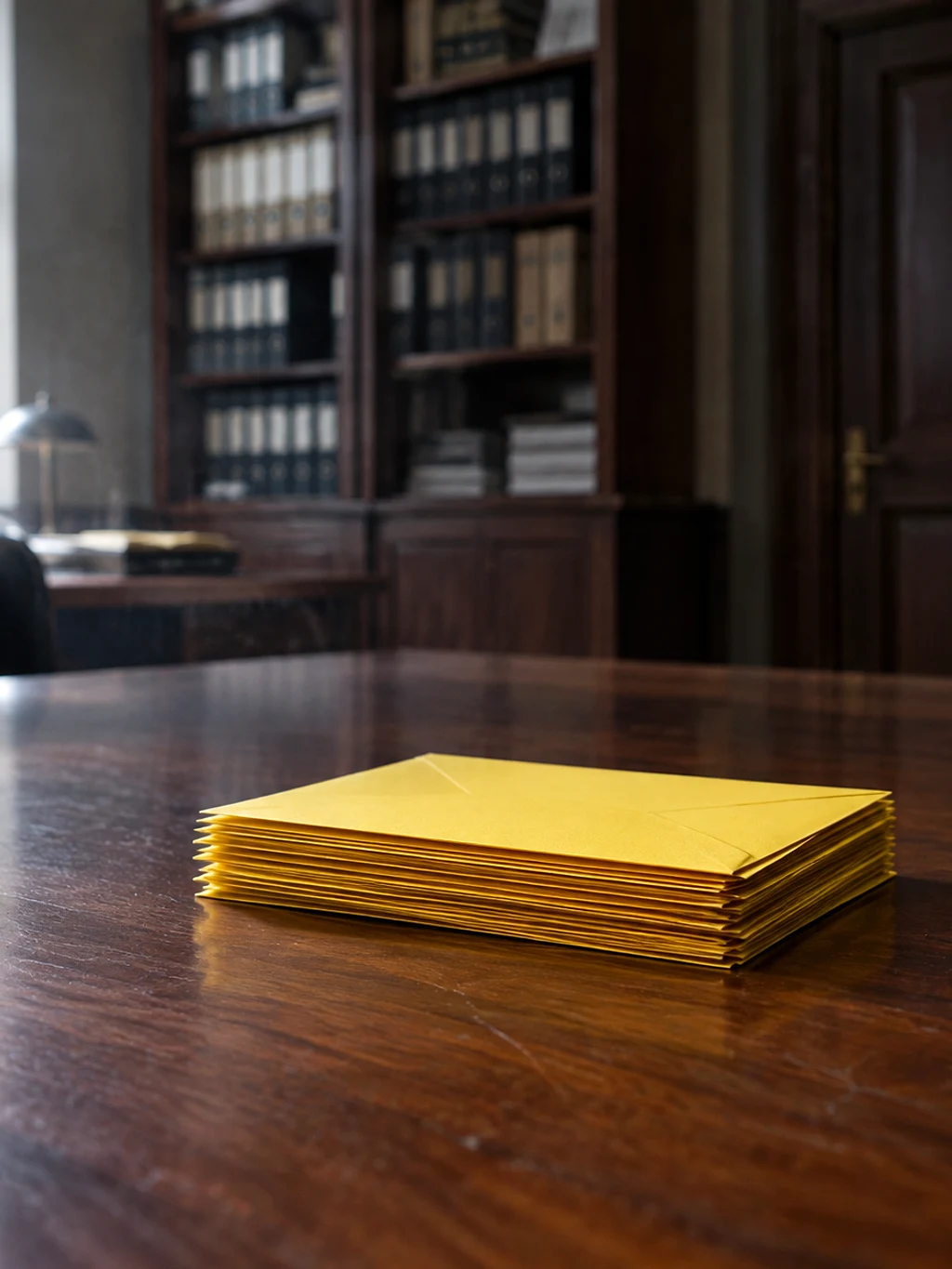
柏林有十六个月时间换新的黄信封,结果两个星期就用完,该进监狱的人留在了家里
Berlin Had Sixteen Months to Switch Envelopes. The New Ones Ran Out in Two Weeks, and People Due in Prison Stayed Home.
About this story
In Germany a prison-reporting summons is only legally served if it arrives in a specific yellow envelope. The federal justice ministry changed the spec on 31 March 2025 and let old forms run until 31 July 2026 — sixteen months of notice. Berlin procured the new envelopes on time; they were gone in two weeks, and the reorder failed on supplier shortages. Sentences stood, cells sat empty, and nobody recorded how many people stayed home. Chinese listening practice at four levels. HSK 3 Chinese listening practice.
This is an HSK 3-4 Chinese listening episode that runs about 4 minutes. The full Mandarin script is shown with tap-for-pinyin and a line-by-line English translation, so you can listen and read at once — comprehensible input in the sense of Stephen Krashen's i+1 theory. It teaches 12 key vocabulary words such as 结果、原因、通知 and walks through 3 grammar patterns, each explained in English with examples. The same news story is retold at 4 difficulty levels — use the level selector above to find the version that is challenging but still understandable for you.
Read at your level
原文Read the complete story in Chinese. Reveal pinyin and English only when you need them.
English transcript reference
Start with the outcome, because the outcome alone is strange enough.
In Berlin, Germany, a group of people had already been sentenced by a court to prison.
But they did not go. They stayed at home.
They had not run, and nobody was helping them.
Berlin could not get them into prison for one reason only: there were no envelopes.
That sentence is literally true, not a joke.
In Germany, some letters cannot simply be put in an ordinary envelope and posted.
Court judgments, notices, and the letter telling a person which day to report to prison all fall into that category.
Those letters have to go into a particular yellow envelope.
The yellow envelope is itself a procedural step.
In law it establishes one thing: this letter has been formally served.
The recipient cannot claim they never got it.
So the whole path is rigid.
With no yellow envelope, the letter cannot be sent.
If the letter cannot be sent, the person does not know which day they are supposed to go.
If the person does not know, they will not go.
It started with a very small change.
At the end of March last year, the German department responsible for justice changed what these envelopes look like.
The new envelope needed one extra tick box.
That was the whole change.
They notified everyone at the beginning of April, and they also allowed time.
The old envelopes could be used right up to the thirty-first of July this year.
From the notice to the final day, that is roughly sixteen months.
For switching an envelope, sixteen months is a very long time.
And Berlin did prepare.
Before the new rule took effect on the first of August, the new envelopes had been bought.
That part they got right.
The problem came at the next step.
The new envelopes they had bought ran out in two weeks.
Because the quantity actually needed was far higher than they had calculated.
When you run out you reorder — that is normal.
But this time they could not get any.
The manufacturer had none in stock either, and new orders had a long queue.
So Berlin ended up looking very strange indeed.
The court had passed sentence.
Beds in the prison sat empty.
The staff were all at work.
The only thing stuck was the letter telling the person to report — it could not get out the door.
A spokesman in Berlin said afterwards: this was only a short-term supply shortage.
They did manage to buy some more after that.
But the staff inside said: it still is not enough.
So how many people stayed home because of this?
Nobody knows.
Because nobody counted.
Here is what is genuinely interesting about this.
Take the system apart and you cannot find a single broken piece.
The law is sound, the judgment is clear, the prison has space, and the people are all at work.
The only thing it lacked was a paper bag worth a few cents.
The more formal a process is, the less any one of its steps can be replaced by something else.
The yellow envelope works precisely because no other envelope counts.
And the very thing that makes it work is what stopped the whole path dead the day it ran out.
Sixteen months of lead time, punched straight through by two weeks of actual consumption.
What was miscalculated was their own usage; the time was in fact plenty.
If someone gave you sixteen months to do one very simple thing, in which month would you start?
Listen again
Try it without the transcript and notice what sounds clearer.
What vocabulary does this episode teach?
词汇HSK 3. 先说结果,因为结果本身就够奇怪了 — the episode admits its own structure.
HSK 3. 原因只有一个:没有信封了 — the shortest cause in the episode, and the real one.
HSK 3. 法院的判决、通知 — used as both noun and verb across the episode.
HSK 3. 八月一号新规定开始用之前,新信封已经买回来了 — they beat the deadline.
HSK 2. 于是柏林出现了一个很奇怪的样子 — flagged before it is described.
HSK 2. 判决是清楚的 — one item in the list of things that were all working fine.
黄信封有用,正是因为别的信封都不算数 — the sentence the whole episode is built to reach.
法院已经判完了 — the legal work was finished. Only the stationery was missing.
监狱的床空着 — the emptiest image in the episode.
叫一个人哪天去监狱报到的信 — in Germany you report to prison; nobody comes for you.
柏林那边的一位发言人后来说 — the episode attributes the "short-term shortage" line rather than asserting it.
HSK 4. 真正要用的数量,比他们算的多得多 — the one number nobody got right.
* beyond level超纲词
What grammar patterns appear in this episode?
语法正是因为……
Precisely because. 正是 rules out any other explanation, which is what makes the following paradox land.
黄信封有用,正是因为别的信封都不算数。
越……,就越……
The more X, the more Y. Two 越 clauses bind a property to its consequence — here, formality to fragility.
一件事办得越正式,每一步就越不能换别的东西代替。
比……多得多
Far more than. 多得多 after a 比 comparison marks a difference of degree large enough to break a plan.
因为真正要用的数量,比他们算的多得多。
Proper Nouns
专有名词Free account
Keep learning from this story
Create a free account to keep saved words and your preferred level together.
- Keep words with their story context
- Remember your preferred level
- Build your vocabulary over time