
A Chinese podcast · Same story, 4 levels
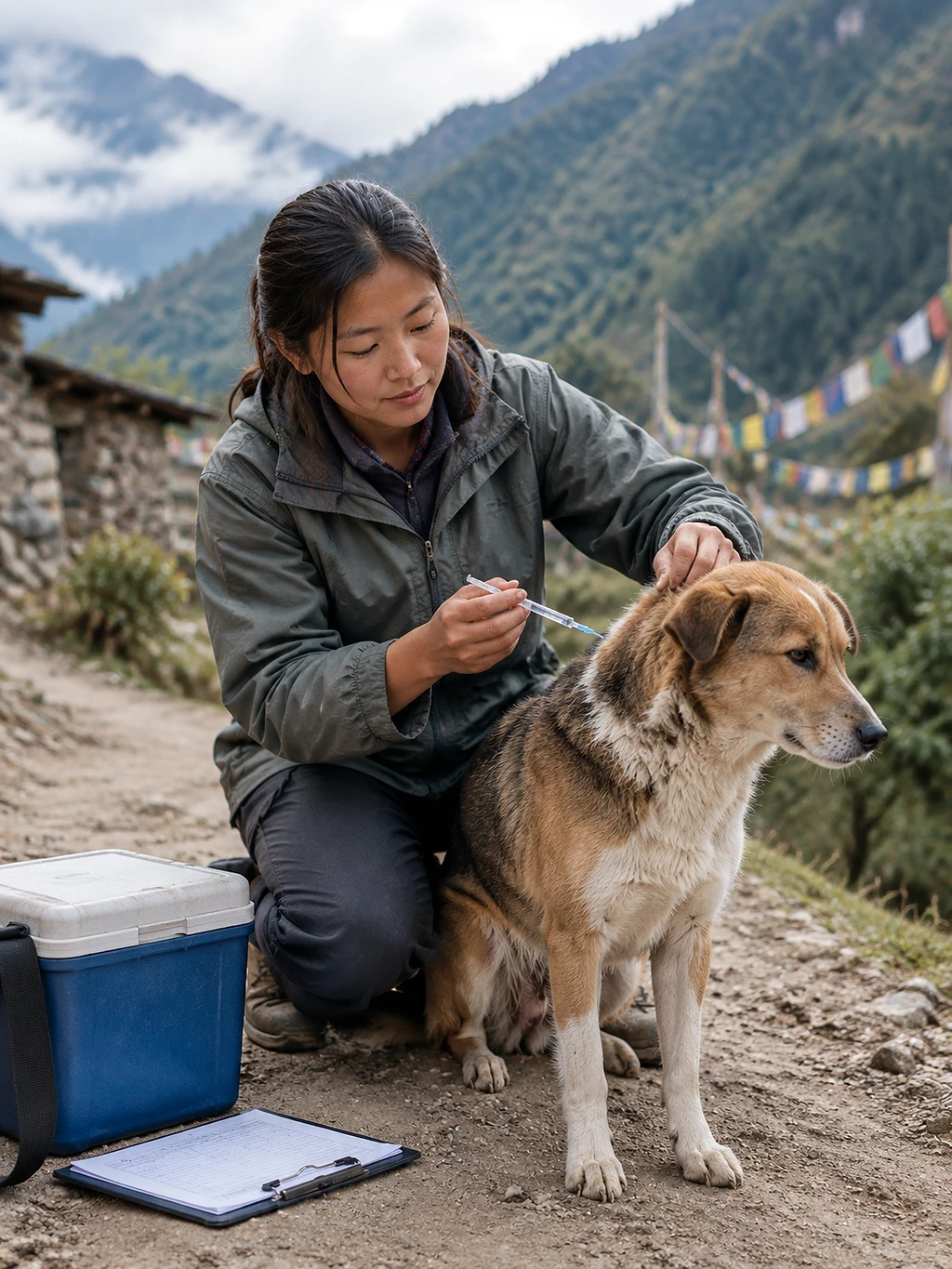
不丹三年没有一个人死于狂犬病:他们没有只救人,他们去给狗打针
Bhutan Prevents Rabies Deaths by Vaccinating Dogs
About this story
The WHO has validated Bhutan for eliminating dog-transmitted rabies — zero human deaths since June 2023, the first country in its region. It worked because Bhutan moved its effort from treating bitten people to vaccinating the dogs. Chinese listening practice at four levels. HSK 5-6 Chinese listening practice.
This is an HSK 5-6 Chinese listening episode that runs about 5 minutes. The full Mandarin script is shown with tap-for-pinyin and a line-by-line English translation, so you can listen and read at once — comprehensible input in the sense of Stephen Krashen's i+1 theory. It teaches 12 key vocabulary words such as 系统、资源、过程 and walks through 3 grammar patterns, each explained in English with examples. The same news story is retold at 4 difficulty levels — use the level selector above to find the version that is challenging but still understandable for you.
Read at your level
原文Read the complete story in Chinese. Reveal pinyin and English only when you need them.
English transcript reference
Here is a number to start with: zero.
Since June 2023, Bhutan has recorded not one human death from dog-transmitted rabies.
More than three years, not a single case.
On September the fourth, the World Health Organization formally certified that Bhutan has eliminated dog-transmitted rabies as a public health problem.
Among all the countries in the WHO's South-East Asia region, Bhutan is the first.
Today we are going to set this out properly: why this disease is so hard, what Bhutan actually did, and why other countries should be copying its homework.
Start with the disease itself, because its nature dictates every strategy that follows.
Rabies is caused by the rabies virus, transmitted mainly through the saliva of an infected animal; worldwide, over ninety percent of human cases come from dogs.
The bite itself is often not serious, and the wound can be small enough to ignore.
The virus then migrates along the peripheral nerves toward the central nervous system, with an incubation period ranging from weeks to months.
The genuinely lethal part is this: once clinical symptoms appear, the case fatality rate is close to one hundred percent.
Modern medicine, almost without exception, cannot save a patient who has begun to show symptoms.
Around fifty to sixty thousand people die of rabies globally each year, overwhelmingly in Asia and Africa, and a substantial proportion of them are children.
In other words, this is a disease that is entirely preventable and almost entirely untreatable.
Bhutan's starting position was not an advantageous one.
Most of its territory is embedded in the Himalayas, with a population of about eight hundred thousand — lower than many individual cities worldwide.
It is not a wealthy country; the terrain makes transport enormously expensive, and some villages remain hard to reach by road even now.
And it is this country that has completed what many far better-resourced nations have not.
Its method is the real content of this story.
Faced with rabies, the most intuitive response is to protect the person: immediate vaccination and immunoglobulin after exposure, known as post-exposure prophylaxis.
This element is indispensable, and Bhutan has been doing it, and doing it solidly — widely accessible, affordably priced.
But post-exposure prophylaxis has a structural limitation: it is permanently reactive.
You save one person, the virus continues to circulate in the dog population, the dog at the edge of the village is still there, and tomorrow there is another person bitten.
It can suppress the death count, but it cannot terminate the chain of transmission.
It is a war of attrition you must fight indefinitely.
Bhutan shifted the centre of gravity onto the source of transmission itself.
The core was mass canine vaccination, covering both owned and stray dogs, paired with sterilisation to control stray numbers.
The more decisive step was genuinely connecting the human public health system to the animal health system.
Information about a person being bitten reaches those responsible for animals; information about a sick dog reaches those responsible for people.
The framework is called "One Health", and its premise is the acknowledgment of something administratively very inconvenient: human health and animal health are one system.
The difficulty here lies in organisation, not technology: canine rabies vaccine is cheap and mature, and the hard part is doing it across departments, across years, out to the remotest mountain villages, without a break for over a decade.
The mechanism behind it can be quantified.
Once vaccination coverage in the dog population is sustained above a certain threshold, the effective reproduction number of the virus within that population falls below one, and the chain of transmission extinguishes itself.
Break transmission between dogs and human cases go to zero on their own.
So that zero is the necessary consequence of decisions taken more than ten years ago.
It also explains why it took over a decade: coverage has to be maintained year after year, and a gap of only one or two years turns the dog population back into a susceptible one.
The certification process itself is worth noting.
From the seventeenth to the twenty-second of August this year, a regional review group sent jointly by the WHO and the World Organisation for Animal Health visited Bhutan for an on-site assessment, preceded by a round of documentary review.
Both stages had to pass before the conclusion of September the fourth.
This is a verification with an evidentiary threshold, not a verbal commendation.
Finally, widening the lens.
The WHO's goal is to end human deaths from dog-transmitted rabies worldwide by 2030.
Bhutan's value lies precisely in being small, difficult in terrain, and tight on budget.
What it demonstrates is that this depends on which end you put your effort into.
A country that spends all of its money on the emergency room will always have emergency patients.
Two questions to leave you with.
The first is concrete: if something is entirely preventable and almost entirely untreatable, would you spend your money on prevention or on treatment?
And why do most real systems choose the latter?
The second is bigger: what other problems are we permanently treating the consequences of, while nobody touches the source?
There is no standard answer to these two questions, but they are worth thinking through slowly.
Listen again
Try it without the transcript and notice what sounds clearer.
What vocabulary does this episode teach?
词汇HSK 4. The core claim of One Health: human and animal health are one system.
HSK 4. What Bhutan lacked, and what richer countries have without the result.
HSK 4. The incubation period, and the decade-long process behind the zero.
HSK 4. Where the real difficulty lived: 跨部门、跨年度.
HSK 3. 十余年前一系列决策的必然结果 — the zero was decided long ago.
HSK 3. The thing that had to flow between the two systems for this to work.
Weeks to months — which is why the bite feels harmless at the time.
Close to one hundred percent once symptoms appear — the fact that dictates the whole strategy.
Indispensable and permanently reactive: it suppresses deaths without ending transmission.
Above a certain vaccination coverage, transmission extinguishes itself.
Why it can never stop: a one-year gap turns the dog population susceptible again.
What treating only people commits you to, indefinitely.
* beyond level超纲词
What grammar patterns appear in this episode?
语法……,却……
Yet, contrary to expectation. 却 sits before the verb, not at the head of the clause, and carries the contrast more tightly than 但是.
它能压住死亡数字,却不能终止传播链。
这是一种完全可以预防、却几乎无法治疗的疾病。
A 的难点在 B,不在 C
States where a difficulty actually lies. Chinese can put the positive claim first and let the negative trail, which reads less mannered than the reverse.
这件事的难点在组织,不在技术。
恰恰在于……
Lies precisely in — used when the apparent weakness turns out to be the point. Here, Bhutan mattering because it is small and poor.
不丹的价值恰恰在于它体量小、地形难、预算紧。
Proper nouns
专有名词Sources
来源Free account
Keep learning from this story
Create a free account to keep saved words and your preferred level together.
- Keep words with their story context
- Remember your preferred level
- Build your vocabulary over time