
A Chinese podcast · Same story, 4 levels
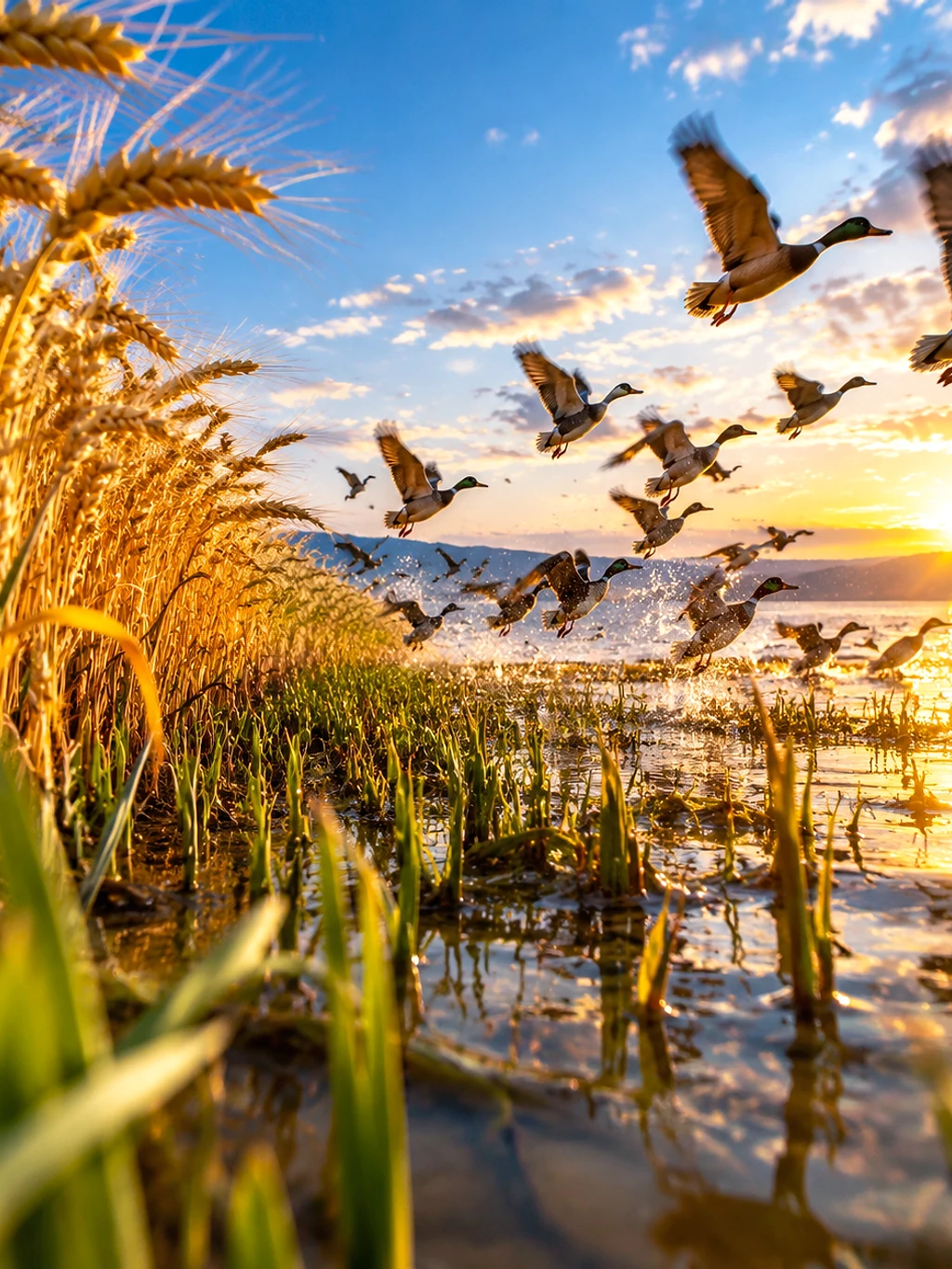
他把七十英亩麦地还给了水:现在那里住着一百四十种鸟,和两种快没有了的鱼
Oregon Barley Field Becomes Wetland for 140 Birds
About this story
A southern Oregon farmer took 70 of his 400 acres of barley ground out of production and let the water back in. The managed wetland now filters phosphorus out of Upper Klamath Lake, records 140 bird species, and is rearing two endangered sucker fish whose young almost never survived. Chinese listening practice at four levels. HSK 5-6 Chinese listening practice.
This is an HSK 5-6 Chinese listening episode that runs about 5 minutes. The full Mandarin script is shown with tap-for-pinyin and a line-by-line English translation, so you can listen and read at once — comprehensible input in the sense of Stephen Krashen's i+1 theory. It teaches 12 key vocabulary words such as 污染、判断、标准 and walks through 3 grammar patterns, each explained in English with examples. The same news story is retold at 4 difficulty levels — use the level selector above to find the version that is challenging but still understandable for you.
Read at your level
原文Read the complete story in Chinese. Reveal pinyin and English only when you need them.
English transcript reference
Let's begin with a sentence, spoken by a farmer.
He said: this place always wanted to become a wetland.
That sounds lyrical, and it is in fact a rather precise technical judgement.
The setting is southern Oregon, on the shore of Upper Klamath Lake.
Beside the lake sits a four-hundred-acre farm that has grown barley for nearly a century, across three generations.
The ground here is low and flat; every winter the fields flood, and the following spring the water drains back into the lake.
The problem lies in that draining step.
As the water flows back off the fields, it carries phosphorus with it.
The phosphorus comes from fertiliser: a nutrient to a crop, a burden to a lake.
High phosphorus loading drives large-scale algal blooms; when the algae die and decompose they consume dissolved oxygen, and the water goes hypoxic.
The first to suffer are the fish.
This water system holds two fish — the shortnose sucker and the Lost River sucker — endemic here and found nowhere else.
Both are listed under the United States federal endangered species list.
Their predicament has a very specific shape: the adults are still present, while juveniles almost never survive to maturity.
The cost of deteriorating water quality falls mainly on the most fragile stage of life.
A population can appear to still hold plenty of fish while having functionally stopped reproducing.
The farmer thought about it for years, and eventually made a decision his peers found distinctly odd.
He took seventy acres out of four hundred, stopped cultivating them, let water back in, and built a managed wetland.
It needs stressing that he did not sell the land, and he did not exit farming.
The remaining three hundred-odd acres still grow barley.
This was a reallocation.
The role this wetland plays in the system is essentially that of a filter.
Water entering it slows down, particulate phosphorus settles out, and dissolved phosphorus is taken up and fixed by aquatic plants.
The water that then discharges into the lake carries a markedly lower phosphorus load.
The same piece of land went from being the source of the pollution to being the facility that treats it.
And it was already the hardest ground to farm — flooded every year, with the worst return on input.
The ecological response came faster than expected, and in a clear order.
First aquatic plants colonised, then invertebrates, then the birds that feed on them.
Today those seventy acres have recorded a hundred and forty bird species.
In winter, tens of thousands of ducks, geese and swans stop over — migratory birds on this flyway need exactly this kind of landing place.
Otters, beavers and muskrats have settled in as well.
The genuinely important progress is in the fish.
Researchers placed juveniles of those two endangered suckers into the wetland to rear.
Shallow water, abundant food, low predation pressure: precisely the gap in their life history that was killing them.
Last year, researchers partially drew the water down to count, and recorded fifty individuals that had reached adult body size.
Fifty is a negligible number in any ordinary fisheries statistic.
But for two species whose juvenile survival has long been close to zero, it means the chain has been joined for the first time.
This is worth telling because it does not fit the narrative template we are used to.
We are accustomed to framing stories like this as conservation against agriculture: someone concedes, someone gains.
What happened here looks more like a recalculation.
A patch of low ground, flooded annually and the most expensive to work, produced greater value under a different use — including for the farmer himself.
The lake water improved, and so did irrigation and water supply conditions.
The farmer stayed put, the birds returned, and the fish survived.
It is also worth being clear about the limits.
Seventy acres does not solve the Klamath basin.
Water rights, irrigation, tribal fishing rights and drought make that basin a system tangled for decades.
One wetland is a replicable sample.
What it demonstrates is that on land assumed to allow only two options, a third use exists.
Two questions to leave you with.
The first is concrete: if you held a piece of land that lost money every year, would you keep farming it, or let it go back to what it was?
The second is bigger: when we judge whether a piece of land is "useful", whose standard are we actually using?
There is no standard answer to these two questions, but they are worth thinking through slowly.
Listen again
Try it without the transcript and notice what sounds clearer.
What vocabulary does this episode teach?
词汇HSK 4. 从污染的来源变成了污染的处理设施 — the same land, both roles.
HSK 4. Opens the episode (一句相当准确的技术判断) and closes it (我们判断一块土地).
HSK 4. The final question: 用的到底是谁的标准?
HSK 5. 一个纠缠了几十年的复杂系统 — why one wetland cannot fix the basin.
HSK 5. 换一种用途之后产出了更高的价值 — the whole argument in one phrase.
HSK 5. 最脆弱的那个生命阶段 — where the cost of bad water actually falls.
入湖磷负荷 — the technical term for how much phosphorus reaches the lake.
The end of the chain: algae die, decompose, consume the dissolved oxygen.
Found in this water system and nowhere else, which makes local loss total loss.
幼鱼存活率长期接近于零 — the number that made fifty adult fish meaningful.
HSK 6. 这条线路上的迁徙鸟类,正需要这样的落脚点。
在功能上停止繁衍 — a population can look healthy and have already stopped.
* beyond level超纲词
What grammar patterns appear in this episode?
语法之所以……,是因为……
The reason X is the case is Y. Puts the claim first and the explanation second — common in spoken analysis when you want the listener holding the claim while you argue it.
这件事之所以值得讲,是因为它不符合我们熟悉的那个叙事模板。
对 A 而言
As far as A is concerned. 而言 is the written-leaning counterpart of 对……来说, and marks whose perspective a figure is being measured from.
但对两个幼鱼存活率长期接近于零的物种而言,它意味着这条链条第一次被接上了。
换一种用途之后产出了更高的价值——包括对农民自己而言。
放在……里都……
Measured against X, it is still Y. Sets a number inside a frame of reference before judging it — here to concede that fifty is tiny, then explain why it counts.
五十这个数字,放在任何常规渔业统计里都微不足道。
Proper nouns
专有名词Sources
来源Free account
Keep learning from this story
Create a free account to keep saved words and your preferred level together.
- Keep words with their story context
- Remember your preferred level
- Build your vocabulary over time