
A Chinese podcast · Same story, 4 levels
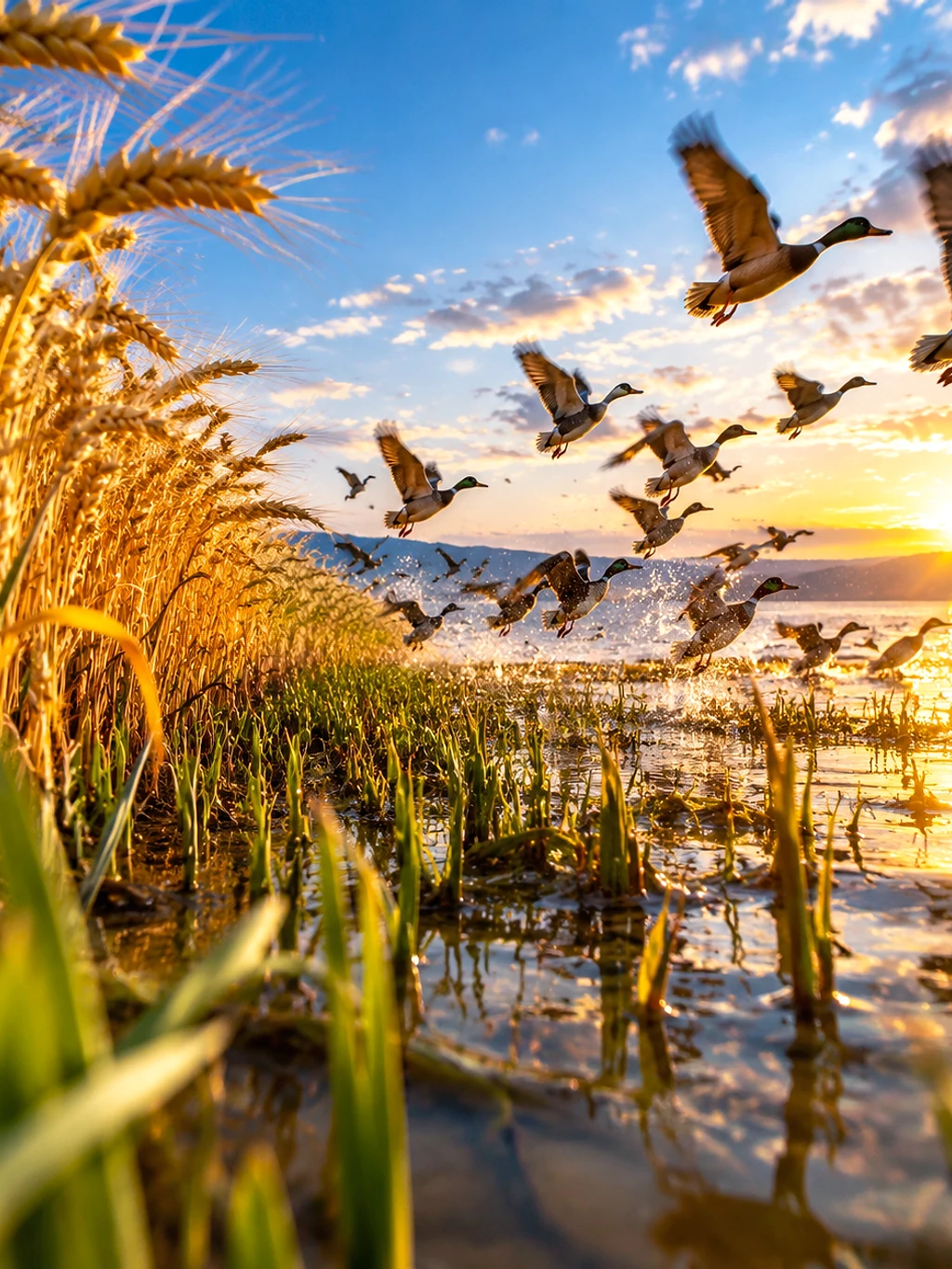
他把七十英亩麦地还给了水:现在那里住着一百四十种鸟,和两种快没有了的鱼
Oregon Barley Field Becomes Wetland for 140 Birds
About this story
A southern Oregon farmer took 70 of his 400 acres of barley ground out of production and let the water back in. The managed wetland now filters phosphorus out of Upper Klamath Lake, records 140 bird species, and is rearing two endangered sucker fish whose young almost never survived. Chinese listening practice at four levels. HSK 3 Chinese listening practice.
This is an HSK 3-4 Chinese listening episode that runs about 4 minutes. The full Mandarin script is shown with tap-for-pinyin and a line-by-line English translation, so you can listen and read at once — comprehensible input in the sense of Stephen Krashen's i+1 theory. It teaches 12 key vocabulary words such as 决定、变化、干净 and walks through 3 grammar patterns, each explained in English with examples. The same news story is retold at 4 difficulty levels — use the level selector above to find the version that is challenging but still understandable for you.
Read at your level
原文Read the complete story in Chinese. Reveal pinyin and English only when you need them.
English transcript reference
Let's start with a sentence, said by a farmer.
He said: this place always wanted to be a wetland.
It sounds a little literary, but what it describes is something very concrete.
The setting is southern Oregon, beside a lake called Upper Klamath.
By the lake there is a farm, four hundred acres, growing barley for close to a hundred years.
Three generations, all of them farming it.
The trouble comes in winter.
This is low ground, and every winter the fields flood.
When the water drains back into the lake in spring, the problem arrives.
The water carries phosphorus out of the fields and into the lake.
Phosphorus comes from fertiliser; it is good for crops, and not good for a lake.
Once there is too much phosphorus in a lake, the algae bloom.
Once there is too much algae, the oxygen in the water drops.
And the fish are the first to suffer.
There are two kinds of fish in this lake, called the shortnose sucker and the Lost River sucker.
They live only in this one water system, nowhere else.
Both are now endangered species protected under United States federal law.
Their problem has an unusual shape: the adult fish are still alive, and the young ones almost never reach adulthood.
With water quality this poor, the juveniles do not survive their first year.
The farmer thought about it for many years.
Then he made a decision that looked very strange to his neighbours.
Out of four hundred acres, he took seventy out and stopped planting them.
He put water back onto those seventy acres and built a managed wetland.
Note that he did not sell the land, and he did not leave farming.
On the remaining three hundred and something acres, he still grows barley.
What this wetland does is essentially work as a filter.
The water slows down inside it, the phosphorus settles to the bottom, and the water plants take it up.
The water that then flows into the lake is far cleaner.
One piece of land went from being the source of the problem to being the thing that treats it.
The change came faster than expected.
First the grass grew, then the insects came, then the birds.
Today, a hundred and forty bird species have been recorded on those seventy acres.
In winter, tens of thousands of ducks, geese and swans stop there.
Otters live in the water too, along with beavers and muskrats.
But the fish are what matter most.
Researchers put those two endangered species into the wetland to rear them.
The water is shallow, food is plentiful and predators are few — exactly right for young fish.
Last year they lowered the water level in part of it and counted what had survived.
They came out with fifty fish that had reached adult size.
Fifty does not sound like many, but for two species whose juveniles do not survive at all, it is a real signal.
This is worth telling because it is more a re-doing of the arithmetic than a story of conservation against farming.
A patch of low ground that flooded every year and was hard to farm turned out to be worth more used another way.
The lake water got cleaner, and the remaining land became easier to farm.
The farmer stayed where he was, the birds came back, and the fish survived.
Think about it: is there a place near you that everyone keeps forcing into one use, when it would suit another far better?
Listen again
Try it without the transcript and notice what sounds clearer.
What vocabulary does this episode teach?
词汇HSK 3. 一个在同行看来很奇怪的决定 — odd to his peers, and the point of the episode.
HSK 3. 变化来得比想象中快 — the ecological response outran everyone's estimate.
HSK 3. 再流进湖里的水,就干净多了 — the measurable result of the filter.
HSK 3. 它们的问题很特别 — used to flag that this is not ordinary decline.
HSK 4. 美国联邦法律保护的濒危物种 — the legal status of both fish.
HSK 4. 正好适合幼鱼 — shallow water, plenty of food, few predators.
A managed one, built on purpose — not land simply abandoned.
Named after the effect is described: good for a crop, a burden to a lake.
藻类一多,水里的氧就少了 — the two-step that kills the fish.
Both suckers live in this one water system and nowhere else on earth.
The exact stage that was failing: adults alive, young never reaching adulthood.
The one-word description of what the seventy acres now do in the system.
* beyond level超纲词
What grammar patterns appear in this episode?
语法A 一……,B 就……
As soon as A reaches some level, B follows. Chained twice here, it turns a nutrient cycle into two short spoken clauses.
湖里的磷一多,藻类就疯长。
藻类一多,水里的氧就少了。
听起来……,其实……
Sounds like X, is actually Y. A standard spoken move for taking a phrase that seems decorative and showing it is precise.
这句话听起来有点像文学,其实它讲的是一件很具体的事。
从 A 变成 B
Went from being A to being B. The cleanest way to state a reversal of role in Chinese.
一块地,从制造问题的一方,变成了处理问题的一方。
Proper nouns
专有名词Sources
来源Free account
Keep learning from this story
Create a free account to keep saved words and your preferred level together.
- Keep words with their story context
- Remember your preferred level
- Build your vocabulary over time