
A Chinese podcast · Same story, 4 levels
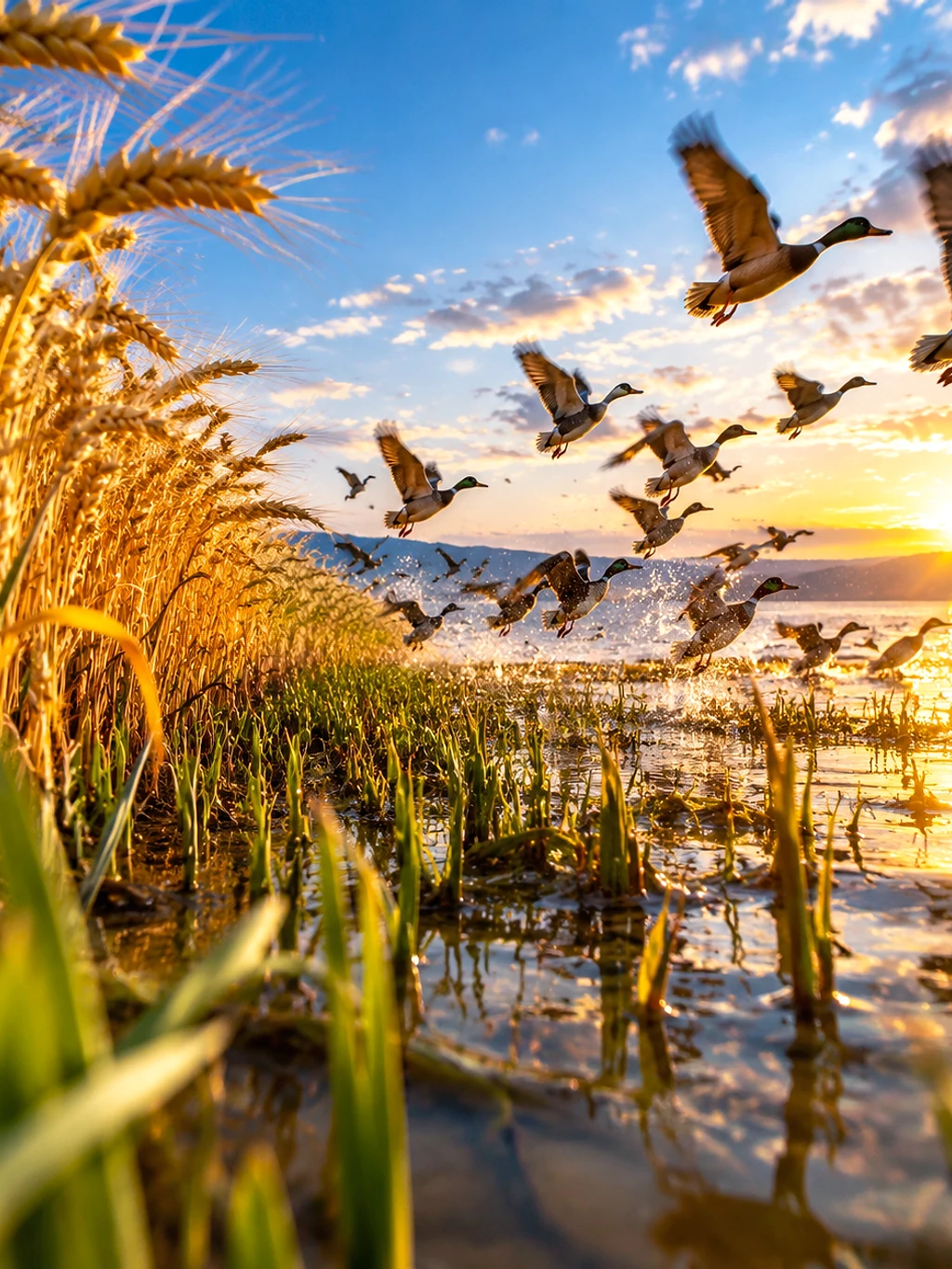
他把七十英亩麦地还给了水:现在那里住着一百四十种鸟,和两种快没有了的鱼
Oregon Barley Field Becomes Wetland for 140 Birds
About this story
A southern Oregon farmer took 70 of his 400 acres of barley ground out of production and let the water back in. The managed wetland now filters phosphorus out of Upper Klamath Lake, records 140 bird species, and is rearing two endangered sucker fish whose young almost never survived. Chinese listening practice at four levels. HSK 2 Chinese listening practice.
This is an HSK 2 Chinese listening episode that runs about 3 minutes. The full Mandarin script is shown with tap-for-pinyin and a line-by-line English translation, so you can listen and read at once — comprehensible input in the sense of Stephen Krashen's i+1 theory. It teaches 12 key vocabulary words such as 问题、意思、决定 and walks through 3 grammar patterns, each explained in English with examples. The same news story is retold at 4 difficulty levels — use the level selector above to find the version that is challenging but still understandable for you.
Read at your level
原文Read the complete story in Chinese. Reveal pinyin and English only when you need them.
English transcript reference
In the west of America there is a state called Oregon.
There is a very large lake there.
Beside the lake there is a farm.
The farm is an old one.
For nearly a hundred years, this family has grown barley here.
The grandfather grew it, the father grew it, and the son grew it too.
But there was a problem with this land.
Every winter, the water rises.
The fields fill with water and nothing can be grown.
When the water goes down, it flows back into the lake.
And that is where the problem lies.
As the water flows back out of the fields, it carries things from the fields with it.
Those things go into the lake, and the lake water gets worse.
Too much weed grows in the water, and the fish suffer.
There are two kinds of fish in this lake found nowhere else in the world.
Both are now very rare.
The farmer in this family thought about it for years.
One day he said a sentence:
this place always wanted to be a wetland.
What he meant was: long ago, there was water here anyway.
People took the water away later, and that is how it became fields.
So he made a decision.
His family has four hundred acres in all.
He took seventy acres out and stopped planting them.
Those seventy acres he gave back to the water.
He let the water return, and made it into a wetland.
What is a wetland?
It is a place that is both water and land.
The water is shallow, and grass grows in it.
It does not sound like much, but the change came quickly.
First the grass.
Then the insects.
And once there were insects, the birds came.
Now there are a hundred and forty kinds of bird on those seventy acres.
In winter, tens of thousands of ducks and geese stop there.
There are otters in the water too, and beavers.
But the best part is the fish.
Those two nearly vanished kinds of fish were put into this wetland.
The young fish can hardly survive anywhere else.
But here, they lived.
Last year, researchers let out some of the water to see what was inside.
They counted fifty fish that had grown to full size.
That number is not large, but for these two kinds of fish it matters enormously.
What I find interesting about this is the following.
This farmer did not sell his land, and he did not move away.
He still grows barley there.
He simply gave one part of the land back to what it had been.
And the rest of the land, because the water got cleaner, is actually better to farm.
Think about it: where you live, what did it look like a hundred years ago?
Listen again
Try it without the transcript and notice what sounds clearer.
What vocabulary does this episode teach?
词汇HSK 2. 问题就在这里 — used to point at the exact step where things go wrong.
HSK 2. 他的意思是 — how the episode unpacks the farmer's one strange sentence.
HSK 3. 于是他做了一个决定 — the hinge of the whole episode.
HSK 3. 这个地方本来就想做一片湿地 — the sentence everything else explains.
HSK 3. 因为水变干净了 — the reason the rest of his land got easier to farm.
HSK 3. 全世界只有这里有 — what makes losing these two fish permanent.
Named, then defined in plain words: 就是又是水又是地的地方。
Four hundred acres, three generations — the scale is set before the problem is.
The one crop, grown here for a hundred years and still grown on the rest of the land.
HSK 4. 可是这块地有一个麻烦 — the flooding, stated before it is explained.
HSK 4. Carries the argument: the water was here first, the field came later.
HSK 5. Marks the outcome nobody expected: giving up land made the rest better.
* beyond level超纲词
What grammar patterns appear in this episode?
语法本来就……
Was always the case, before anyone interfered. 就 tightens it — not "used to be" but "was so all along".
这个地方本来就想做一片湿地。
很久以前,这里本来就有水。
什么也……不了
Cannot do anything at all. 也 with a negative sweeps the whole category; 不了 says the action is impossible, not merely unwanted.
田里全是水,什么也种不了。
因为……,反而……
Because of X, the opposite of what you would expect happened. 反而 is what makes the sentence surprising.
剩下的地,因为水变干净了,反而更好种。
Proper nouns
专有名词Sources
来源Free account
Keep learning from this story
Create a free account to keep saved words and your preferred level together.
- Keep words with their story context
- Remember your preferred level
- Build your vocabulary over time