
A Chinese podcast · Same story, 4 levels
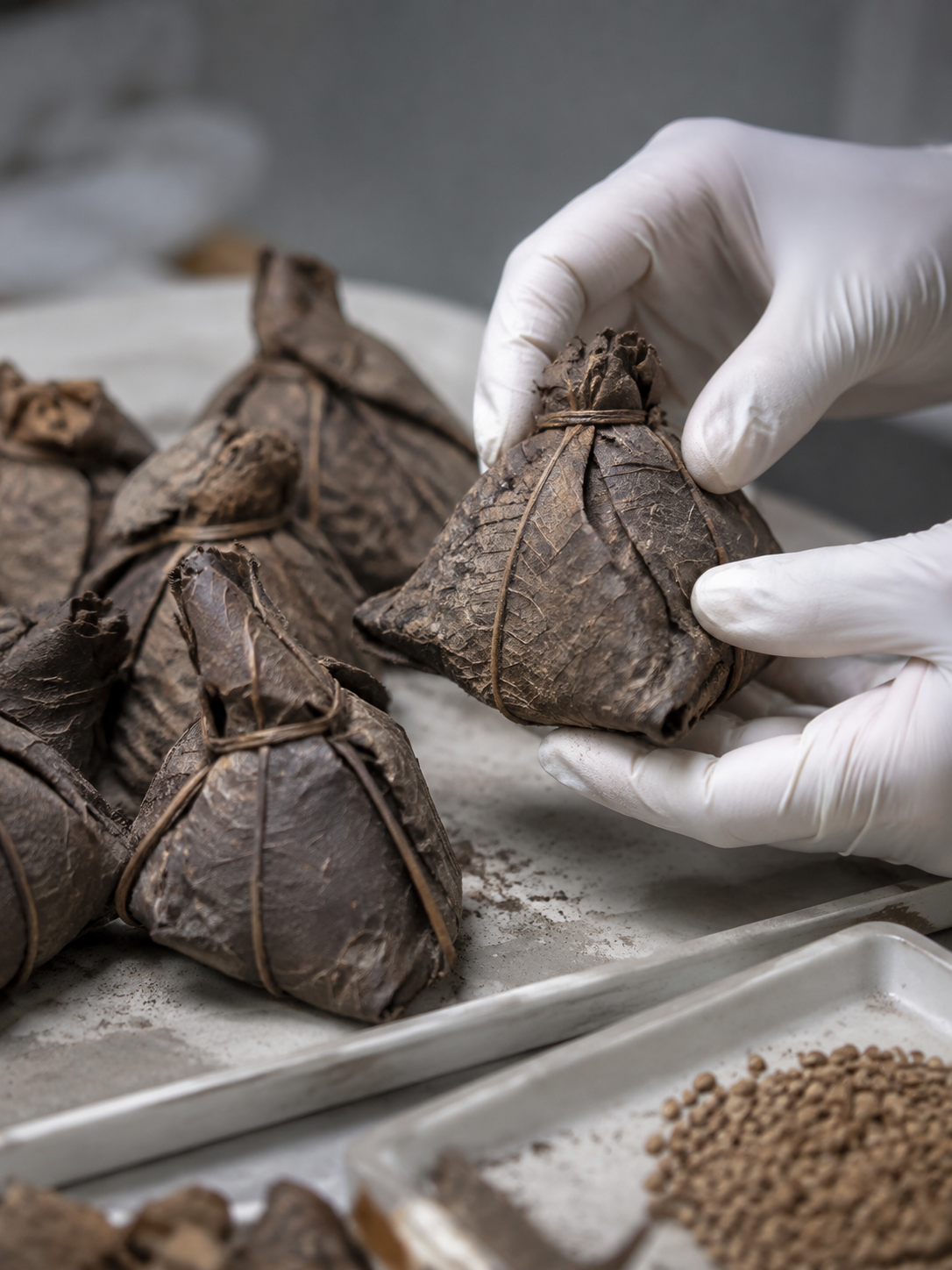
两千三百年前的粽子,从两座楚墓里挖了出来。一批素的,一批有肉——荤素之争比屈原还老。
2,300-Year-Old Zongzi Found in Chu Tombs
About this story
2,300-Year-Old Zongzi Found in Chu Tombs. HSK 3 Chinese listening practice.
This is an HSK 3-4 Chinese listening episode that runs about 4 minutes. The full Mandarin script is shown with tap-for-pinyin and a line-by-line English translation, so you can listen and read at once — comprehensible input in the sense of Stephen Krashen's i+1 theory. It teaches 8 key vocabulary words such as 研究、一样、第一 and walks through 3 grammar patterns, each explained in English with examples. The same news story is retold at 4 difficulty levels — use the level selector above to find the version that is challenging but still understandable for you.
Read at your level
原文Read the complete story in Chinese. Reveal pinyin and English only when you need them.
English transcript reference
Start with a story everyone knows.
A very long time ago there was a man called Qu Yuan, and he threw himself into a river.
The people by the river were afraid the fish would bite his body, so they wrapped rice up and threw it into the water.
And that is why, every Duanwu, Chinese people eat zongzi.
You and I have heard this since we were small.
This year, archaeologists put a very large question to it.
The question is not "is the story true".
The question is "which came first, zongzi or Qu Yuan".
Look at two tombs.
The first is at Xinyang in Henan, opened in 2015.
In the rear chamber lay forty packages of something, one after another, wrapped very neatly.
The second is at Huainan in Anhui, called Wuwangdun, opened in 2024.
It is the largest and highest-ranking Chu tomb excavated so far; the occupant was a king of Chu.
In its eastern chamber: more than two hundred packages.
Both tombs are Chu, and they are about a hundred years apart.
Open them and look: leaves, wrapped around grain.
Step one is to ask: what kind of leaf is this?
That step is not easy, because the leaves lay underground for two thousand three hundred years.
The researchers extracted ancient DNA from the leaves and compared it against living trees.
The answer came back: oak leaf.
Oak is a kind of tree; its leaves are large, thick and tough — exactly right for wrapping things.
Step two is to ask: what is inside?
In the first tomb: unhusked millet and rice.
Note those two words — "unhusked".
Grain that still has its husk on cannot be eaten directly by a person.
Which tells us it was never a meal for the living. It was an offering.
The second tomb was a completely different matter.
The researchers measured animal fat inside them.
Which is to say: that package had meat in it.
So two thousand three hundred years ago, zongzi had already split into two kinds.
One vegetarian, one with meat.
The very thing Chinese people argue about most fiercely online — whether meat belongs in a zongzi — turns out to have been running for two thousand three hundred years.
Now back to the first question: which came first?
The first tomb dates to roughly 339 to 329 BC.
At that time, Qu Yuan was still a child.
His leap into the river came many years later.
And the earliest book that puts zongzi and Qu Yuan together is called Xu Qi Xie Ji, a Southern Dynasties text — later again by more than seven hundred years.
Put those three dates side by side and it becomes clear.
First there was the food.
A long time later, there was the man.
A long time after that, there was the story that joined them.
This is not to say the legend is false.
A legend does something else: it gives an old thing that already exists a reason you can remember.
A great many customs grow this way — first you do it, and much later there is an explanation.
And there is one last detail, which I think is the most moving part of all of it.
Around Ruzhou in Henan, people still wrap zongzi in oak leaves today.
Put a Ruzhou oak-leaf zongzi beside the one taken out of the Wuwangdun tomb, and they are almost the same object.
Between them, two thousand three hundred years, and one dynasty after another.
One person laid a package of oak-leaf zongzi in a king’s tomb.
Two thousand three hundred years later, another person in a kitchen wrapped one almost exactly like it.
Think about it: is there something in your family that nobody can quite explain, but that everyone keeps doing?
Listen again
Try it without the transcript and notice what sounds clearer.
What vocabulary does this episode teach?
词汇研究的人从叶子里取出古代的DNA。
A Ruzhou zongzi and a tomb zongzi are almost 一样.
第一步是问:这是什么叶子?
How the forty packages were laid out — 包得很整齐.
Unhusked grain cannot be eaten 直接 by a person — that is what makes it an offering.
第二个墓里的,就完全不一样了。
Used for what evidence tells you: 这说明它不是给活人的饭.
考 to examine, 古 ancient. 考古的人 = archaeologists.
* beyond level超纲词
What grammar patterns appear in this episode?
语法第一步是……,第二步是……
Walks through a process in numbered stages — useful for any explanation.
第一步是问:这是什么叶子? — Step one is to ask: what leaf is this?
不是……,是……
Not X, but Y — corrects the expected reading.
它不是给活人的饭,是祭祀用的东西。 — It was not food for the living; it was an offering.
把 A 和 B 放在一起
Put A and B side by side — used for comparison.
把这三个时间放在一起,事情就清楚了。 — Line those three dates up and it becomes clear.
Proper nouns
专有名词Sources
来源Free account
Keep learning from this story
Create a free account to keep saved words and your preferred level together.
- Keep words with their story context
- Remember your preferred level
- Build your vocabulary over time