
A Chinese podcast · Same story, 4 levels
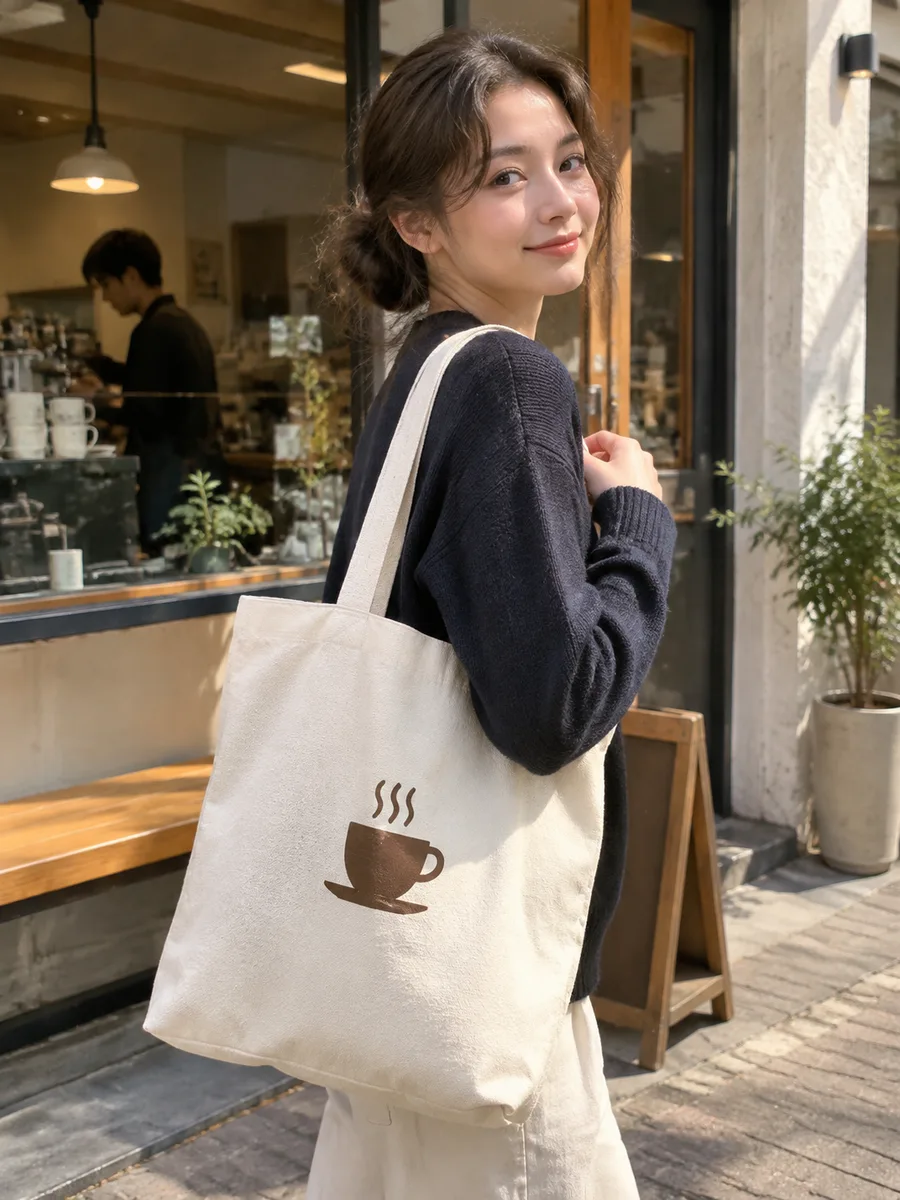
咖啡店为什么开始卖包?
Coffee Shops Turn Tote Bags Into Branding
About this story
HSK 5 Chinese listening. Small shops sell branded canvas bags, turning inexpensive merchandise into advertising and signs of belonging.
This is an HSK 5-6 Chinese listening episode that runs about 5 minutes. The full Mandarin script is shown with tap-for-pinyin and a line-by-line English translation, so you can listen and read at once — comprehensible input in the sense of Stephen Krashen's i+1 theory. It teaches 12 key vocabulary words such as 超市、品牌、衣服 and walks through 4 grammar patterns, each explained in English with examples. The same news story is retold at 4 difficulty levels — use the level selector above to find the version that is challenging but still understandable for you.
Read at your level
原文Read the complete story in Chinese. Reveal pinyin and English only when you need them.
English transcript reference
Recently in the US, there is a supermarket called Trader Joe's, and a kind of small bag it sells has made many people want it very much.
This kind of bag is very small, about only as big as an iPad, and the price is $2.99.
On September 30, this supermarket launched a Halloween special edition of the small bag.
As a result, long lines formed at the doors of many stores in the US.
Some stores had no choice but to set a rule that each person could buy only a few at most.
Strangely, this bag is so small it can hardly hold anything, but people still scramble to get it.
People who could not buy one went to second-hand websites to look for it.
There, for this bag with an original price of $2.99, some listed it at $20, and some even listed it at $50,000.
These are the prices sellers listed; the report did not say which prices actually sold.
You might wonder, why is such a small bag so desirable?
The store name on the bag also carries the buyer's fondness for this store.
This kind of bag, we call it 'peripheral products', or simply 'merch'.
The word 'merch' is now more and more common.
It refers to small things made by a company or brand, such as clothes, hats, cups, bags and so on, printed with their name or logo.
According to an estimate by a research company, the world spends about $338 billion a year on merch.
This number is very large.
However, this company's definition is very broad, including licensed goods, clothes, branded goods, and print-on-demand items.
Moreover, it is not only supermarkets that sell merch.
Bakeries, bookstores, home brands, hardware stores, and even tech companies are all selling their own merch.
For example, there is a tech company called Palantir, and in July this year it started selling white tennis outfits printed with the company's logo.
There is also OpenAI, the company that makes the chatbot, which recently also launched its own clothing line.
Someone joked online: 'This is the easiest way to be bullied in public.'
It means wearing clothes like this might get you laughed at.
But no matter what, merch is already everywhere.
But today, more and more ordinary businesses are also starting to sell merch, treating it as a marketing tool.
Why?
Because making merch is cheap and easy.
For a canvas bag, if produced in bulk, the cost might be less than $1.
But this bag will be seen by many people.
For example, if you walk down the street holding a bookstore's bag, maybe thousands of people will see it.
The bags of Daunt Books and Shakespeare and Company are very popular with readers, and the store names travel to more places along with these bags.
So merch is a very cost-effective advertisement.
Moreover, merch can also make a company seem fun and full of personality.
Many companies use humor to show their personality.
For example, in June this year, the supermarket Lidl, to tie in with the World Cup, launched a 'Three Lidl Shirts'.
This is a funny product imitating the England football team jersey, made of liquid-repellent and odor-resistant material, so it can withstand the beer poured by other excited fans.
As a result, this jersey sold out within 55 seconds.
For consumers, buying a brand's merch is also a way to support a local shop they like.
This trend became more obvious after the pandemic.
New York University's Jared Watson says the merch trend also marks a change in the way young people 'send signals' through clothes and accessories.
He says growing up in the digital age has changed their consumer psychology.
Clothing brands may all look about the same.
Now, young people want more to show their uniqueness through experiences they have had, or places they have been.
Brand consulting firm's Connor Archibald says the meaning of status has changed; before it relied on name brands and watches, now it relies more on taste and a sense of belonging.
Interestingly, wearing merch is to stand out, but at the same time it is also a way to fit into a group.
In the West, almost half of people do not belong to any group, whether a religious group, a sports club, or another civic organization.
Against the background of an increasingly fragmented society, wearing a piece of merch, especially a more niche one, is, as Watson says, 'being a small fish in a big pond, able to find other small fish'.
For some people, the ultimate goal is just a knowing nod of recognition from a stranger.
The next trend is more personal merch.
Companies like Etsy let consumers make customized things, such as cups, matches, and short-sleeved tops, as gifts for birthday parties, bachelor parties, or weddings.
This year, Architectural Digest wrote an article about people giving gifts to overnight guests, and the article asked: 'Should your home have its own merch?'
The more people value experiences, the more valuable souvenirs become.
Everyone has understood this point.
Think about it: if you had to use a bag to tell others what you like, which store's bag would you choose?
Listen again
Try it without the transcript and notice what sounds clearer.
What vocabulary does this episode teach?
词汇HSK 4. A place that sells food and daily goods; in the script, Trader Joe's and Lidl are both 超市.
HSK 5. Common in business contexts; 品牌商品 means branded goods, and 品牌咨询公司 means brand consulting firm.
HSK 3. A general word for clothing; the script mentions 网球服 and 衣服系列.
HSK 4. Used for the listed price; 原价 means original price.
HSK 5. 消费心理 means consumer psychology; 消费者 means consumer.
HSK 5. Used for the merch trend and the next trend.
Beyond-level business term. Refers to branded small items like bags, cups and hats; often shortened to 周边.
Beyond-level. 营销 means marketing and 手段 means means or method; the script says businesses treat merch as a 营销手段.
Beyond-level. 帆布 is canvas and 袋 is bag; a cheap item often used for merch.
Beyond-level. Used for personalized products made to order, such as cups or shirts.
Beyond-level. 归属 means belonging and 感 is a sense; the script says status now relies more on taste and 归属感.
Beyond-level idiom. Literally 'no place it is not'; the script says merch is already 无处不在.
* beyond level超纲词
What grammar patterns appear in this episode?
语法被 + Verb (passive)
Marks the receiver of an action as the subject, often with a negative or notable result.
但是,这个袋子会被很多人看到。
意思是,穿这样的衣服可能会被人嘲笑。
越来越 + Adjective/Verb
Expresses a gradual increase: 'more and more'.
周边这个词,现在越来越常见了。
但是今天,越来越多的普通商家也开始卖周边,把它当作一种营销手段。
在这个社会越来越分散的背景下,穿一件周边,尤其是比较小众的周边,就像沃森说的,“是大池塘里的小鱼,可以找到其他小鱼”。
把 + Object + Verb Phrase
The disposal construction, moving the object before the verb to show how it is handled or treated.
但是今天,越来越多的普通商家也开始卖周边,把它当作一种营销手段。
越……越……
Correlative pattern meaning 'the more..., the more...'.
人们越重视体验,纪念品就越有价值。
Proper nouns
专有名词Sources
来源Free account
Keep learning from this story
Create a free account to keep saved words and your preferred level together.
- Keep words with their story context
- Remember your preferred level
- Build your vocabulary over time