
A Chinese podcast · Same story, 4 levels
基因编辑的树能救佛罗里达的柑橘吗?
Could Gene-Edited Trees Save Florida's Citrus Industry From Greening?
About this story
Florida citrus fell from 300 million boxes to about 15 million. A CRISPR-edited rootstock won EPA approval, but growers must wait for the fruit. HSK 4 Chinese listening practice.
This is an HSK 4 Chinese listening episode that runs about 4 minutes. The full Mandarin script is shown with tap-for-pinyin and a line-by-line English translation, so you can listen and read at once — comprehensible input in the sense of Stephen Krashen's i+1 theory. It teaches 12 key vocabulary words such as 树、公司、技术 and walks through 5 grammar patterns, each explained in English with examples. The same news story is retold at 4 difficulty levels — use the level selector above to find the version that is challenging but still understandable for you.
Read at your level
原文Read the complete story in Chinese. Reveal pinyin and English only when you need them.
English transcript reference
Before the disease came, Florida growers could sell 300 million boxes of fruit in one season.
Now, one season has only a little more than 15 million boxes.
This is not a small change.
A disease has caused Florida's citrus to drop sharply.
The disease is called citrus greening.
In 2005, the disease reached Florida for the first time.
A tiny insect called the Asian citrus psyllid carries the disease from tree to tree.
The insect is small, can fly, and is hard to see.
When the disease enters the tree, the tree's immune system breaks down.
The tree cannot fight the disease.
The tree is sick; the fruit is bitter and the color is wrong.
After a few years, the tree often dies.
To this day, there is still no medicine for the disease.
The growers have tried many things.
They have used tents and sprays.
But the trees still dwindle year after year.
In 2003 and 2004, Florida's citrus peaked at nearly 300 million boxes.
After that, the numbers fell year after year.
EPA says the latest crop was less than 5 percent of those two years.
EPA says that over the past 20 years, the disease has destroyed more than 90 percent of Florida's citrus.
Ron English's family grew citrus in Florida for many years.
In 2015, they closed their company.
He says the trees used to grow very well.
He watched the trees decline year after year.
Now he looks after trees for a company.
The company is called Soilcea and is in Tampa.
The company used CRISPR gene-editing technology to create a new rootstock.
The rootstock is called CarriCea T1.
The company says this rootstock keeps a tree's immune system working.
With less disease in the trees, growers can use less spray.
Soilcea CEO Yianni Lagos says you cannot judge a tree by its leaves alone.
He says that by the time people see yellow leaves, half the root system is already dead.
So the company focused on the roots.
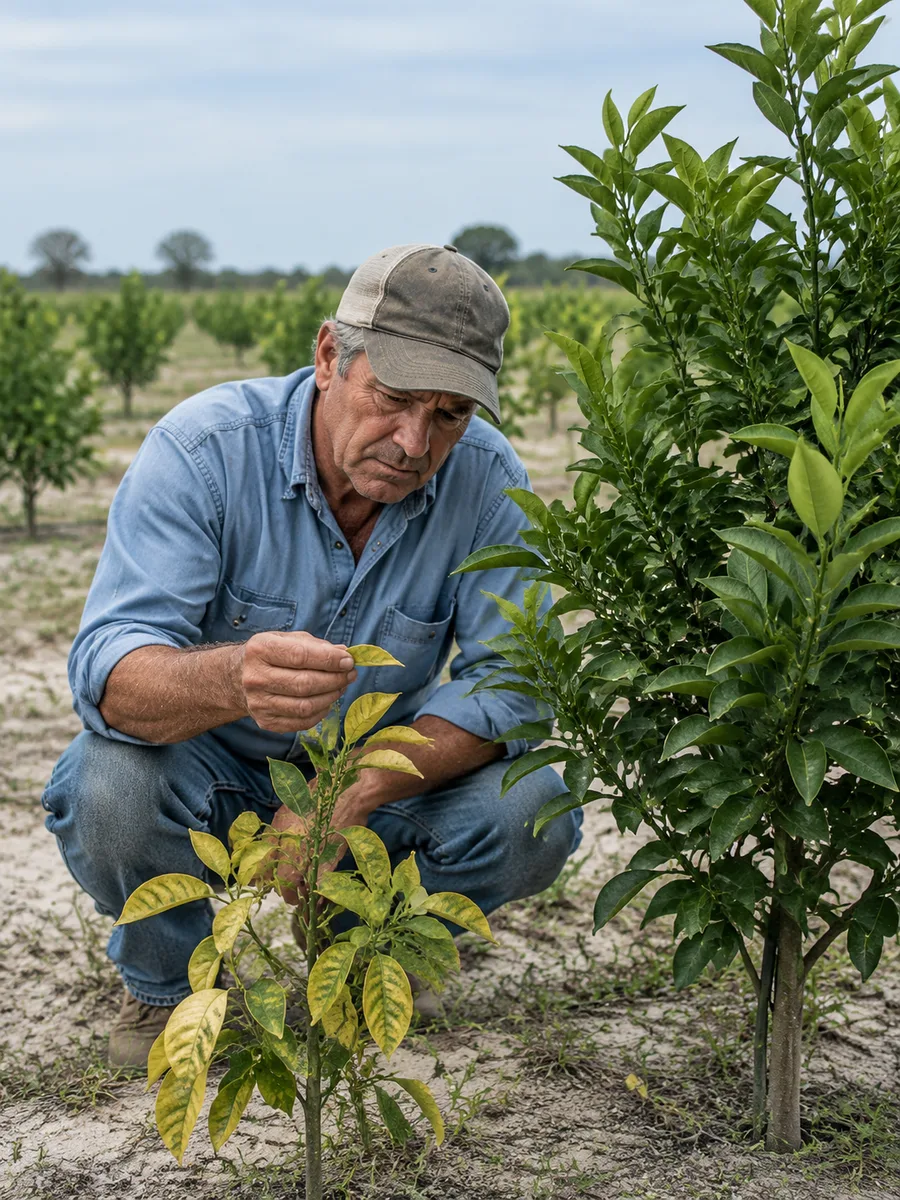
In the company's test field, Ron English looks at many new trees.
These trees were planted last summer.
Beside them are older trees without this rootstock.
The new trees are taller, have more leaves, and are greener.
The older trees are smaller, with yellow leaves.
Ron English says, look how big the new trees' leaves are.
He says the older trees' color is wrong; the disease is already inside them.
The company's people are confident.
But Lagos says the real test is the fruit.
The fruit will take many years.
Whether the fruit is good depends on how big it grows and how it tastes.
Lagos says the data suggest it may work.
But without a ten-year-old tree, we do not know how it will really perform.
This is something both the company and growers must wait for.
The company says this rootstock can change the industry.
EPA assessed the fruit scientifically.
EPA says people can eat this fruit.
EPA says that without new tools, prices will rise.
That will make Americans eat more foreign fruit.
In April 2026, EPA agreed.
Growers can plant these new trees in the 2026-2027 season.
EPA says this fruit is the same as ordinary fruit.
EPA says the technology reduces spraying and is good for people and the environment.
EPA says that without new tools, American citrus will keep shrinking.
The company says 200,000 young trees are now growing.
A growers' group says this gives them new confidence.
They say this is the first rootstock of its kind in the world.
It is also the citrus industry's first new tool of this kind.
Some growers are happy.
Others still want to wait and see.
They still need to see how the fruit tastes.
Only a ten-year-old tree will show whether it is good.
People who support this approach hope it works.
The company says the technology can reduce pesticides.
This is a completely new technology.
Economically, this also matters.
Whether growers plant it also depends on the fruit.
If the fruit is bad, growers will not plant it.
No one knows now what will happen in ten years.
Ron English says he will keep watching these trees.
Florida's growers will watch these trees too.
Can these trees bring Florida's citrus back?
Growers still have to wait ten years.
Listen again
Try it without the transcript and notice what sounds clearer.
What vocabulary does this episode teach?
词汇HSK 1-3. 新树 = the newly planted trees; 老树 = the older trees.
HSK 1-3. Soilcea is the company behind the new rootstock.
HSK 1-3. 基因编辑技术 = gene-editing technology.
HSK 1-3. 很多办法 = many methods.
HSK 1-3. 一个季节 = one growing season.
HSK 1-3. 少用药 = use less spray.
HSK 1-3. 颜色也不对 = the color is wrong too.
Beyond HSK 3. The citrus crop at the center of the story.
Beyond HSK 3. 基因 carry the tree's inherited instructions.
Beyond HSK 3. 基因编辑 = gene editing.
Beyond HSK 3. The rootstock is the root the new trees are grafted onto.
Beyond HSK 3. Florida's citrus growers.
* beyond level超纲词
What grammar patterns appear in this episode?
语法让 + 宾语 + 动词
让 means 'let' or 'make'. 一种病让柑橘少了很多 = a disease made citrus drop sharply.
一种病,让佛罗里达的柑橘少了很多。
不到 + 数量
不到 means 'less than' a number or share.
EPA 说,最近一次的水果,不到那两年的百分之五。
'If ..., then ...' 如果水果不好,农民就不会种 = if the fruit is bad, growers will not plant it.
如果水果不好,农民就不会种。
越来越 + 形容词
越来越 means 'more and more' as a change continues.
EPA 说,如果没有新办法,美国的柑橘会越来越少。
在……以前
'Before ...' 在病来以前 = before the disease came.
在病来以前,佛罗里达的农民一个季节可以卖出三亿箱水果。
Proper nouns
专有名词Sources
来源- Could trees developed with gene-editing technology protect Florida's citrus industry? — NPR
- New Citrus Tool to Help Prevent Widespread Loss of Citrus Crops and Support America's Food Supply — U.S. EPA
- EPA approves Soilcea's CarriCea T1: The first CRISPR-edited rootstock to offer greening tolerance for Florida citrus — FreshFruitPortal
Free account
Keep learning from this story
Create a free account to keep saved words and your preferred level together.
- Keep words with their story context
- Remember your preferred level
- Build your vocabulary over time