
A Chinese podcast · Same story, 4 levels
基因编辑的树能救佛罗里达的柑橘吗?
Could Gene-Edited Trees Save Florida's Citrus Industry From Greening?
About this story
Florida's citrus harvest is the lowest since 1919-1920. A gene-edited rootstock offers hope, but its real test comes with fruit from ten-year-old trees. HSK 5+ Chinese listening practice.
This is an HSK 5+ Chinese listening episode that runs about 6 minutes. The full Mandarin script is shown with tap-for-pinyin and a line-by-line English translation, so you can listen and read at once — comprehensible input in the sense of Stephen Krashen's i+1 theory. It teaches 12 key vocabulary words such as 树、水果、公司 and walks through 5 grammar patterns, each explained in English with examples. The same news story is retold at 4 difficulty levels — use the level selector above to find the version that is challenging but still understandable for you.
Read at your level
原文Read the complete story in Chinese. Reveal pinyin and English only when you need them.
English transcript reference
Ron English says he watched his family's citrus dwindle year after year.
Ron English's family grew citrus in Florida for many years.
In 2015, their company closed.
He says their trees used to be the best around here.
After the disease came, the trees disappeared one by one.
Citrus is an important industry in Florida.
The disease is called citrus greening, also known as HLB.
In 2005, it reached Florida.
It is spread by a tiny insect called the Asian citrus psyllid.
The insect is small and can fly.
It bites the tree and carries bacteria into it.
When the bacteria enter the tree, its immune system fails.
The tree cannot fight the disease.
The fruit turns bitter, and its color is wrong.
The tree often dies a few years later.
To this day, there is no cure.
Growers have tried tents, sprays, and other methods.
These methods help a little, but they cannot save the trees.
Growers have spent a lot of money and still cannot save the trees.
Before the disease came, Florida growers could sell 300 million boxes of fruit in a season.
Now, a season has only a little more than 15 million boxes left.
Production falls year after year.
EPA's figures are more specific.
In 2024-2025, Florida harvested oranges.
A total of 12.15 million boxes.
Grapefruit was 1.3 million boxes.
Tangerines were 400,000 boxes.
It was the smallest harvest since 1919-1920.
In those two years, Florida's citrus was at its peak.
There were nearly 292 million boxes.
The latest crop was less than 5 percent of that.
EPA says the disease has caused citrus to drop sharply.
In 20 years, more than 90 percent was lost.
This is a huge challenge for growers.
When one tree is sick, the insect flies to the tree beside it.
In one field, many trees are sick.
The roots are in the soil, where people cannot see them.
What people see are the leaves.
By the time the leaves turn yellow, the disease is already deep.
So the industry is pinning its hopes on new growing technology.
Soilcea is a small company in Tampa.
It used CRISPR gene-editing technology to create a new rootstock.
The rootstock is called CarriCea T1.
Soilcea developed it with the University of Florida.
The CRISPR method edits genes that citrus already has.
EPA says it does not insert genes from other plants.
The genetic change is small and precise.
This rootstock keeps a tree's immune system working.
With less disease in the trees, growers can spray less.
Lagos is cautious.
Lagos says you cannot judge a tree by its leaves alone.
People only see the disease when the leaves turn yellow.
But by then, half the root system is already dead.
So they focused on the roots.
This rootstock is not grown onto old trees.
Growers take a cutting from a tree.
They graft that cutting onto this rootstock.
Then they plant it.
This way, the tree has a root below that can fight the disease.
Above the root is still the original citrus.
This rootstock is only for citrus.
It also has to be used on new trees.
So growers have to plant new trees.
New trees take years to bear fruit.
During those years, older trees still need the old methods.
The old methods cost a lot.
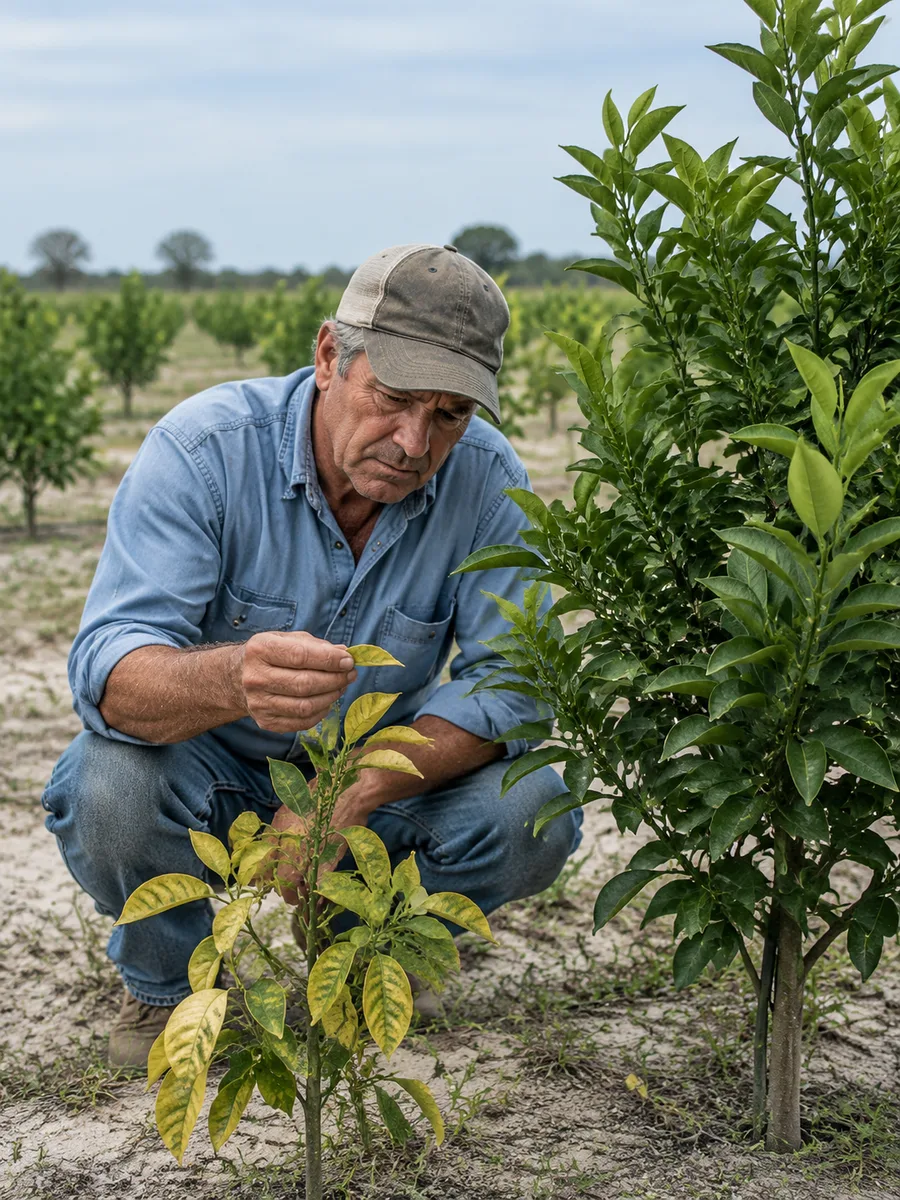
In a test field in Thonotosassa, Ron English looks at these trees.
These trees were planted last summer.
The older trees beside them do not have this rootstock.
The new trees grow taller, with more leaves, and are greener.
The older trees beside them are smaller, with yellow leaves.
English says the new trees' leaves are very big.
He says the color is wrong; the disease is already in the tree.
These trees look good.
But this field has only a few dozen trees.
These trees have also had only one summer.
This is not ten years of data.
Lagos himself says the real test is the fruit.
The fruit takes years to appear.
How well it grows and how it tastes both matter.
He says the data suggest it may work.
But without a ten-year-old tree, you do not know how it will really perform.
In April 2026, EPA approved CarriCea T1.
Growers can plant it in the 2026-2027 season.
EPA checked the environment.
It also checked human health.
EPA's assessment found no risk.
EPA says this fruit is the same as fruit grown on other rootstocks.
EPA says people cannot taste a difference.
What was changed is the root.
The fruit itself was not changed.
EPA says there is no safety problem with people eating this fruit.
EPA also says the technology can let growers use less pesticide.
The company says 200,000 trees are being prepared.
Lagos says they are getting the trees ready.
A Florida Citrus Mutual official says this gives the industry new confidence.
They say there is no second rootstock like it in the world.
The industry wants to recover and rebuild.
But even optimists have to wait.
Because the fruit has not appeared yet.
Because there is no ten-year-old tree yet.
Whether it tastes good is still a question.
Whether growers will plant it is also a question.
If the fruit is bad, growers will not plant it.
If the trees do not grow well in the field, growers will not plant them either.
Growers will have to watch for years before deciding whether to plant.
These questions will only be answered when the fruit appears.
EPA says that without new tools, American citrus could disappear.
This is not just a Florida issue.
America's fruit supply depends on foreign countries.
Without citrus, prices will be higher.
This threatens many growers' families.
So this new rootstock is not just a scientific experiment.
It affects whether America has enough fruit.
It also affects many growers' jobs.
But science cannot be rushed.
Trees take time, and fruit takes time.
If these trees really work, Florida's citrus will slowly recover.
Ron English still has to wait.
Florida's growers still have to wait.
Only after ten years will we know.
Whether these trees can save Florida's citrus.
Listen again
Try it without the transcript and notice what sounds clearer.
What vocabulary does this episode teach?
词汇HSK 1-4. 新树 = new trees; 老树 = older trees.
HSK 1-4. The general word for fruit; here it means citrus.
HSK 1-4. Soilcea is the company behind the new rootstock.
HSK 1-4. 新的种植技术 = new growing technology.
HSK 1-4. 数据说明它可能有用 = the data suggest it may work.
HSK 1-4. 少喷药 = spray less.
HSK 1-4. 慢慢恢复 = slowly recover.
Beyond HSK 4. The citrus crop at the center of the story.
Beyond HSK 4. 基因 carry a tree's inherited instructions.
Beyond HSK 4. 基因编辑 = gene editing.
Beyond HSK 4. The rootstock is the edited root new trees are grafted onto.
Beyond HSK 4. Florida's citrus growers.
* beyond level超纲词
What grammar patterns appear in this episode?
语法把 + 宾语 + 动词
把 moves the object before the verb when something is done to it. 把这一段接到这种根上 = graft this cutting onto the rootstock.
他们把这一段接到这种根上。
所以,行业把希望放在新的种植技术上。
'If ..., then ...' 如果水果不好,农民就不会种 = if the fruit is bad, growers will not plant it.
如果水果不好,农民就不会种。
如果树在田里长不好,农民也不会种。
对 + 人 + 是 + 名词
对 marks who is affected: 这对农民是一个大挑战 = this is a big challenge for growers.
这对农民是一个大挑战。
一年比一年 + 形容词
'More ... with each passing year.' 产量一年比一年少 = production falls year after year.
产量一年比一年少。
事件 + 以后
以后 means 'after'. 病来了以后 = after the disease came.
病来了以后,树一棵一棵没有了。
Proper nouns
专有名词Sources
来源- Could trees developed with gene-editing technology protect Florida's citrus industry? — NPR
- New Citrus Tool to Help Prevent Widespread Loss of Citrus Crops and Support America's Food Supply — U.S. EPA
- EPA approves Soilcea's CarriCea T1: The first CRISPR-edited rootstock to offer greening tolerance for Florida citrus — FreshFruitPortal
Free account
Keep learning from this story
Create a free account to keep saved words and your preferred level together.
- Keep words with their story context
- Remember your preferred level
- Build your vocabulary over time